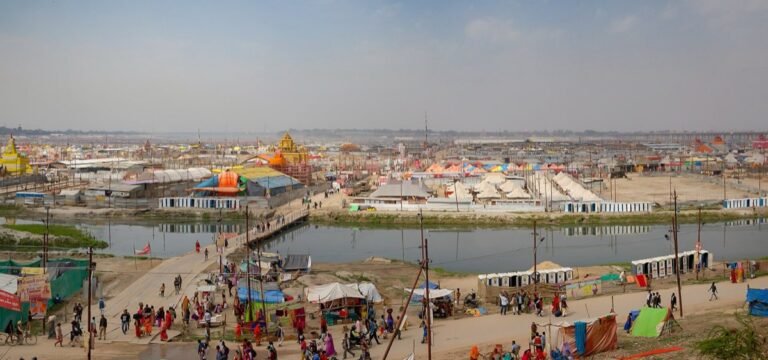
The Shri Panch Dashnam Juna Akhara is a Shaiva order of the Dashnami sannyasi tradition, and the Prayagraj Mela Authority describes it as the largest of the 13 akharas. Its seat is in Varanasi, its tradition centres on Lord Dattatreya, and at the Kumbh it bathes together with the Avahan and Agni akharas.
Tradition and deity
Juna is one of the seven Shaiva akharas in the Uttar Pradesh government’s list of 13. The Prayagraj Mela Authority says the Shaiva akharas take Lord Shiva as their favoured deity and worship him in different forms, each by its own beliefs. The Ministry of Tourism’s Incredible India page says the name Juna means ancient, that the akhara follows Shaivism, and that by its tradition it was founded by Bhagavan Dattatreya and later reorganised by Adi Shankaracharya as part of the sannyasi order.
Origin accounts like this belong to the akhara’s own tradition. Historians describe a more layered past for the ascetic orders, as our guide to the akharas of Kumbh Mela explains, so treat founding dates as tradition rather than settled history.
Lord Dattatreya stays at the centre of the akhara’s Kumbh rituals. In July 2026 the akhara released its own calendar for the Haridwar Kumbh, ETV Bharat reported. It places the raising of the akhara’s dharma dhwaja (religious flag) on Dattatreya Jayanti, and says its peshwai, the entry procession into the mela, will carry Lord Dattatreya’s palanquin with the akhara’s flags and drums.
Where its seat is
Varanasi is the akhara’s spiritual and administrative headquarters, according to Incredible India, which says decisions about its part in the Kumbh and Ardh Kumbh are guided from there. Official Kumbh websites point to the same city.
Go deeperWhere the official lists place Juna1 min read
The 2015 Nashik Simhastha website listed the akhara at Hanuman Ghat in Kashi, and the 2016 Ujjain Simhastha website gave its head office as Bada Hanuman Ghat, Kashi. A 2019 Press Trust of India report also placed it in Varanasi.
The akhara is present in the other Kumbh cities too. The 2016 Ujjain list gave a Haridwar address, the Mayadevi Bhairav Akhara, and at the 2021 Haridwar Kumbh, Amar Ujala reported that Juna’s camp stood in the Maya Devi temple complex, with the Agni and Avahan akharas camped there as well. Where the akharas will camp in 2027 has not been announced.
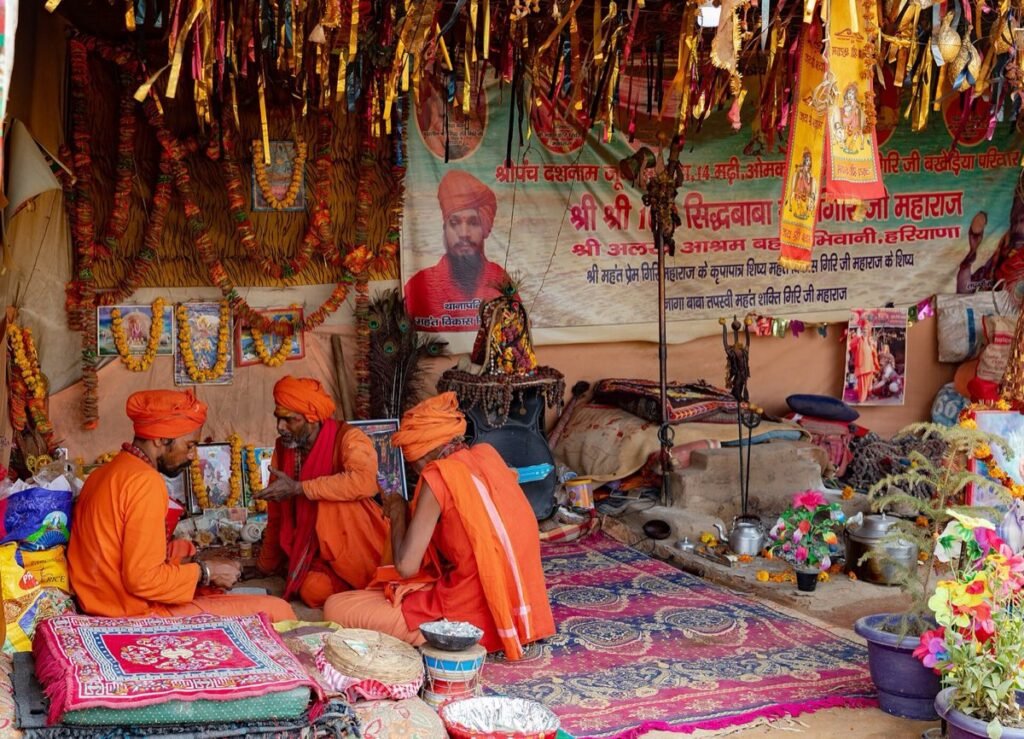 Photo: Ninara from Helsinki, Finland, CC BY 2.0, via Wikimedia Commons
Size, Naga sannyasis and women ascetics
The Prayagraj Mela Authority’s page on akharas says Juna is the largest akhara by numbers, followed by Niranjani and then Mahanirvani. A Government of India feature for Maha Kumbh 2025 calls Juna the largest and one of the most influential akharas at the Kumbh, and notes its vast number of initiated Naga sannyasis.
Incredible India describes Juna as a network of saints, monasteries and lineages across India rather than a single monastery, traditionally led by a Mahant or an Acharya Mahamandaleshwar with senior monks.
Not everyone in the akhara is a Naga, and not every Naga belongs to Juna. For who the Naga sannyasis are, read Naga sadhus: history, tradition and role.
Juna in the Amrit Snan order
Juna does not bathe alone. On each Amrit Snan day the akharas go to the river one group after another, in an order set for that Kumbh. At Maha Kumbh 2025 each of the 13 akharas was told its time and place in the sequence, All India Radio reported. On Makar Sankranti, 14 January 2025, Aaj Tak reported the order of the Shaiva akharas as follows:
- Mahanirvani, with Atal
- Niranjani, with Anand
- Juna, with Avahan and Agni (Panchagni)
The three Vaishnav akharas, the two Udasin akharas and the Nirmal Akhara followed. The order can differ from one Kumbh to the next, so it is set and announced for each event.
For Haridwar 2027, ETV Bharat reported that Juna will again bathe with its allied akharas, Agni and Avahan. The akhara’s own calendar names three Amrit Snans for it in 2027:
The official Haridwar Kumbh website lists a fourth Amrit Snan, Dev Doli on Monday 15 March, so check the Haridwar dates page for the current list. The order of the akharas for 2027 has not been announced.
Amrit Snan days usually draw the most pilgrims; follow police and mela instructions on the day. Before you watch a procession, read what to expect around an akhara procession, which also explains the peshwai, the way the akharas enter the mela.
Sources
13 sources · checked 16 Oct 2026
- Juna Akhara, Varanasi (Incredible India) · Ministry of Tourism, Government of India ·
- आध्यात्मिक गुरुजन: अखाड़ा (Spiritual Gurus: Akharas, Hindi page, Maha Kumbh 2025 official website) · Prayagraj Mela Authority, Government of Uttar Pradesh ·
- Spiritual Powerhouses: Akharas at the Forefront of Maha Kumbh 2025 (Ministry of Culture feature, PDF) · Press Information Bureau, Government of India (Ministry of Culture) ·
- Maha Kumbh: Akhara Walk Tour · Uttar Pradesh State Tourism Development Corporation, Government of Uttar Pradesh ·
- 'Akharas' ready to steal the show at Kumbh Mela · Press Trust of India (via Free Press Journal) ·
- Akhadas: Trimbakeshwar akhadas and addresses (Simhastha Kumbh Mela Nashik-Trimbakeshwar 2015 official website) · Simhastha Kumbh Mela Nashik-Trimbakeshwar 2015, Government of Maharashtra ·
- Akhara Details (Simhasth Kumbh Mahaparv Ujjain 2016 official website) · Simhasth Kumbh Mahaparv Ujjain 2016, Government of Madhya Pradesh ·
- Haridwar Kumbh Mela 2021: camps of Juna and allied akharas (photo report) · Amar Ujala ·
- हरिद्वार कुंभ मेले का पंचांग जारी, तीन शाही स्नान करेगा जूना अखाड़ा, जानिए पूरा कार्यक्रम (Juna Akhara releases its Haridwar Kumbh calendar) · ETV Bharat (Uttarakhand) ·
- महाकुंभ में अखाड़ों का अमृत स्नान जारी, घाट पर आने-जाने की टाइमिंग फिक्स (Akharas' Amrit Snan under way at Maha Kumbh, timings fixed) · Aaj Tak (India Today Group) ·
- Makar Sankranti Amrit Snan underway at Mahakumbh in Prayagraj · News On AIR (All India Radio, Prasar Bharati) ·
- Snan and Events: Haridwar Kumbh 2027 (official website) · Haridwar Kumbh Mela administration, Government of Uttarakhand ·
- Warrior Ascetics and Indian Empires · Cambridge University Press ·
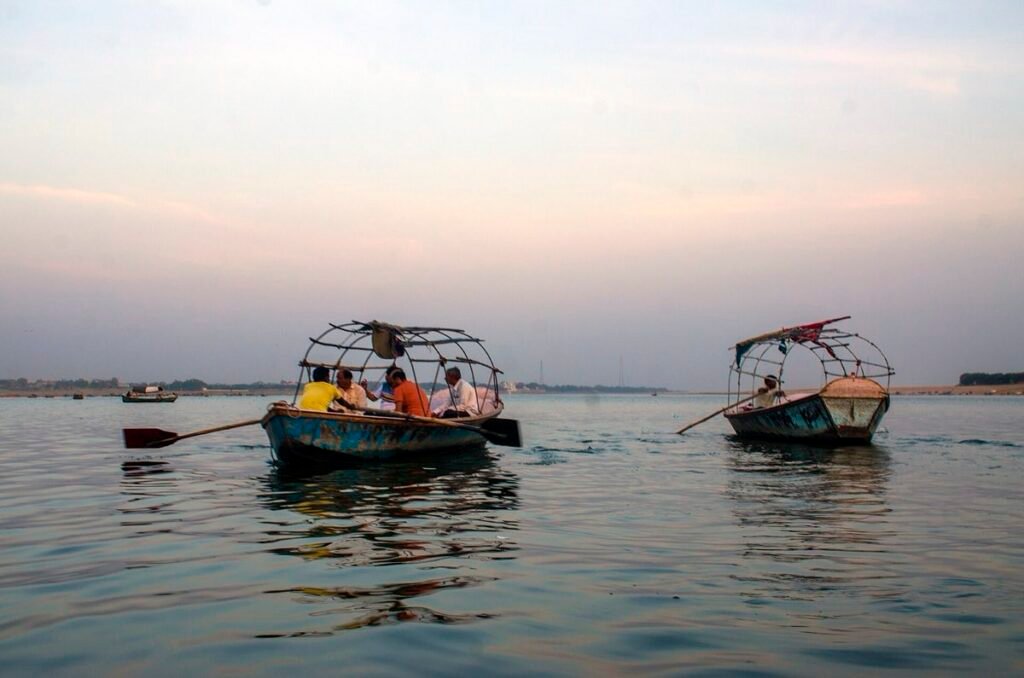 Photo: Rangan Datta Wiki, CC BY-SA 4.0