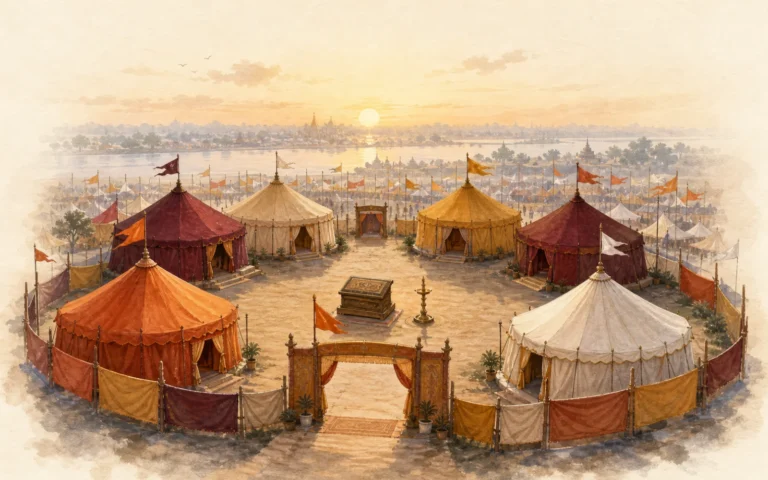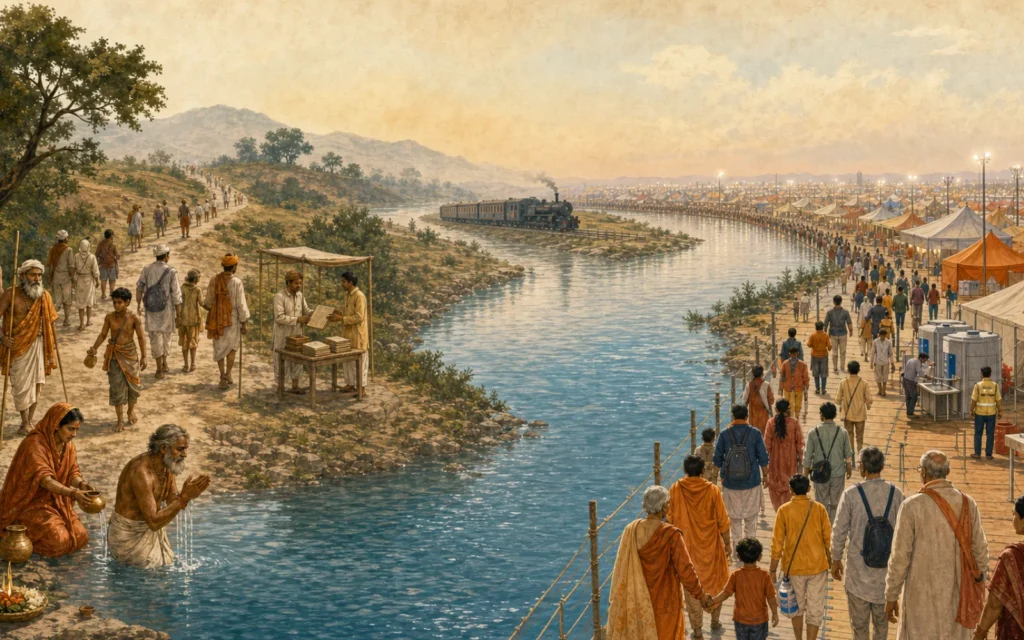
A Kumbh site is not only a gathering; it can become a temporary urban system. Research on Prayagraj has described the large-scale coordination of roads, bridges, camps, sanitation, water, power, public services and governance that appears for the event and later recedes.
Temporary does not mean simple
An ephemeral city still needs land allocation, movement corridors, utilities, waste systems, emergency planning, communication and institutional coordination. Different zones may serve pilgrims, akharas, administration, services and transport.
Plans and operations are different stages
A plan, budget or work approval shows intent and preparation. It does not prove that a public facility is complete, tested or open. Visitor guidance should change only when the responsible authority publishes an operating arrangement.
Why the system changes the visitor experience
- normal roads may serve different purposes;
- temporary bridges or pedestrian corridors may be one-way;
- camp addresses may work differently from ordinary neighbourhood addresses;
- sanitation and water points can be event-specific;
- crowd-management controls may change movement at short notice.
Read the temporary city through current evidence
Use official maps and instructions for the actual event. Treat editorial diagrams as explanations, not live navigation. Keep essential directions offline, but update them when a newer authority notice appears.
The history of Kumbh Mela explains how the public form evolved, while What Is Kumbh Mela? provides the wider cultural context.
The useful lesson
The temporary city is an achievement of coordination, but it is also dynamic. A good visitor plan stays modest: know the current zone and centre, carry a meeting point, follow movement controls and avoid guessing that a past event’s layout will return unchanged.
Sources
- Kumbh Mela — Mapping the Ephemeral Mega-City — Harvard Graduate School of Design —
- Kumbh Mela — Representative List of the Intangible Cultural Heritage of Humanity — UNESCO Intangible Cultural Heritage —
- Pilgrimage and Power: The Kumbh Mela in Allahabad, 1765–1954 — Oxford University Press —