Independent Kumbh knowledge guide
Why Kumbh Is Held at Four Locations
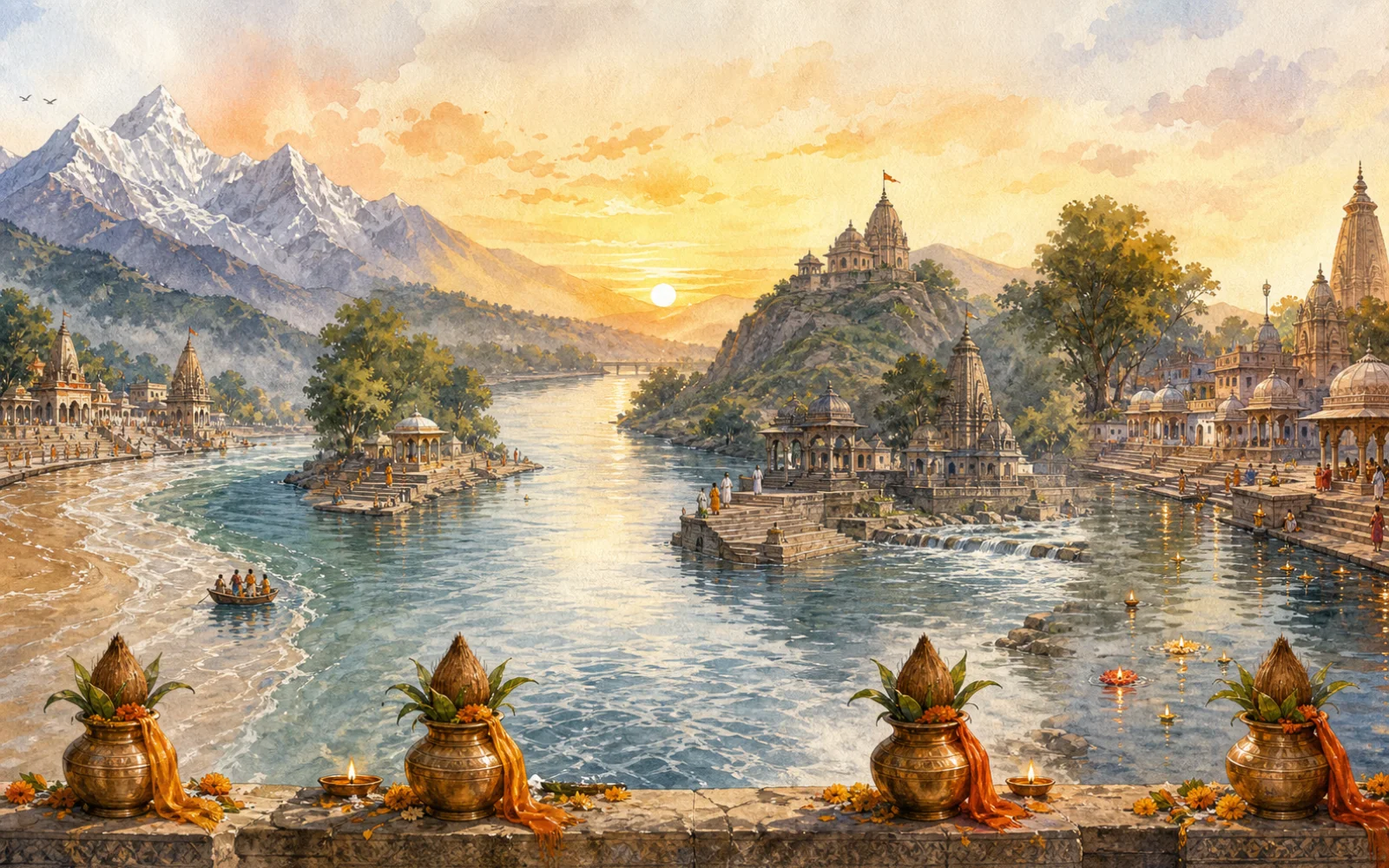
Kumbh Mela is associated with four places—Prayagraj, Haridwar, Nashik–Trimbakeshwar and Ujjain—because a living Hindu tradition connects them with the amrita-kalasha story, and because each has an established sacred-river pilgrimage landscape with its own calendrical and astrological tradition. They share a Kumbh identity, but they are not four copies of one event.
The four locations at a glance
| Kumbh location | Sacred water | Common event name | What makes the geography distinct |
|---|---|---|---|
| Prayagraj, Uttar Pradesh | Sangam of the Ganga and Yamuna; Saraswati in tradition | Kumbh or Maha Kumbh, depending on the edition | A river confluence rather than one riverbank |
| Haridwar, Uttarakhand | Ganga | Kumbh; Ardh Kumbh is also associated with Haridwar | The Ganga reaches the plains within a major pilgrimage city |
| Nashik–Trimbakeshwar, Maharashtra | Godavari | Simhastha Kumbh | One connected event geography with two distinct ritual centres |
| Ujjain, Madhya Pradesh | Shipra or Kshipra | Simhastha | Sacred ghats and a city tradition closely associated with Simha timing |
UNESCO’s heritage record and Indian government cultural sources recognise these four places. The table is an orientation, not an event-access map. Bathing areas, procession routes and transport arrangements change and must come from current authorities.
The traditional connection: the amrita kalasha
According to a widely told Kumbh tradition, devas and asuras churned the cosmic ocean in search of amrita, the nectar of immortality. The amrita appeared in a kalasha—a sacred vessel or pot. Later retellings connect the vessel with the four Kumbh places.
The details vary. One account says drops fell while the kalasha was carried; another says the vessel was set down or protected at the four places. These variations are part of a living religious tradition. They should not be compressed into a claim that one version appears identically in every old text or that a precise drop point has been archaeologically established.
The mythology and origin guide tells the Samudra Manthan story in full and explains how mythology differs from historical evidence.
Prayagraj: Kumbh at the Sangam
Prayagraj’s sacred geography centres on the Sangam, where the Ganga and Yamuna meet. Saraswati is present in religious tradition as an invisible or subterranean river. The confluence is therefore commonly called the Triveni Sangam—the meeting of three rivers.
The visible meeting of the Ganga and Yamuna is a geographic fact. Saraswati’s presence here should be described as tradition, not as a visible mapped channel. This distinction allows the page to be both respectful and precise.
Prayagraj has a long history as a tirtha, a sacred crossing or pilgrimage place. Modern editions have used event names such as Kumbh and Maha Kumbh. Readers planning a visit should use the Prayagraj Kumbh guide for local orientation and a dated official event source for schedules.
Haridwar: Kumbh on the Ganga
Haridwar stands where the Ganga emerges from the Himalayan foothills into the plains. The city’s Kumbh landscape is associated especially with Har Ki Pauri and Brahma Kund in local tradition.
Official Haridwar accounts connect the place with the amrita-kalasha story. They also describe a roughly twelve-year Kumbh recurrence and a six-year Ardh Kumbh tradition. Those intervals explain the broad cycle; they do not confirm a future date without a current notification.
Haridwar’s riverfront, processions and urban movement are different from Prayagraj’s confluence setting. See the Haridwar Kumbh guide for the location’s own history and practical context.
Nashik–Trimbakeshwar: one Kumbh geography, two centres
Nashik–Trimbakeshwar must be written with both names. The official event authority treats them as a connected Kumbh geography, while local traditions and bathing arrangements distinguish the two centres.
Trimbakeshwar lies near Brahmagiri, associated with the origin of the Godavari and the Trimbakeshwar Jyotirlinga. Nashik has major urban ghats on the Godavari. Historical and ritual arrangements have not always assigned the same groups to the same bathing place, so the two centres should never be reduced to one generic “Nashik ghat.”
The event is commonly called Simhastha because its timing is associated with Simha, or Leo, in Hindu astrological tradition. For stable location context, open the Nashik–Trimbakeshwar location guide. For current preparation, use the separate Nashik Kumbh event guide.
Ujjain: Simhastha on the Shipra
Ujjain’s Kumbh tradition is centred on the Shipra, also written Kshipra, and the city’s sacred ghats. Like Nashik–Trimbakeshwar, the event is widely known as Simhastha.
Ujjain is not merely the fourth point in a diagram. It has its own temple landscape, local pilgrimage practices, processional traditions and administrative setting. Official district material supports the stable city–river relationship, while future arrangements require a current Simhastha authority source.
Explore the place in the Ujjain Simhastha guide.
How celestial timing relates to the four places
Government cultural summaries relate Kumbh timing to traditional combinations involving Jupiter, the Sun and sometimes the Moon. Each location is associated with a particular configuration. Jupiter’s approximately twelve-year passage through the zodiac helps explain why a full gathering returns to the same place at roughly twelve-year intervals.
Exact formulas are not stated here as a date calculator. Official summaries differ in some of their location-specific details, especially for Ujjain and Haridwar. A responsible explanation therefore separates three things:
- the shared principle of location-specific celestial timing;
- a formula attributed to a named tradition or source; and
- the final schedule issued by the responsible authority.
The Kumbh cycle guide explains these safeguards and the meaning of “officially confirmed,” “provisional” and “awaiting official confirmation.”
How the four Kumbh locations differ
The four places share ritual bathing, ascetic and institutional participation, teaching, pilgrimage and large temporary arrangements. Their local expression still differs.
- Water: a confluence at Prayagraj, the Ganga at Haridwar, the Godavari across Nashik–Trimbakeshwar, and the Shipra at Ujjain.
- Event name: Kumbh, Maha Kumbh and Simhastha are used in different contexts; the exact official title matters.
- Ritual geography: local ghats, temples, akhara routes and bathing arrangements are not interchangeable.
- Urban setting: access roads, railway stations, camp areas and emergency systems are planned locally.
- Calendar: the broad cycle is shared, but each edition requires its own confirmed schedule.
These differences are why the all Kumbh locations hub has a separate guide for every place.
Common misunderstandings
Is Kumbh held at one of the four places exactly every three years?
That is a useful broad-cycle shorthand, not a guaranteed timetable. A full Kumbh returns to a particular place at roughly twelve-year intervals, while actual sequencing and dates depend on the applicable calendar and official declaration.
Did amrita literally fall at four verified coordinates?
The four-place connection is a sacred Kumbh tradition. KumbhMela.info does not present it as an archaeologically verified set of coordinates.
Are Nashik and Trimbakeshwar the same place?
No. They are distinct centres connected within one Kumbh event geography. Current official instructions should be checked for the role of each place in a particular edition.
Are all four events called Maha Kumbh?
No. Naming varies by location, edition and administration. Use the official title for the specific event and read the Kumbh terminology guide for the differences.
Sources and review status
This page was reviewed on 15 July 2026 and is labelled Evergreen. Sacred and astrological statements are attributed to tradition; no future date or live route is asserted.
Material sources include UNESCO’s Kumbh Mela record; Government of India cultural material; official Prayagraj, Haridwar, Nashik and Ujjain pages; the Garhwal Division cycle summary; the Nashik–Trimbakeshwar event authority; and the Metropolitan Museum’s cultural account of Samudra Manthan. Source IDs: SRC-UNESCO-001, SRC-MOC-001, SRC-PRY-001, SRC-HRD-001, SRC-NSK-001, SRC-UJN-001, SRC-MET-001, SRC-GAR-001, SRC-PIB-MK25-001 and SRC-NTKMA-001.
If a local tradition or city–river relationship is represented inaccurately, send a source through Contact and Corrections.