Independent Kumbh knowledge guide
Kumbh, Ardh Kumbh, Purna Kumbh and Maha Kumbh
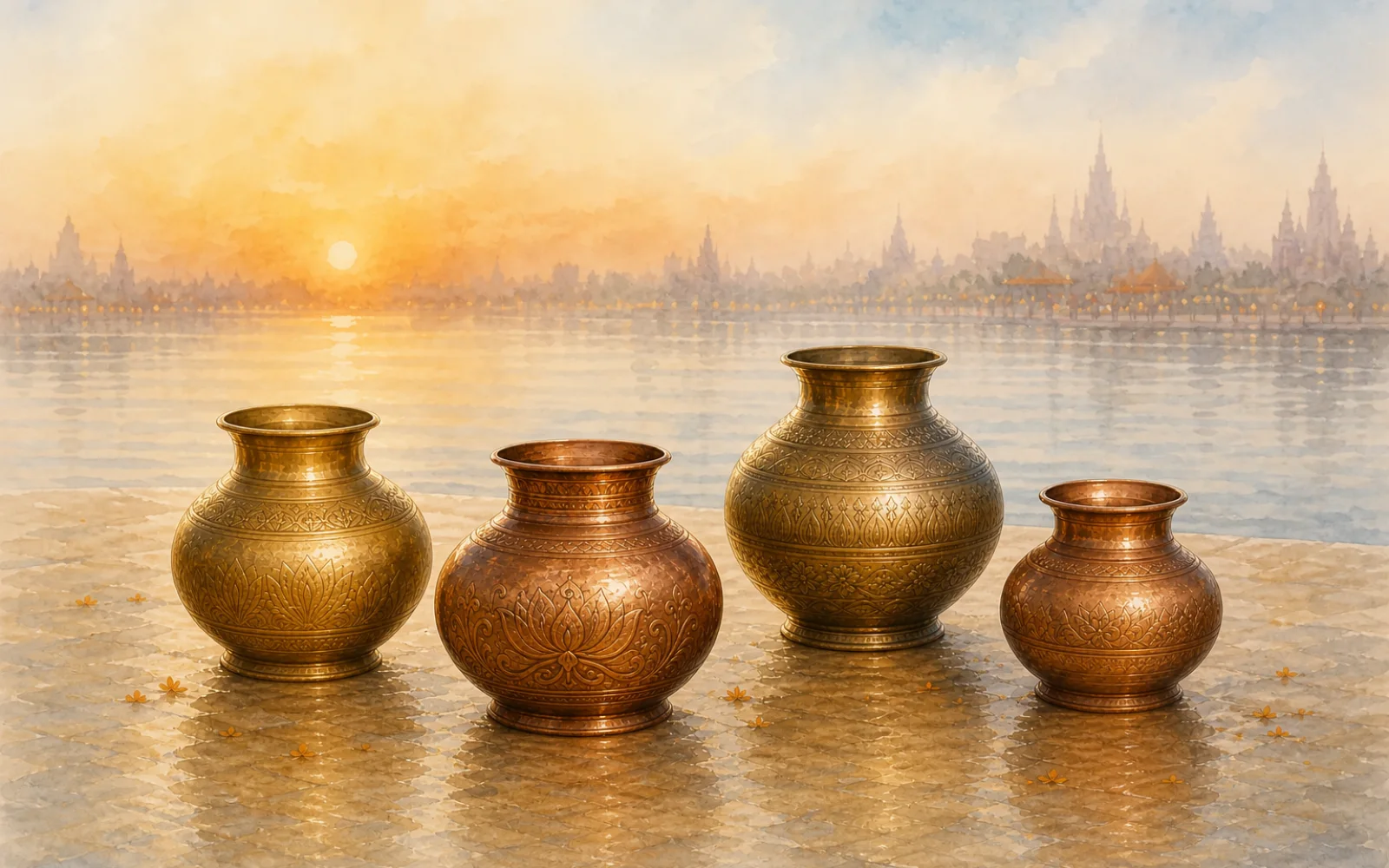
Kumbh is both the name of the wider four-location pilgrimage tradition and a name used for individual events. Ardh Kumbh commonly refers to a roughly six-year gathering at Haridwar or Prayagraj. Purna Kumbh is a descriptive term for a full, roughly twelve-year gathering, but it is not the formal title used everywhere. Maha Kumbh is especially associated with Prayagraj, and official sources show that its numerical meaning has not been completely uniform.
Direct comparison
| Term | Common explanatory use | Location association | Important qualification |
|---|---|---|---|
| Kumbh | The umbrella tradition, or a named gathering; full recurrence often framed around twelve years at one place | Prayagraj, Haridwar, Nashik–Trimbakeshwar and Ujjain | It can also be the official name of a six-year edition |
| Ardh Kumbh | “Half Kumbh,” usually the approximately six-year gathering | Haridwar and Prayagraj | An authority may rename a specific edition |
| Purna Kumbh | “Full Kumbh,” commonly used to distinguish a roughly twelve-year gathering from Ardh Kumbh | Most often used in general explanation | Not consistently the formal event title in reviewed current sources |
| Maha Kumbh | “Great Kumbh,” strongly associated with Prayagraj | Prayagraj in current central-government communication | Official records show both a twelve-year naming usage and a 144-year framing |
This table explains common usage; it does not override the name printed on an authority’s notice. For a specific event, use its official title, location and year together.
Why the terminology is not a perfect mathematical system
People often expect the four words to form a universal ladder: half, ordinary, full and great. Actual usage is more complicated.
- “Kumbh” can refer to the whole tradition or one edition.
- Governments may change event branding.
- A popular explanatory term may not appear in a formal notification.
- Old reports may preserve the name used at the time.
- Hindi, English and regional media may translate or shorten a title differently.
- Local traditions at Haridwar, Prayagraj, Nashik–Trimbakeshwar and Ujjain do not use every term in exactly the same way.
The best approach is contextual rather than dogmatic: what event, where, when, and according to which source?
What “Kumbh” means
Kumbh or kumbha means a pot, pitcher or vessel and evokes the amrita kalasha in the festival’s mythological tradition. In contemporary use, “Kumbh Mela” names the living pilgrimage tradition recognised at four places: Prayagraj, Haridwar, Nashik–Trimbakeshwar and Ujjain.
The same word may name a particular edition. In 2019, for example, a Government of India account recorded that the Prayagraj gathering previously called Ardh Kumbh was officially presented as Kumbh. This is why “Kumbh” on an event page does not by itself prove a twelve-year interval.
Read what Kumbh Mela is for the broader meaning and practices.
What “Ardh Kumbh” means
Ardh means half. In the conventional cycle explanation, Ardh Kumbh is the approximately six-year gathering between full twelve-year editions. Official Nashik, Garhwal, Haridwar and central-government summaries associate it with two places:
- Haridwar on the Ganga; and
- Prayagraj at the Sangam.
It is not normally used for Nashik–Trimbakeshwar or Ujjain in the sources reviewed here. “Half” also does not mean half the devotion, half the cultural importance or a minor experience. It describes the interval within one naming convention.
Administrative naming can supersede the convention for a particular edition. If an authority calls an event Kumbh, this site should not relabel it Ardh Kumbh merely because it occurs around the six-year point.
What “Purna Kumbh” means
Purna means full or complete. Many explanatory articles use “Purna Kumbh” for the full gathering that returns to a place after roughly twelve years, especially when contrasting it with Ardh Kumbh.
The term is useful, but two cautions matter:
- the recurrence is governed by the applicable traditional calendar, not a fixed number of Gregorian days; and
- the current official sources reviewed do not consistently use “Purna Kumbh” as the formal event title.
Use it as a descriptive category when the context is clear. Do not insert it into the title of an official notice that says simply Kumbh, Simhastha or Maha Kumbh.
What “Maha Kumbh” means
Maha means great. The name is especially associated with Prayagraj in contemporary government communication. Its use, however, shows why rigid definitions fail.
A Press Information Bureau account of Prayagraj 2019 says that the gathering earlier called Ardh Kumbh would be known as Kumbh, while the event earlier called Kumbh would be known as Maha Kumbh. In that administrative language, Maha Kumbh named the roughly twelve-year Prayagraj edition.
Government of India material for Prayagraj 2025 also calls the event Maha Kumbh and describes a rare 144-year framing. Both records are official. Instead of pretending they say the same thing, responsible copy gives the context:
- “Maha Kumbh 2025” is the official event name;
- a source may explain it through a 144-year belief or configuration;
- an earlier administration also used Maha Kumbh as the new name for the twelve-year Prayagraj gathering.
The term should therefore not be used to rank Prayagraj above other sacred locations or to infer a date without an official schedule.
Where Simhastha fits
Simhastha is another important Kumbh name. It is used for Nashik–Trimbakeshwar and Ujjain because their timing traditions are associated with Simha, or Leo, particularly the position of Jupiter.
Simhastha is not an additional fifth Kumbh type. It is a location-linked name within the four-place Kumbh tradition. The four locations guide explains the Godavari and Shipra geographies.
Frequency and location: a safer guide
| Question | Safe answer |
|---|---|
| Is every six-year gathering called Ardh Kumbh? | It is the conventional term at Haridwar and Prayagraj, but authorities may choose another official name. |
| Is every twelve-year event called Purna Kumbh? | No. Kumbh, Maha Kumbh and Simhastha may be used depending on place and edition. |
| Is Maha Kumbh held at all four locations? | Current reviewed central-government usage strongly associates it with Prayagraj. |
| Are Nashik and Ujjain events Kumbh? | Yes. They are part of the four-location Kumbh tradition and are commonly called Simhastha. |
| Does a label confirm a date? | No. A dated authority schedule is still required. |
For timing rather than terminology, use the Kumbh cycle guide.
Common terminology mistakes
“Maha Kumbh always means exactly 144 years”
Too absolute. The 144-year explanation appears in current government material, but another official government account uses Maha Kumbh for the renamed twelve-year Prayagraj edition. State the source context.
“Purna Kumbh is the official name of every full event”
Not supported. It is a helpful descriptive term, not a universal formal title.
“Ardh Kumbh happens at all four locations”
The official sources reviewed associate it with Haridwar and Prayagraj, not Nashik–Trimbakeshwar and Ujjain.
“Ardh means less sacred”
No. The word describes the conventional interval. It does not measure devotion, spiritual value or the dignity of participants.
“Kumbh and Maha Kumbh can always be swapped”
No. They can overlap in popular speech, but event titles should be reproduced accurately.
How KumbhMela.info names events
For clarity and historical accuracy, this site follows five rules:
- use the current authority’s exact name for a current event;
- add the location and year on first mention when needed;
- retain the name used in a historical record rather than rewriting it retrospectively;
- explain alternative terms and naming changes in the page body or metadata;
- never infer confirmation, frequency or spiritual status from the adjective alone.
These rules also help multilingual search. A Hindi speaker may search “अर्ध कुंभ,” while an official English page says “Kumbh.” Both terms can be explained without altering the authority’s title.
Frequently asked questions
What is the main difference between Kumbh and Maha Kumbh?
Kumbh is the umbrella tradition and also an event name. Maha Kumbh is a distinguished name especially associated with Prayagraj. Its exact cycle explanation varies across official contexts, so the event year and source matter.
Is Ardh Kumbh held every six years?
That is the conventional interval at Haridwar and Prayagraj. The official name of a specific edition may differ.
What is Purna Kumbh?
It is a common descriptive term for a full gathering at roughly the twelve-year point, often contrasted with Ardh Kumbh. It is not the mandatory formal title at every location.
Is Simhastha different from Kumbh?
Simhastha is the Kumbh name commonly used at Nashik–Trimbakeshwar and Ujjain in connection with their Simha timing traditions. It remains part of the four-location Kumbh system.
Which term should I use in a travel plan?
Use the exact current event name printed by the responsible authority, together with the location and year. Use the separate dates page to verify the schedule.
Sources and review status
This page was reviewed on 15 July 2026 and is labelled Evergreen. Its main conclusion is that terminology must be explained in place-and-period context.
Material sources include UNESCO and Ministry of Culture overviews; official Nashik, Haridwar and Garhwal pages; the Government of India account of the 2019 Prayagraj naming change; and central-government communication for Maha Kumbh 2025. Source IDs: SRC-UNESCO-001, SRC-MOC-001, SRC-NSK-001, SRC-HRD-001, SRC-GAR-001, SRC-PIB-NAMING-001 and SRC-PIB-MK25-001.
If an event authority publishes a new naming decision, submit the dated notice through Contact and Corrections.