Independent Kumbh knowledge guide
Prayagraj Kumbh
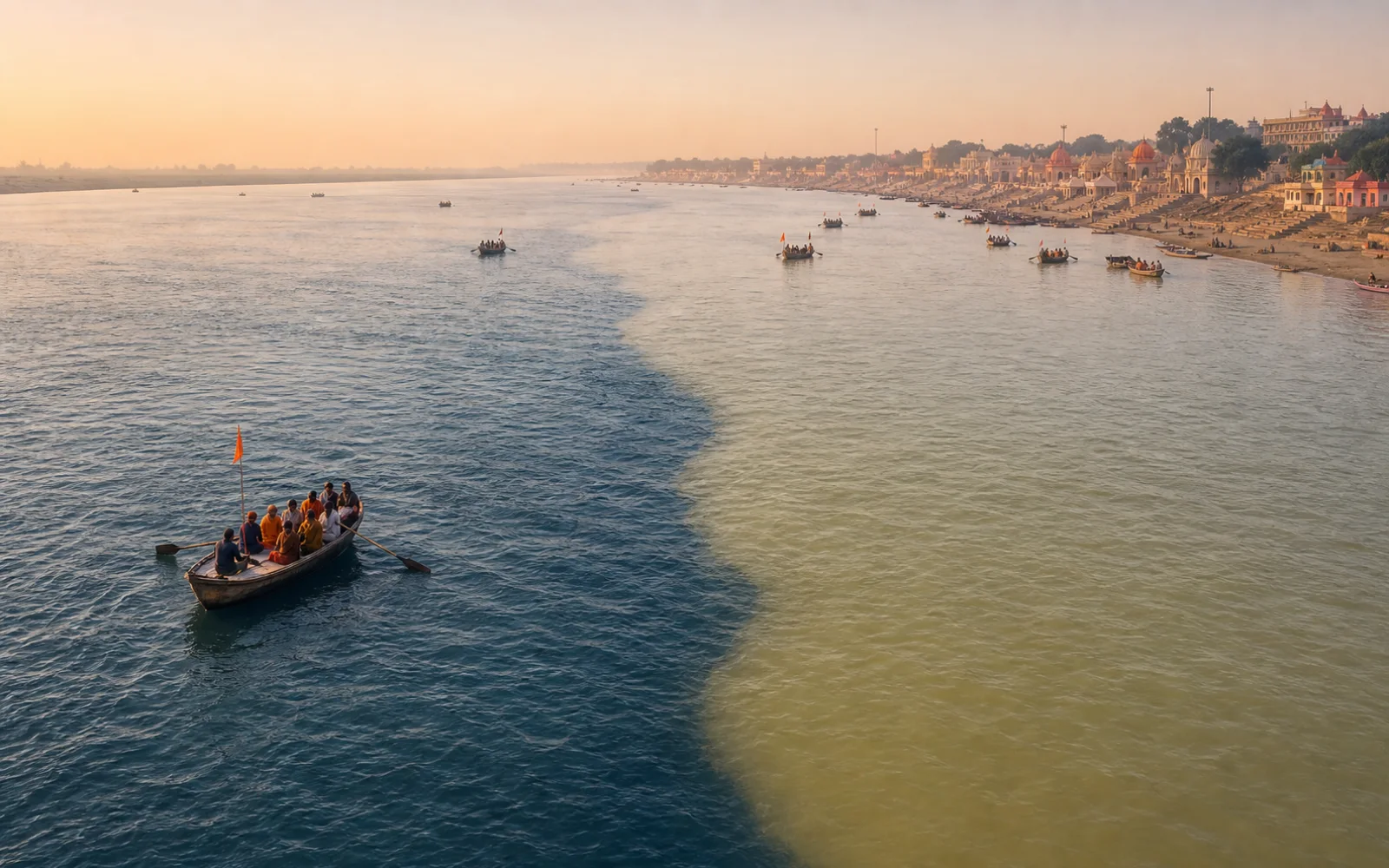
Prayagraj Kumbh is centred on the Sangam of the Ganga and Yamuna, with Saraswati present in religious tradition. The confluence and nearby sacred sites are permanent; the vast tented city, pontoon bridges, sectors, routes and controlled bathing areas are rebuilt for a particular edition. This page explains the lasting place and its history, not a live event plan.
Key facts
| Topic | Verified orientation |
|---|---|
| State | Uttar Pradesh |
| Sacred water | Ganga–Yamuna Sangam; Saraswati in tradition |
| Event names | Kumbh, Ardh Kumbh or Maha Kumbh depending on edition and official usage |
| Permanent centre | Sangam and the surrounding Prayag pilgrimage landscape |
| Previous major edition | Maha Kumbh 2025, now an archived event |
| Future status | No later operational Kumbh schedule confirmed in sources reviewed on 15 July 2026 |
Triveni Sangam: sacred river and geography
The Sangam is where the visible Ganga and Yamuna meet. Official district material describes the Saraswati as unseen and present in tradition. A responsible map therefore shows two visible rivers and explains the third sacred association in text; it does not draw an invented modern surface channel.
The river environment changes with season and water level. Boat access, temporary platforms and the exact approach to the bathing area can also change. During Kumbh, the confluence becomes the centre of a much larger temporary city. Harvard research on the 2013 event shows how roads, camps, utilities and services form an extraordinary but temporary urban system.
Why Kumbh is held at Prayagraj
According to Kumbh tradition, Prayagraj is one of the four places associated with the amrita-kalasha narrative. The confluence also has an older pilgrimage identity beyond the modern Kumbh event. Historical references support Prayag as a significant sacred place, but they do not prove that today’s four-location festival and administration existed unchanged in every ancient period.
For the shared tradition, see why Kumbh is held at four locations.
History and cultural significance
Prayag’s confluence setting has attracted pilgrims over a long period. The city and its public institutions changed under Mughal, colonial and post-independence rule. Historian Kama Maclean’s research is important here: it shows that the modern organised mela was shaped by administration, local religious actors, print culture and politics, rather than remaining one unaltered institution outside history.
This distinction allows two statements to be true:
- Prayagraj has a deep sacred and pilgrimage history; and
- the scale, name, governance and physical form of Kumbh have changed.
The 1954 Kumbh is a major post-independence administrative milestone. The 2013 event became the subject of detailed temporary-city research. The 2025 edition was officially called Maha Kumbh.
Major ghats and sacred sites
Sangam and the fort-side riverfront
The confluence is the primary Kumbh landscape. Allahabad Fort stands nearby on the Yamuna side. Access around military-controlled or protected areas may be limited, so a historic visitor description is not a current permission notice.
Patalpuri and Akshayavat
The underground Patalpuri temple and Akshayavat are part of the fort-area sacred landscape. The tree’s “indestructible” identity and salvation narratives belong to religious tradition. Current access must be checked locally.
Nag Vasuki Temple
The district overview places Nag Vasuki Temple on the Ganga side north of the Sangam in Daraganj. It is part of the wider pilgrimage circuit rather than the mid-river bathing point.
Veni Madhav and Daraganj
Veni Madhav is a significant Madhav site in Daraganj. Prayagraj’s sacred geography extends beyond one photograph of the confluence and includes neighbourhoods, temples and multiple riverbanks.
Kumbh, Ardh Kumbh and Maha Kumbh
Prayagraj illustrates why event names need a year and source. Ardh Kumbh is the conventional term for a roughly six-year gathering, but the 2019 edition was officially called Kumbh. Government communication called the 2025 edition Maha Kumbh. Older records should retain the names used in their own period.
Do not treat “Maha Kumbh” as the permanent name of the place or use it to rank Prayagraj above Haridwar, Nashik–Trimbakeshwar or Ujjain. The Kumbh terminology guide explains the differences.
Previous and future event context
Status reviewed 15 July 2026: no future Prayagraj Kumbh schedule is confirmed in the sources used for this page.
Maha Kumbh 2025 is an archived completed event. Its bridges, sectors, routes, helplines, parking, counts and access controls are not current guidance. A future year or bathing date must not be calculated from a twelve-year shortcut; it requires a dated authority notice.
Read the Kumbh cycle guide for how timing works without guessing dates.
Travel orientation
Prayagraj has rail, road and air connections, but event diversions and station use change. The Sangam is reached through different banks and approaches, and the final journey may involve walking, controlled transport or authorised boats. Check current district, rail, police and mela notices before travel.
Do not rely on an archived distance table during a future event. Water level, bridge placement and security zones can alter the practical route.
Frequently asked questions
Which rivers meet at the Prayagraj Sangam?
The visible Ganga and Yamuna meet there. Saraswati is part of the sacred description in religious tradition and is commonly described as unseen.
Is every Prayagraj Kumbh called Maha Kumbh?
No. Official naming has included Ardh Kumbh, Kumbh and Maha Kumbh in different periods and editions.
Is Maha Kumbh 2025 information still current?
It is valid as an archived account of that edition, not as a future route, contact or access plan.
Can I always enter Akshayavat and the fort area?
No. Access may be controlled. Check current district and site instructions.
When is the next Prayagraj Kumbh?
No later operational schedule was confirmed in the sources reviewed on 15 July 2026. Wait for a dated official announcement.
Sources and review status
Reviewed 15 July 2026. Stable geography is Evergreen; event status requires quarterly review. Sources include UNESCO, the Prayagraj district Sangam, history and places-of-interest pages, research by Kama Maclean, Harvard’s temporary-city project and Government of India naming records. Source IDs: SRC-UNESCO-001, SRC-MOC-001, SRC-PRY-001, SRC-PRY-HIST-001, SRC-PRY-SITES-001, SRC-JAS-001, SRC-OUP-001, SRC-HARVARD-001, SRC-PIB-NAMING-001 and SRC-PIB-MK25-001.