Independent Kumbh knowledge guide
Naga Sadhus: History, Tradition and Role
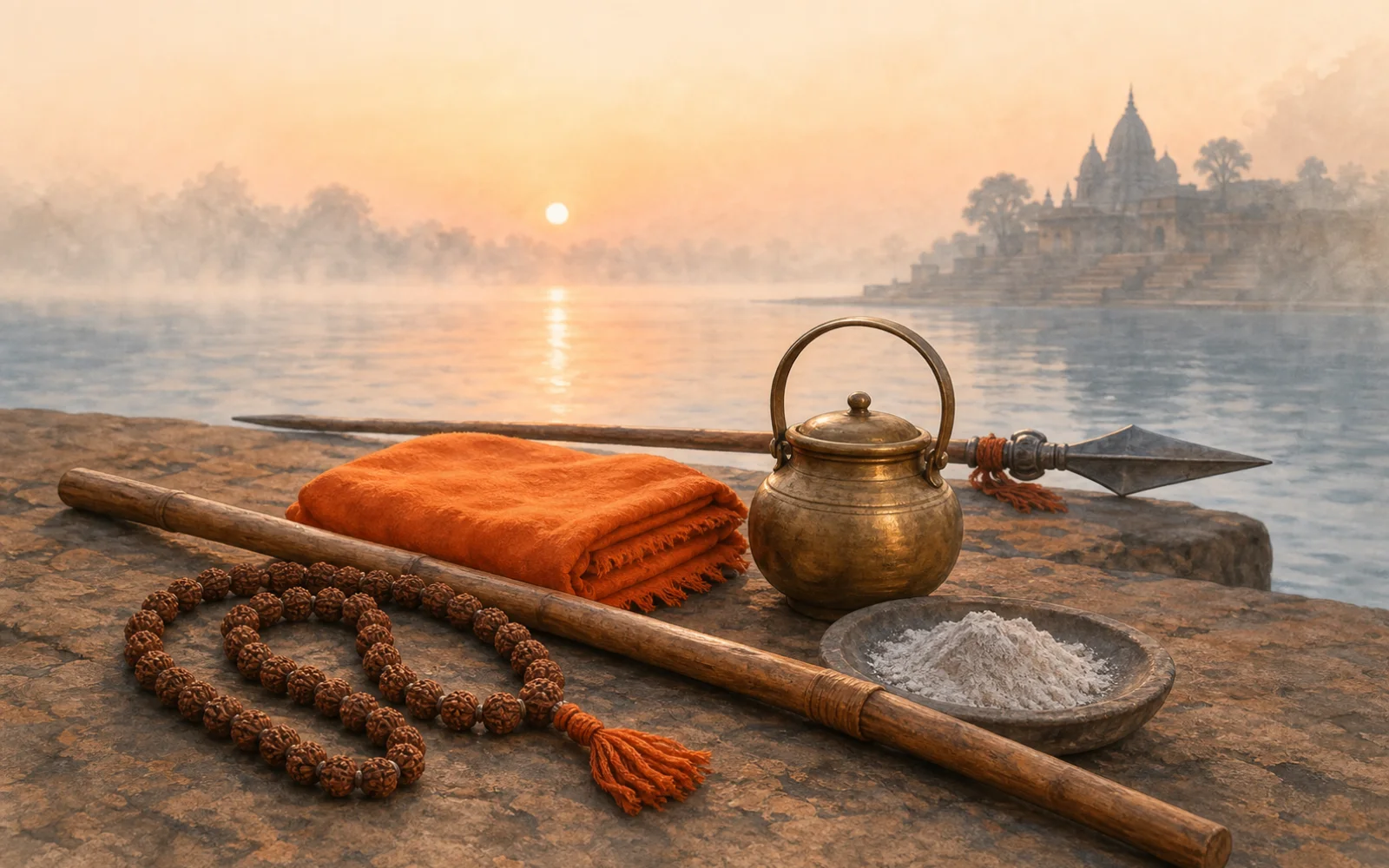
Naga Sadhus, also called Naga Sannyasis, are initiated renunciants associated especially with particular Dashnami and Shaiva Akharas. Their identity centres on lineage, guru, discipline and renunciation; it is not defined only by nudity, ash or weapons. They are highly visible in Kumbh processions and ceremonial bathing, but they are religious participants—not performers or an attraction available for unrestricted photography.
Who are Naga Sadhus?
A Naga Sadhu belongs to a specific ascetic and institutional world. Initiation connects the person with a guru, a lineage and an Akhara. The life may include worship, meditation, study, service, austerity and disciplined separation from ordinary household identity.
Three boundaries make the definition clearer:
- not every sadhu is a Naga Sadhu;
- not every member of an Akhara is Naga; and
- not every Naga Sadhu has the same appearance, residence or public role.
The word sadhu is broad. Sannyasi refers to a renunciant, while Naga Sannyasi is a more specialised initiated identity. Public discussion often compresses these differences because Naga processions are visually striking. Accurate explanation begins with the institution and discipline, not the photograph.
A careful historical background
Institutional traditions frequently connect Naga organisation with Adi Shankaracharya, religious teaching and the protection of sacred institutions. Those accounts are part of living memory and should be attributed respectfully.
Historical scholarship adds an important caution. William R. Pinch documents that armed ascetics were called by different names in different periods and regions—among them yogi, gosain, sannyasi, bairagi and naga. In the evidence he reviews, the use of naga for these ascetics becomes visible in the eighteenth century, while the wider history of armed ascetics extends across the early-modern period.
These ascetics interacted with Mughal courts, regional states, pilgrimage economies and later the East India Company. Some protected property or served political and military patrons. Their past cannot be reduced to the claim that Naga orders were created at one moment only to fight Muslims. The available evidence is more complex and does not support that single communal origin story.
This does not cancel an Akhara’s own religious memory. It means the page distinguishes:
- institutional tradition;
- documented historical evidence;
- later popular retelling; and
- contemporary religious practice.
Ascetic discipline and symbolism
The details of initiation and vows belong to living institutions, gurus and initiates. A public information page should explain the visible principles without turning private rites into a manual.
Renunciation
Naga life is associated with leaving ordinary household identity and accepting the discipline of an ascetic lineage. Renunciation does not mean that every individual is completely cut off from society. Ascetics may teach, travel, manage institutions, meet disciples or live with varying degrees of seclusion.
Guru and Akhara
The identity is not simply self-declared. A guru and Akhara relationship provides religious authority, training, community and responsibility. Internal stages, vows and titles vary, so one media account should never be presented as the universal process.
Sacred ash
Ash is widely associated with Shaiva asceticism and may symbolise impermanence, renunciation and devotion to Shiva. Not every application has one meaning, and visitors should not touch or request ash from an individual without invitation.
Hair and appearance
Matted hair, shaved heads, rudraksha beads and other forms of dress or grooming may appear. They are not a costume code shared identically by all Naga Sadhus.
Nudity
Some Naga Sadhus practise ritual or public nudity as an expression of renunciation and freedom from ordinary possession or social convention. Others may be clothed in particular settings. Nudity is not consent to stare, photograph, sexualise or publish a person’s image.
Ceremonial weapons
Spears, swords, staffs or other weapons may carry historical, institutional and ceremonial meaning. Their presence recalls martial dimensions in the history of some ascetic orders. Visitors must keep distance, follow safety controls and never touch or request a display.
Relationship with Akharas
Naga Sannyasis are especially associated with several Dashnami/Shaiva Akharas. The Akhara connects individuals through lineage, leadership, camp organisation, public processions and participation in ceremonial bathing.
This relationship should not be generalised beyond its limits:
- the 13 established Akharas also include Vaishnava Ani, Udaseen and Nirmal traditions;
- not all of those traditions use Naga identity in the same way;
- an Akhara contains more roles than its most visible procession participants; and
- a person’s clothing alone does not prove institutional affiliation.
Read the Akharas of Kumbh Mela for the full list and classification.
Role of Naga Sadhus during Kumbh
Processions
Naga Sadhus are prominent in several Akhara entry and bathing processions. The public scene may include flags, religious leaders, music, horses or vehicles, ceremonial weapons and groups of ascetics moving along a controlled route.
The route, sequence and access rules are specific to an event. A photograph from Prayagraj 2025 does not confirm the route or timing at Nashik–Trimbakeshwar 2027.
Ceremonial bathing
Akhara bathing—called Amrit Snan in some current official communication and Shahi Snan in other contexts—is among Kumbh’s most recognised ceremonies. Naga Sadhus may lead or be highly visible within their Akhara groups.
This is not an open race for visitors. Police and mela authorities use barriers and time windows because a procession carries religious significance and moves through a very crowded environment. Use only authorised public viewing and bathing areas.
Camp and religious life
Outside processions, Naga Sadhus may worship, meet teachers and disciples, rest, receive visitors or participate in institutional activity. Some encounters are public; others are not. A tent opening is not automatic permission to enter.
Initiation
Kumbh can be an important time for initiation within some Akhara traditions. The site does not publish a step-by-step account, film private rites or promise access. Any public reporting should be based on permission from the responsible institution and the people involved.
Common misconceptions
“Every sadhu at Kumbh is a Naga”
No. Kumbh includes many ascetic traditions, teachers, monks, pilgrims and institutional roles. Naga is a specific initiated identity.
“Naga means only naked”
Too narrow. Nudity may be a visible expression of renunciation in some settings, but lineage, initiation, discipline and Akhara relationship are central.
“All Naga Sadhus live in caves”
No single residence pattern describes everyone. Some live with greater seclusion; others travel, teach, manage institutions or engage publicly.
“They were created only to fight Muslims”
This is an unsupported simplification. Scholarship documents mixed political relationships, changing terminology and a much more complex history of armed ascetics.
“All Naga Sadhus have supernatural powers”
Claims of supernatural ability belong to belief, storytelling or an individual’s reputation. They should not be presented as verified fact, and no spiritual result should be promised.
“A public procession permits any photograph”
No. A public setting may permit wide contextual photography under event rules, but a close portrait, vulnerable moment, bathing scene or private ritual still requires consent and ethical judgment.
Photography and respectful conduct
Curiosity is natural; entitlement is not. Use these rules:
- Ask before a portrait. Seek clear permission from the individual or responsible camp representative.
- Treat uncertainty as refusal. Silence, turning away, a hand gesture, a barrier or a private setting means do not photograph.
- Protect private moments. Do not record changing, bathing, sleeping, illness, distress, initiation, grief or private worship.
- Never stage nudity or weapons. Do not pay, pressure or provoke someone to remove clothing, pose or perform.
- Keep physical distance. Never touch ash, hair, beads, weapons, seats, flags or personal belongings.
- Follow the current event plan. Stay outside controlled routes and obey police, Akhara and mela-authority instructions.
- Caption neutrally. Identify the event and context; avoid words such as “wild,” “primitive,” “bizarre” or “naked spectacle.”
- Do not infer identity. If affiliation is not confirmed, use a general, accurate caption rather than naming an Akhara.
These are KumbhMela.info’s dignity and consent standards. An individual Akhara or event authority may impose stricter rules.
The Kumbh Snan Guide covers public bathing conduct and safety.
How to observe a procession safely
- Check the current authority’s official route and timing notice.
- Arrive only in permitted public viewing areas.
- Keep children, older companions and loose belongings away from the route edge.
- Do not move against the procession or cross through it.
- Avoid using selfie sticks or equipment that intrudes into the path.
- Follow announcements immediately if access changes.
- Leave space for emergency and service personnel.
An event can alter access at short notice. Historical descriptions on this page are not operational guidance.
Frequently asked questions
Are Naga Sadhus only found at Kumbh Mela?
No. Naga ascetic institutions and individuals exist beyond Kumbh. The festival makes them unusually visible because Akharas gather and process at a large public event.
Why do some Naga Sadhus cover themselves in ash?
Ash is associated with Shaiva ascetic symbolism, including impermanence and renunciation. Meaning and practice can vary by teacher and lineage.
Why do Naga Sadhus carry weapons?
Weapons can express the historical martial dimension and ceremonial identity of some orders. They are not props for visitors to handle.
Are all Naga Sadhus unclothed?
No universal appearance rule can be inferred from festival photographs. Some public rituals include nudity, while individuals may be clothed in other contexts.
Can I speak with a Naga Sadhu?
Possibly, if the person or camp welcomes conversation. Approach calmly, follow local etiquette, accept refusal and do not treat the meeting as a performance.
Can I photograph Naga Sadhus?
Ask for clear consent for portraits or close recording, obey event restrictions and never photograph private or vulnerable moments. Public visibility is not blanket permission.
Sources and review status
This page was reviewed on 15 July 2026 and is labelled Evergreen. Official Prayagraj and Government of India material supports the Akhara relationship and Kumbh role. Historical cautions draw on William R. Pinch’s Cambridge University Press research, while James G. Lochtefeld’s Oxford scholarship supports the broader institutional diversity of ascetic life. UNESCO identifies ascetics, Akharas and ashrams among the bearers of the Kumbh tradition.
Source IDs: SRC-UNESCO-001, SRC-PRY-001, SRC-UPSTDC-AKHARA-001, SRC-PIB-AKHARA-001, SRC-KUMBH25-GURUS-001, SRC-PINCH-001, SRC-OUP-LOCHTEFELD-001 and SRC-KUMBH25-CONDUCT-001.
If an event authority or Akhara publishes current conduct or photography guidance, submit the dated source through Contact and Corrections.