Independent Kumbh knowledge guide
Akharas of Kumbh Mela
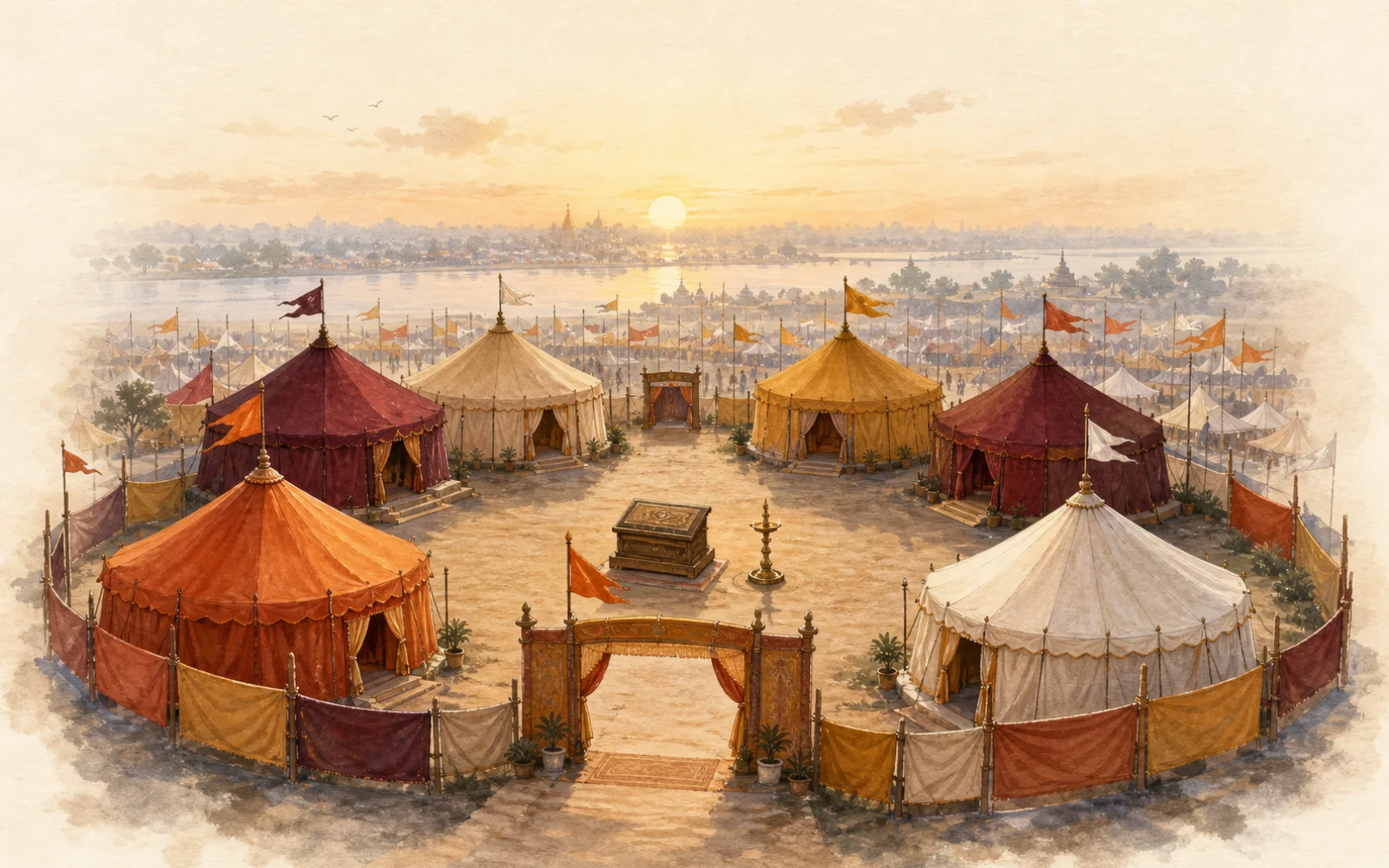
At Kumbh Mela, an Akhara is an organised religious institution of ascetics, teachers and disciples—not simply a wrestling arena or a festival camp. Akharas sustain lineages and disciplines throughout the year, then take visible roles at Kumbh through worship, teaching, processions, camps and scheduled ceremonial bathing. Current government Kumbh material lists 13 established Akharas across Dashnami, Vaishnava Ani, Udaseen and Nirmal traditions.
What is an Akhara?
The word akhara has more than one meaning in India. It can describe a physical training ground, but in the Kumbh context it refers to a religious and ascetic institution. An Akhara may include renunciants, teachers, disciples, monasteries or maths, temples, property, charitable work and an internal system of leadership.
Its Kumbh camp is temporary; the institution is not. This distinction matters because a visitor sees only one public moment in a much longer religious life.
An Akhara is also not the same as every related term:
- an ashram is a place or community organised around religious practice;
- a math is a monastic or institutional centre;
- a sampradaya is a wider religious tradition or lineage;
- a sadhu, sannyasi or vairagi is a renunciant, not automatically an Akhara;
- a mahant is a leadership or custodial title whose role varies;
- a guru is a teacher and guide.
These categories overlap, but treating them as synonyms hides how diverse Kumbh’s religious institutions are.
The 13 Akharas in current government Kumbh material
The following is the 13-name list published in reviewed Uttar Pradesh government Kumbh material. English spellings and full honorific forms vary. The order below groups institutions for clarity; it does not rank them.
| Broad tradition | Akharas | What the grouping means |
|---|---|---|
| Dashnami, primarily Shaiva | Shri Panch Dashnam Juna; Shri Panchayati Niranjani; Shri Panch Atal; Shri Panchayati Mahanirvani; Shri Taponidhi Anand Panchayati; Shri Panch Dashnam Avahan; Shri Panch Dashnam Agni | Seven institutions associated broadly with Dashnami and Shaiva ascetic traditions; their customs and structures are not identical |
| Vaishnava Bairagi Ani | Shri Digambar Ani; Shri Nirvani Ani; Shri Panch Nirmohi Ani | Three Vaishnava Ani institutions with their own lineages and practices |
| Udaseen | Shri Panchayati Bada Udasin; Shri Panchayati Naya Udasin | Two distinct Udaseen institutions |
| Nirmal | Shri Panchayati Nirmal | A distinct institution associated with the Nirmala tradition |
You may also see Akhada instead of Akhara, Aavahan instead of Avahan, and Udaseen instead of Udasin. A spelling variation does not usually indicate a separate institution.
The simple three-part classification—Shaiva, Vaishnava and Udaseen—appears on official Kumbh pages and is useful as an introduction. The table keeps Nirmal separate because the reviewed government list identifies its Nirmala institutional connection. A neat chart should not erase a real religious distinction.
Is this list permanent?
The 13-name list is the established institutional list used in the government material reviewed for this page. Contemporary Kumbh life also includes women ascetics, women’s monastic organisations and Kinnar Akhara. Their participation is significant and should not be made invisible.
At the same time, current government features sometimes use “13 Akharas” while also discussing newer or separately organised bodies. KumbhMela.info therefore does not silently replace a name in the established list or make a legal-recognition claim. Newer participation is described in its own context, with the event and source made clear.
How did Akharas develop?
Institutional accounts often connect the organisation of Akharas with Adi Shankaracharya, the teaching of scripture and the defence of religious life. These are important traditions, but the precise founding history of all 13 institutions is not settled by one account.
Historical research presents a more layered picture. Armed ascetics participated in pilgrimage networks, protected endowments, served regional powers and adapted to Mughal, Company and later colonial settings. Terms such as yogi, gosain, sannyasi, bairagi and naga changed across regions and centuries.
This evidence does not support the popular claim that every Akhara was founded at one moment for the single purpose of fighting Muslims. Scholar William R. Pinch shows that warrior-ascetic history crossed religious and political boundaries and that the evidence is insufficient for such a simple communal origin story.
The responsible summary is therefore:
- Akharas preserve living religious traditions and institutional memories;
- several have historically martial dimensions;
- their documentary histories differ; and
- origin stories should be attributed rather than presented as one uncontested timeline.
Major traditions and broad classifications
Dashnami and Shaiva institutions
The seven institutions in the first row are broadly associated with Dashnami and Shaiva renunciation. Several are especially connected with Naga Sannyasis, whose public presence is prominent during Kumbh. “Shaiva,” however, does not make every member a Naga or every Akhara practice identical.
Vaishnava Ani institutions
Digambar Ani, Nirvani Ani and Nirmohi Ani belong to Vaishnava Bairagi traditions. Official Kumbh communication identifies them as an important part of the festival’s institutional diversity. They should not be described through Shaiva terminology simply because the Shaiva Naga processions receive more photography.
Udaseen institutions
Bada Udasin and Naya Udasin are separate institutions within the Udaseen tradition. Their names indicate an institutional relationship, not one combined Akhara.
Nirmal institution
The Nirmal Akhara is associated with the Nirmala tradition and a Sikh-linked monastic history in the reviewed government account. Presenting it separately is more accurate than forcing it into an Udaseen category.
What do Akharas do during Kumbh?
Maintain camps and religious life
Akhara camps provide spaces for worship, teaching, meetings, food service, discipleship and institutional activity. Some areas are open to visitors; others are private or controlled. A camp is a religious environment, not a theme-park exhibit.
Join public processions
The entry of Akharas into the mela and their ceremonial processions may be described by terms such as Peshwai or Chhavani Pravesh, depending on the institution and event. Flags, music, vehicles, horses, religious leaders, ascetics and tradition-specific symbols may form part of the procession.
The order and route are not casual. They are coordinated for a particular Kumbh with the responsible administration. An archived procession route should never be reused as a future access plan.
Participate in ceremonial bathing
Akhara bathing is one of Kumbh’s most visible institutional ceremonies. Recent official communication may use Amrit Snan, while older or other material may use Shahi Snan. The site follows the current event authority’s terminology rather than declaring one label universal.
Bathing order has ceremonial importance and practical crowd-management consequences. The public should follow barriers, signs and announcements and must not enter a moving procession or restricted ghat zone.
Teach and meet disciples
Kumbh brings religious teachers, ascetics and disciples together at exceptional scale. Discourses, worship, debates, meetings and initiation may take place, but access and privacy differ. A public camp does not make every ceremony public.
Coordinate with event authorities
Akhara representatives work with mela authorities on camp areas, processions, routes, timing, safety and services. These are administrative relationships for a specific edition. They do not make an Akhara a government department or KumbhMela.info an official platform.
Akhara-related terms
| Term | Plain-language explanation |
|---|---|
| Naga Sannyasi | An initiated ascetic identity connected especially with certain Dashnami/Shaiva Akharas |
| Mahant | A leader or custodian; duties vary by institution |
| Mahamandaleshwar | A senior title used in several Akhara settings, not one identical office everywhere |
| Peshwai / Chhavani Pravesh | Terms used for public arrival or entry processions, depending on event and tradition |
| Shahi Snan / Amrit Snan | Event-language for ceremonial bathing by Akharas; official usage changes by edition |
| Dharm Dhwaja | A religious flag associated with an institution or tradition |
| Sadhu Gram | A planned camp area for ascetics and institutions at some events; layout is edition-specific |
For the specialised ascetic identity, read Naga Sadhus: history, tradition and role.
Respectful conduct for visitors
- Treat every camp as a religious space and follow the host’s instructions.
- Observe gates, signs, barriers and the current mela administration’s movement rules.
- Ask before photographing an individual, ritual, living area or sacred object.
- Accept silence or a gesture of refusal as “no.”
- Do not touch flags, weapons, seats, altars, ash, hair or personal belongings.
- Do not request a ritual, pose, blessing or display for social media.
- Avoid sectarian comparisons and questions about which Akhara is “highest.”
- Keep clear of processions and use only authorised public areas.
- Do not assume every person in saffron belongs to an Akhara.
The Kumbh Snan Guide explains how public bathing guidance differs from Akhara ceremonial arrangements.
Frequently asked questions
How many Akharas are there at Kumbh Mela?
Current government Kumbh material uses an established list of 13 Akharas. Contemporary events also include newer or separately organised ascetic bodies, which should be described without silently altering that list.
Are all Akharas Shaiva?
No. The list includes Dashnami/Shaiva, Vaishnava Ani, Udaseen and Nirmal institutions.
Is an Akhara a wrestling school?
That is one common meaning of the word, but not the main meaning at Kumbh. Here it refers to an organised ascetic and religious institution.
Are all Akhara members Naga Sadhus?
No. Naga Sannyasi is a specific initiated identity associated especially with certain Dashnami/Shaiva Akharas. Akharas include other ascetics, teachers, leaders and disciples.
Can visitors enter Akhara camps?
Some public areas may welcome visitors, while others are private or restricted. Follow the current event plan, signs and the host institution’s directions.
Why do Akharas bathe in an organised order?
The order reflects ceremonial tradition and is also coordinated for safe event management. It may change by location and edition, so use only current official guidance.
Sources and review status
This page was reviewed on 15 July 2026 and is labelled Evergreen. The 13-name list comes from Uttar Pradesh government Kumbh material and is cross-checked against official event explanations. Historical interpretation is qualified using university-press research by William R. Pinch and James G. Lochtefeld. UNESCO supports the role of Akharas and ascetic communities as bearers of the Kumbh tradition.
Source IDs: SRC-UNESCO-001, SRC-UPSTDC-AKHARA-001, SRC-PIB-AKHARA-001, SRC-KUMBH25-GURUS-001, SRC-PINCH-001, SRC-OUP-LOCHTEFELD-001 and SRC-KUMBH25-CONDUCT-001.
If a current authority publishes a revised participation list, submit the dated source through Contact and Corrections.