Independent Kumbh knowledge guide
Mythology and Origin of Kumbh Mela
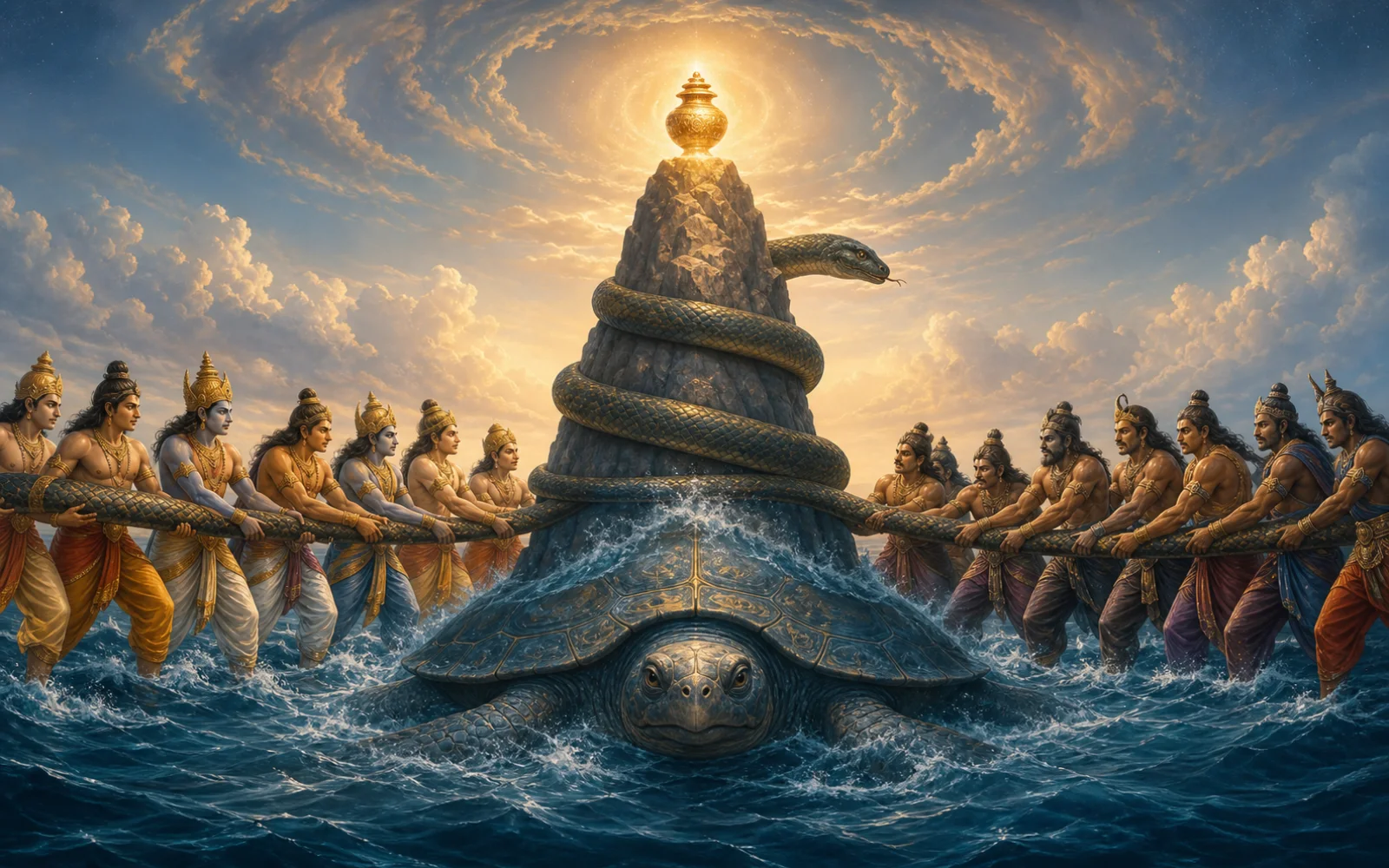
According to a widely told Hindu tradition, Kumbh Mela is connected with the Samudra Manthan—the churning of the cosmic ocean—and the struggle over a kalasha containing amrita, the nectar of immortality. Later Kumbh retellings associate the nectar with Prayagraj, Haridwar, Nashik–Trimbakeshwar and Ujjain. The broad story is widely recognised, but details vary by text, place and oral tradition; it should be presented as sacred mythology, not as a single archaeological account of the festival’s founding.
The story in brief
| Element | Role in a widely recognised telling |
|---|---|
| Devas and asuras | Opposing powers who cooperate to churn the cosmic ocean in search of amrita. |
| Mount Mandara | The mountain used as the churning pivot. |
| Vasuki | The serpent used as the churning rope. |
| Kurma | Vishnu’s tortoise form, which supports the mountain. |
| Amrita | The nectar of immortality that emerges after the churning. |
| Kalasha or kumbha | The vessel associated with the nectar and, in Kumbh tradition, the four sacred locations. |
Historical paintings in museum collections show how artists have represented this narrative in different regions and periods. These works help us understand the story’s cultural life; they are not photographs of a literal historical event.
Samudra Manthan: the churning of the cosmic ocean
The narrative begins with the devas and asuras seeking amrita. Neither side can obtain it alone, so they agree to churn the great ocean. Mount Mandara becomes the central pivot. Vasuki is wound around it as a rope, with the two sides pulling in turn. When the mountain needs support, Vishnu takes the Kurma, or tortoise, form beneath it.
The churning produces many beings and treasures in different tellings. It also brings danger: a powerful poison emerges before the nectar. The wider narrative includes divine intervention, endurance, rivalry and the difficult separation of what harms from what sustains.
At last, amrita appears in a vessel. A struggle follows because possession of the nectar represents freedom from mortality within the story. Retellings differ about who holds, protects or carries the kalasha and how control of the amrita changes hands.
The amrita-kalasha and the four Kumbh places
In the Kumbh tradition familiar today, the contested vessel becomes linked with four sacred places:
- Prayagraj, at the Sangam of the Ganga and Yamuna and, in tradition, the invisible Saraswati;
- Haridwar, on the Ganga;
- Nashik–Trimbakeshwar, on the Godavari;
- Ujjain, on the Shipra or Kshipra.
A common retelling says drops of amrita fell at these places while the vessel was being carried or protected. Official cultural pages for Nashik, Haridwar and Prayagraj all present forms of this four-location tradition. The details are not identical, which is why responsible writing says “according to tradition” rather than declaring one version universal.
See the places and rivers together in why Kumbh is held at four locations or open the all-locations hub.
Why versions of the story differ
Myths live through recitation, worship, commentary, art, regional memory and family teaching. Variation does not necessarily mean that one community has misunderstood the story. It may show what a place or teaching tradition emphasises.
Differences include:
- who carries or guards the kalasha;
- whether drops spill during a chase, whether the vessel is set down, or whether a place becomes associated in another way;
- how long the struggle lasts and how “divine days” are related to human time;
- which divine figures or treasures receive attention;
- the exact local ghat or sacred point associated with the nectar;
- whether the telling focuses on cosmic balance, moral discernment, pilgrimage or ritual bathing.
The broad Kumbh connection is shared, but a local account should remain attached to its location. A Haridwar belief about Brahma Kund, for example, should be introduced as Haridwar tradition rather than projected onto all four cities.
What the story can symbolise
The Samudra Manthan is first a sacred narrative. It has also inspired many symbolic readings. These are interpretations, not one compulsory doctrine.
Cooperation and tension
The devas and asuras must cooperate even though their aims conflict. The image can represent the difficult work required to obtain something precious and the tension that remains when power is shared.
Discipline before reward
The churning is prolonged and demanding. It can be read as an image of sustained discipline: valuable insight or transformation may require patience rather than a quick act.
Poison and nectar
Danger emerges alongside treasure. Some readers see this as a reminder that discernment is needed when difficult processes reveal both benefit and harm.
The vessel as sacred capacity
The kalasha is an important ritual form across Hindu practice. In the Kumbh story it can signify the capacity to hold life, abundance, knowledge or divine blessing. The word association helps explain the festival’s name, but etymology alone does not establish a precise historical founding date.
Pilgrimage as inner and outer movement
For a pilgrim, travelling to a sacred river may be both a physical journey and a disciplined inward practice. This is a spiritual interpretation, not a guaranteed result promised by a website or event.
Sacred bathing and the nectar tradition
Many devotees believe that the rivers at Kumbh carry special spiritual significance at the auspicious time. Ritual bathing may be understood as purification, renewal, remembrance or a step in one’s religious journey. UNESCO’s heritage description records bathing in a sacred river as a central practice and notes the knowledge carried by akharas, ashrams, teachers and communities.
Belief in sacred water must not be turned into a medical or water-quality claim. A pilgrim can honour a river’s sanctity while also following current public-health guidance, using safe drinking water and obeying event safety rules. The Kumbh snan guide treats ritual respect and practical safety together.
Mythology and historical evidence are different questions
Mythology communicates sacred meaning, memory and identity. History asks when names, institutions, records and practices can be documented. One does not have to insult mythology in order to write careful history, and one does not have to treat a sacred story as archaeology in order to respect it.
The four-location amrita tradition is central to how many people understand Kumbh. Historical research, especially on Prayagraj, also shows that the modern organised mela changed through administration, public-space negotiation, print culture, transport and politics. The history of Kumbh Mela explains that evidence separately.
This distinction prevents two common mistakes:
- claiming that the myth proves every feature of the current event has existed unchanged since antiquity; or
- assuming that historical change makes the religious tradition unimportant.
Kumbh can be both an old sacred tradition and a living institution whose public form continues to evolve.
Related sacred geography
The story gains local meaning through four different river landscapes.
| Location | Sacred water | Traditional association |
|---|---|---|
| Prayagraj | Ganga–Yamuna Sangam; Saraswati in tradition | The confluence is revered as Tirtharaj in local tradition. |
| Haridwar | Ganga | Har Ki Pauri and Brahma Kund are prominent in the local amrita account. |
| Nashik–Trimbakeshwar | Godavari | The shared Kumbh geography spans Nashik and Trimbakeshwar. |
| Ujjain | Shipra/Kshipra | Simhastha joins the river, city and astrological tradition. |
This table explains religious associations, not current event access. Use the relevant location guide for geography and a dated official authority notice for any schedule or operational arrangement.
Frequently asked questions
Is the Samudra Manthan story the historical origin of Kumbh Mela?
It is the central mythological origin tradition associated with Kumbh. It explains sacred meaning and the connection among four places. A historical founding claim requires different evidence, and the modern institution developed over time.
Did amrita literally fall at four places?
Many Hindu traditions say that the four Kumbh places are connected with drops of amrita. This is a matter of sacred tradition and belief, not a claim that KumbhMela.info presents as archaeologically verified.
Are all versions of the story the same?
No. The main elements are widely recognised, but the carrier of the vessel, the route, the drop details, the divine participants and local associations vary.
What does “Kumbh” mean?
Kumbh or kumbha refers to a pot, pitcher or vessel. In the festival tradition it evokes the kalasha containing amrita.
Does bathing at Kumbh guarantee moksha?
Many devotees believe sacred bathing has purifying and liberating significance. It is a devotional belief, not a guaranteed spiritual or medical outcome.
Is the Saraswati physically visible at Prayagraj?
The Ganga and Yamuna meet visibly at the Sangam. Saraswati is understood in the local religious tradition as an invisible or subterranean river; it should be described as tradition rather than a visible channel.
Sources and review status
This page was reviewed on 14 July 2026 and is labelled Evergreen. Mythological and devotional statements are deliberately attributed as tradition or belief.
Material sources include the Metropolitan Museum of Art’s interpretation of a historical Samudra Manthan painting; official Nashik, Haridwar and Prayagraj cultural accounts of the four-location amrita tradition; UNESCO’s Kumbh Mela heritage record; and historical scholarship used to separate mythology from the documented modern institution. Source IDs: SRC-MET-001, SRC-NSK-001, SRC-HRD-001, SRC-PRY-001, SRC-UNESCO-001, SRC-JAS-001 and SRC-OUP-001.
If a regional tradition is represented inaccurately, send the source and location through Contact and Corrections.