Independent Kumbh knowledge guide
What Is Kumbh Mela?
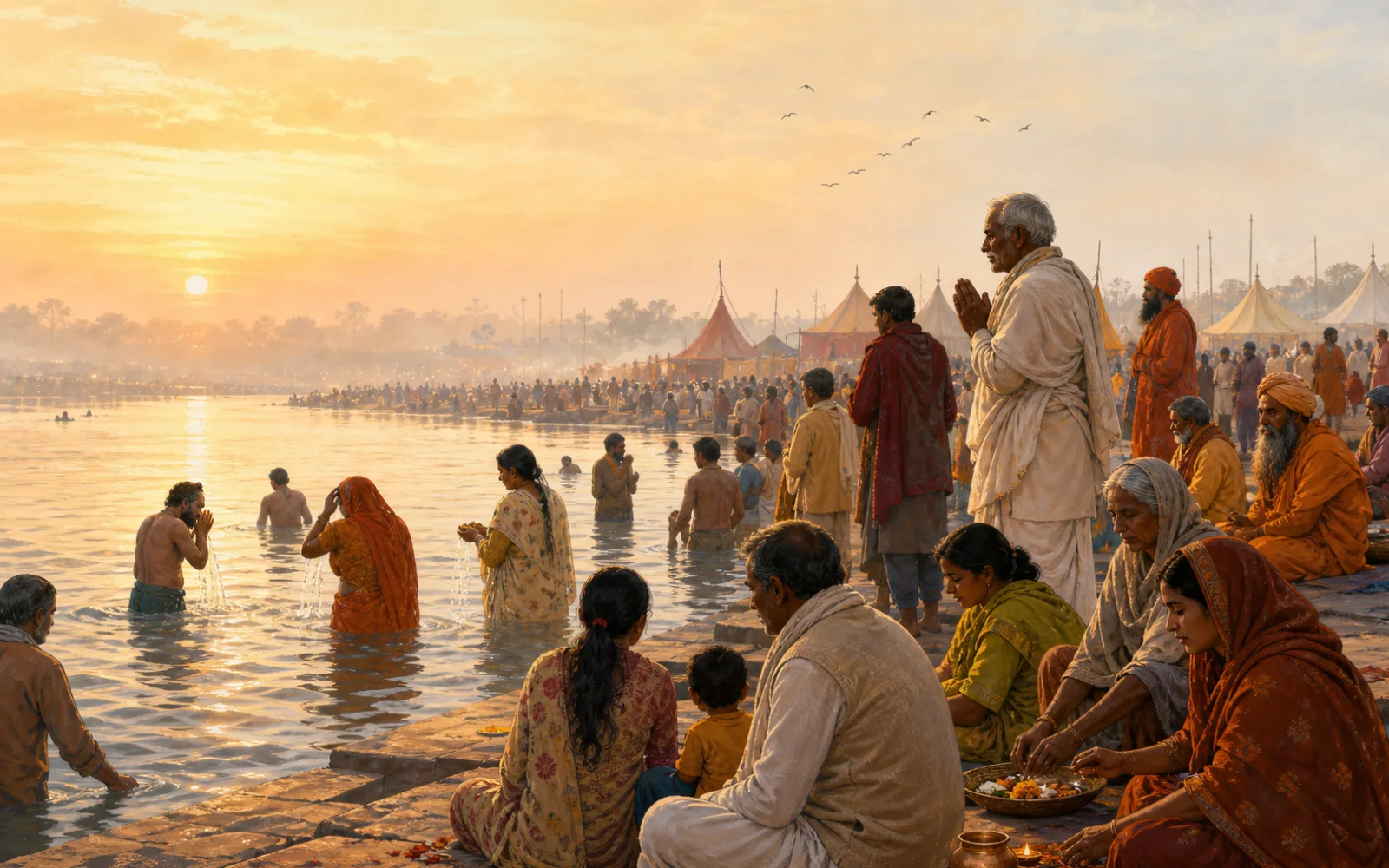
Kumbh Mela is a rotating Hindu pilgrimage gathering centred on sacred rivers. Pilgrims, ascetics, religious teachers and visitors come for ritual bathing, worship, discourse and community life. The recognised Kumbh circuit connects Prayagraj, Haridwar, Nashik–Trimbakeshwar and Ujjain. Its timing follows traditional astrological calendars, so current dates should always be checked against the responsible event authority rather than calculated from a simple fixed interval.
Kumbh Mela at a glance
| Question | Short answer |
|---|---|
| What is it? | A major Hindu pilgrimage congregation and living cultural tradition. |
| What is the central practice? | Bathing or taking a dip in sacred river water at an auspicious time. |
| Where is it held? | Prayagraj, Haridwar, Nashik–Trimbakeshwar and Ujjain. |
| Is it always in the same city? | No. The wider Kumbh circuit rotates among four locations. |
| How often does it return to one location? | A principal Kumbh is generally associated with an approximately twelve-year return, subject to the traditional astrological configuration and official calendar. |
| Who takes part? | Pilgrims, families, ascetics, akharas, teachers, volunteers, officials and visitors. |
| Is KumbhMela.info an event authority? | No. This is an independent information platform; current notices must be verified with the relevant authority. |
In 2017, UNESCO inscribed Kumbh Mela on the Representative List of the Intangible Cultural Heritage of Humanity. The recognition concerns a living body of practices, knowledge and social traditions—not ownership of the festival or a declaration that every account about it is historically settled.
Why Kumbh Mela matters
For many devotees, Kumbh is an opportunity for pilgrimage, ritual bathing, prayer, charitable giving, listening to religious teachings and meeting spiritual lineages. Many believe that bathing at an auspicious time has purifying spiritual significance. That is a matter of faith and tradition; it should not be turned into a guaranteed spiritual or medical claim.
Kumbh is also a major social and civic undertaking. A large event may create a temporary settlement with roads, water and sanitation systems, health facilities, security arrangements, public information and spaces for religious institutions. Harvard’s study of the 2013 Prayagraj event described this as an “ephemeral” or temporary mega-city. The precise arrangements change from one event to another, which is why practical guidance must be based on current official notices.
The four Kumbh locations
Each Kumbh location is tied to a distinct sacred geography.
Prayagraj
Prayagraj’s gathering is associated with the Sangam, the confluence of the Ganga and Yamuna and, in Hindu tradition, the invisible Saraswati. It has a particularly prominent place in modern Kumbh history and is the location most often associated with the term Maha Kumbh.
Explore the Prayagraj Kumbh guide.
Haridwar
Haridwar’s Kumbh is held on the Ganga where the river reaches the plains after descending from the Himalayan region. Har Ki Pauri is one of the city’s best-known ritual landscapes, although event access and bathing arrangements must be checked for the relevant year.
Explore the Haridwar Kumbh guide.
Nashik–Trimbakeshwar
The Nashik–Trimbakeshwar Kumbh is associated with the Godavari. The sacred geography is shared between Nashik and Trimbakeshwar, and different ascetic traditions have historically used distinct bathing places. The event is also called Simhastha in this regional context.
Explore the permanent Nashik–Trimbakeshwar Kumbh guide or begin with the current Nashik Kumbh event guide.
Ujjain
Ujjain’s Simhastha is associated with the Kshipra, also commonly written Shipra. Its name refers to the traditional astrological configuration connected with Simha, or Leo.
Explore the Ujjain Simhastha guide.
See all four together in the Kumbh locations overview.
How the Kumbh cycle works
Two descriptions often sound contradictory:
- Kumbh is said to occur somewhere in the four-location circuit at intervals of a few years.
- A principal Kumbh at a particular location is described as returning roughly every twelve years.
Both refer to different scales of the same rotating tradition. The circuit moves among four places, while the main observance at one place is generally linked with an approximately twelve-year astrological cycle. It is not safe to determine an event date by simply adding twelve years to a previous one. Responsible authorities publish the operative calendar and bathing schedule.
Read the detailed Kumbh cycle and timing explanation.
Kumbh, Ardh Kumbh, Maha Kumbh and Simhastha
Kumbh terminology is not used in exactly the same way at every location or in every period.
- Kumbh Mela is the broad name for the pilgrimage tradition and its principal gatherings.
- Ardh Kumbh means “half Kumbh” and is especially associated with six-year observances at Prayagraj and Haridwar in official accounts.
- Maha Kumbh means “great Kumbh.” It is strongly associated with Prayagraj, but public and official usage has varied; the event authority’s naming should control for a specific edition.
- Simhastha is the established name used for the Kumbh tradition at Ujjain and in the Nashik–Trimbakeshwar context, linked with a traditional astrological association with Simha.
Because the labels can overlap, use the types of Kumbh guide before comparing events.
Sacred bathing and other traditions
Ritual bathing, or snan, is central, but Kumbh is not only a bath. Depending on the location and occasion, pilgrims may also take part in darshan, worship, prayer, fasting, charitable giving, religious discourses, devotional singing and stays with religious camps.
Organised processions of akharas are among the most visible Kumbh traditions. Akharas are religious institutions and ascetic orders with distinct histories, practices and leadership. Some participants, including Naga sadhus, follow renunciant disciplines that are often photographed but too easily reduced to spectacle. They should be described with the same care and dignity applied to other religious communities.
Learn more about akharas, Naga sadhus and the Kumbh snan guide.
Tradition, mythology and history are not the same thing
According to a widely told Hindu tradition connected with the Samudra Manthan—the churning of the ocean—amrita, the nectar of immortality, became associated with the four Kumbh locations. Retellings differ in their details, including who carried or protected the kalasha and whether drops were spilled or the vessel was set down. The shared tradition explains the sacred connection among the four places; it should not be presented as archaeological proof.
The pilgrimage landscapes and religious practices have deep historical roots, but the modern Kumbh is not an institution frozen unchanged in time. Historical research on Prayagraj shows that administration, processions, public space, transport, politics and the festival’s scale developed through negotiation and change, including during the colonial period. Our history of Kumbh Mela and mythology and origin guide treat those two questions separately.
What a first-time visitor should understand
Kumbh is open to a wide range of pilgrims and visitors, but a mass gathering requires preparation.
- Start with the exact location and year. Four places share the Kumbh tradition, but their geography and arrangements differ.
- Use current official notices. Check dates, bathing schedules, entry rules, transport changes, parking and health advisories close to travel.
- Expect long walking distances and changing access controls. Do not assume a normal city route will remain open on a major bathing day.
- Respect bathing areas, processions and religious spaces. Follow steward and police directions, and never obstruct an akhara procession for a photograph.
- Treat sacred water and drinking water as different safety questions. Faith in a river’s sanctity does not replace public-health advice.
- Plan for family and senior needs. Carry identification, essential medicines and a simple meeting plan; use only the emergency contacts published for that event.
For practical preparation, use the first-time visitor guide and what to carry checklist. Nashik-specific details belong in the event cluster and will show an information-status label when official arrangements are still pending.
Frequently asked questions
Is Kumbh Mela held only in Prayagraj?
No. Prayagraj is one of four recognised Kumbh locations. The others are Haridwar, Nashik–Trimbakeshwar and Ujjain.
Is Kumbh Mela held every twelve years?
A principal Kumbh at one location is generally associated with an approximately twelve-year return. The wider circuit rotates among four locations, so a Kumbh gathering may occur elsewhere between two editions at the same place. Exact dates depend on the recognised calendar and official announcement.
Why do pilgrims bathe during Kumbh?
Many devotees believe that bathing at an auspicious time has purifying spiritual significance and supports their religious journey. This is a devotional belief, not a medical claim or a guaranteed outcome.
What is the difference between Kumbh and Maha Kumbh?
Kumbh is the broad tradition. Maha Kumbh is a title most closely associated with a major Prayagraj observance, but naming practices vary. Check the responsible authority’s terminology for a particular event.
Are tourists allowed to attend?
Kumbh gatherings include pilgrims, ascetics, local residents and visitors. Attendance conditions, access zones, photography rules and transport controls can change, so visitors should follow current official guidance and behave respectfully in ritual spaces.
Who are the akharas?
Akharas are organised religious institutions and ascetic orders. They preserve teachings and lineages and take part in Kumbh processions and bathing traditions. They are diverse, so one akhara’s practices should not be assumed to represent all others.
Sources and review status
This page was reviewed on 14 July 2026 and contains evergreen introductory information. It intentionally excludes future event dates and operational claims.
Material sources include UNESCO’s Kumbh Mela cultural-heritage record, the Ministry of Culture’s Culture Corridor catalogue, official Nashik and Haridwar district cultural pages, Kama Maclean’s peer-reviewed historical study, and Harvard’s interdisciplinary Kumbh research project. Full source records are maintained under IDs SRC-UNESCO-001, SRC-MOC-001, SRC-NSK-001, SRC-HRD-001, SRC-JAS-001 and SRC-HARVARD-001.
If you find a factual problem, use Contact and Corrections and include the page URL plus the source you believe should be checked.