Independent Kumbh knowledge guide
History of Kumbh Mela
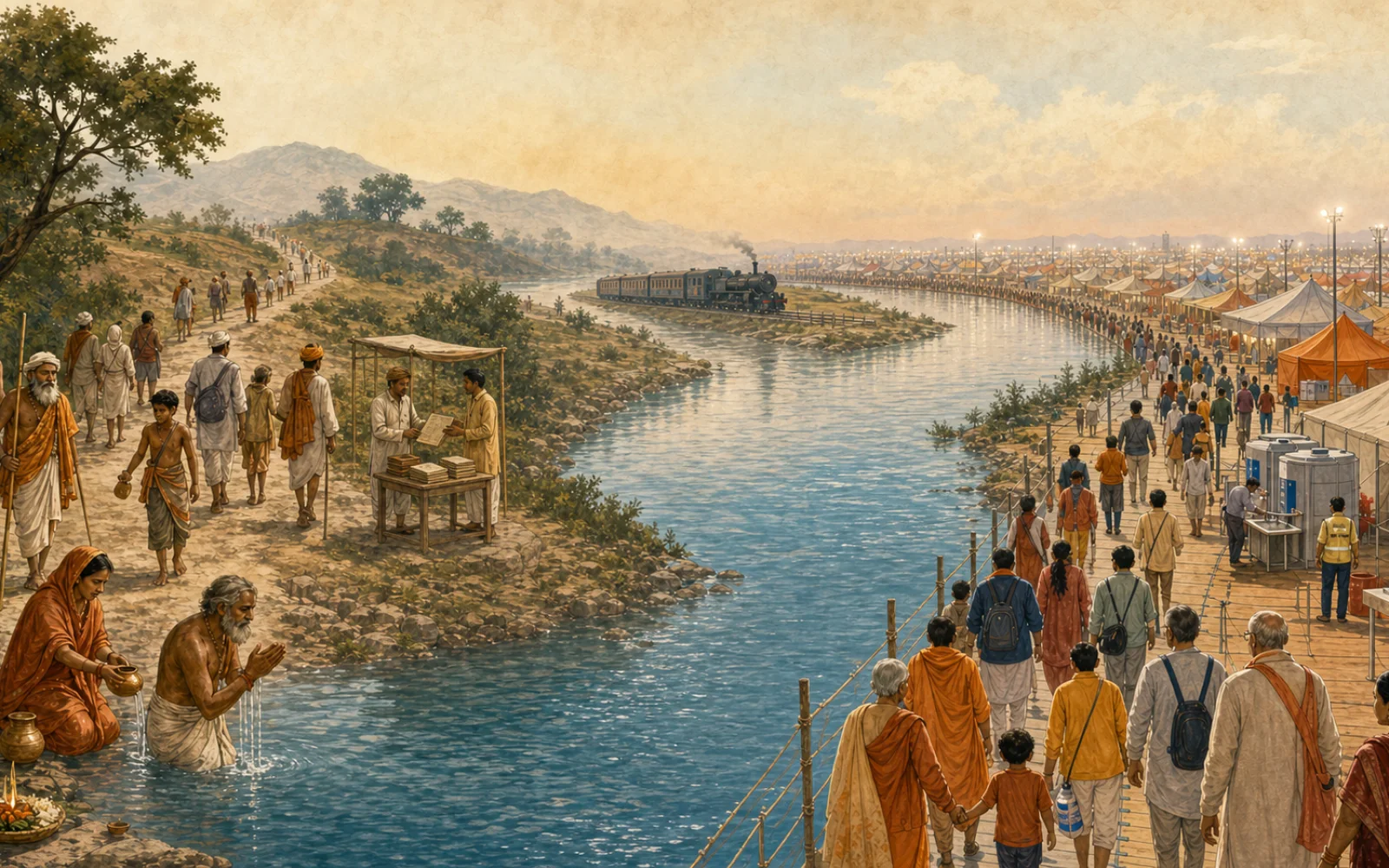
Kumbh Mela has deep roots in India’s sacred-river pilgrimage traditions, but the organised institution seen today did not appear fully formed at one provable moment in antiquity. Historical evidence is strongest when it separates three things: the old sanctity of places such as Prayag, long-standing practices of bathing and gathering, and the later development of a named, administered Kumbh Mela. Records from Prayagraj show that the modern mela changed substantially during the nineteenth and twentieth centuries.
The short historical answer
There is no single, securely documented “first Kumbh Mela” that explains the complete four-location tradition.
- Sacred rivers, confluences, pilgrimage, ritual bathing and religious fairs have long histories in India.
- Prayag’s sacred importance is documented well before modern colonial administration.
- Mythological traditions connect Prayagraj, Haridwar, Nashik–Trimbakeshwar and Ujjain through the amrita story.
- Detailed modern records show that organisation, processions, public space, state involvement, transport and political meaning changed over time.
- Evidence for Prayagraj is especially rich, but each of the four Kumbh locations has its own local history.
This approach respects the tradition’s antiquity without claiming that every feature of a twenty-first-century Kumbh existed unchanged thousands of years ago.
Evidence and tradition: how to read Kumbh history
Kumbh history is often told as one continuous story. A more reliable account identifies what each kind of source can establish.
| Kind of evidence | What it can show | What it cannot prove by itself |
|---|---|---|
| Religious texts and oral traditions | Sacred meanings, ritual ideas and remembered connections among places | A precise date when today’s four-location institution began |
| Travel accounts | That a place attracted pilgrims, assemblies or religious activity in a particular period | That the gathering had the same name, cycle, administration and practices as a modern Kumbh |
| Local records and inscriptions | Location-specific patronage, institutions and sacred geography | A uniform history shared by all four locations |
| Colonial archives and newspapers | Administration, disputes, public space, processions, policing and changing terminology | A complete or neutral account of pilgrims’ own experience |
| Modern government and institutional records | Contemporary event management and recognised heritage status | Proof that the modern system existed unchanged in antiquity |
According to a widely told Hindu tradition, drops of amrita became associated with the four Kumbh places during the Samudra Manthan. This story explains sacred meaning. It belongs in the history of belief and cultural memory, but it is not an archaeological founding record. Read the tradition in the separate mythology and origin guide.
Early sacred and pilgrimage antecedents
Prayag, at the confluence of the Ganga and Yamuna and the traditional Saraswati, has been revered as a tirtha—a sacred crossing or pilgrimage place—for a very long time. Religious literature, regional memory and travel writing all contribute to that history.
The official Prayagraj history records that the seventh-century Chinese traveller Xuanzang encountered Prayag as a place regarded as holy. That is valuable evidence for the sacred importance of the place and for religious assembly in the region. It should not be converted into the stronger claim that Xuanzang attended the same four-location Kumbh institution known today.
Similarly, early references to bathing at a confluence, seasonal observances or charitable gatherings show important antecedents. They do not automatically settle when the name “Kumbh Mela,” the twelve-year framing, the four-location circuit or the current organisation became established.
From pilgrimage gathering to modern public institution
The documentary record becomes more detailed from the late eighteenth century. Historian Kama Maclean’s Oxford University Press study follows the Prayagraj mela from 1765 to 1954. It shows a religious gathering interacting with changing rulers, administrators, local elites, ascetic institutions, pilgrims, traders, journalists and political organisers.
This is not a story in which a government simply invented Kumbh. Nor is it a story of an institution untouched by politics and administration. The modern mela emerged through negotiation over sacred space, processional authority, taxation and public order, alongside the continuing agency of religious communities and pilgrims.
The colonial period and stronger records
British rule produced extensive administrative records, but those records must be read critically. Officials observed the mela through their own priorities: revenue, policing, sanitation, disease control, movement and political risk. Their documents reveal how the event was managed, yet they may underrepresent devotional meaning and local voices.
After the uprising of 1857, control of public space and religious assembly carried additional political weight. Maclean’s research identifies the decades after 1857 as especially important in the modern beginnings of the Allahabad Kumbh. Public claims about customary rights, religious freedom and state authority helped shape how the mela was named and organised.
Akharas, organisers and processional order
Akharas and ascetic orders are not decorative additions to Kumbh history. They are institutional bearers of religious knowledge and participants in processions, camps and bathing traditions. Their relationships with one another and with authorities have influenced the event’s public form.
Local priests, landholders, merchants, municipal actors and voluntary organisers also mattered. The historical mela was never produced by a single institution. It was—and remains—a meeting point among sacred authority, community practice and large-scale coordination. The guide to akharas explores those institutions without treating them as a single uniform group.
Print, public debate and nationalism
By the early twentieth century, newspapers, pamphlets and political organisations used the mela as a powerful communication space. Large gatherings allowed ideas to move through religious networks and a wider public. Maclean’s historical work traces links among the mela, debates about religious autonomy and the growth of Indian nationalism.
That does not mean every pilgrim attended for political purposes. Kumbh remained first and foremost a religious pilgrimage for many participants. The historical point is that a mass sacred gathering can carry several meanings at once: devotion, institutional authority, commerce, social contact, public debate and political symbolism.
The 1954 post-independence milestone
The 1954 Prayagraj Kumbh was the first principal Prayagraj Kumbh after India became independent. It is a useful historical marker because a national government now faced the challenge of supporting and managing a very large pilgrimage while presenting it as part of India’s public cultural life.
The event also exposed the risks of mass gathering. A deadly crowd disaster occurred on a major bathing day. This page does not repeat uncertain casualty or attendance totals; the historical lesson is more important than an unsupported number. Crowd planning, route separation, communication, medical response and administrative accountability became unavoidable parts of modern Kumbh governance.
Post-independence evolution
Later Kumbh events developed alongside India’s expanding rail and road networks, broadcast media, public-health systems and emergency planning. Temporary settlements became more extensive. Event administrations increasingly coordinated sanitation, drinking water, electricity, health facilities, security, transport controls and public information.
Harvard’s interdisciplinary study of the 2013 Prayagraj Kumbh documented the event as a temporary or “ephemeral” mega-city. That description captures an important modern development: Kumbh is both a pilgrimage and a short-lived urban system. It should not obscure the religious communities and practices that give the gathering its purpose.
In 2017, UNESCO inscribed Kumbh Mela on the Representative List of the Intangible Cultural Heritage of Humanity. The inscription recognises living knowledge, ritual, social practices and transmission through akharas, ashrams, teachers and communities. It does not freeze the festival into one unchanging form.
A careful Kumbh history timeline
| Period | What can responsibly be said |
|---|---|
| Long sacred antecedents | River confluences, bathing, pilgrimage, almsgiving and religious assemblies developed at individual sacred places. |
| Seventh century | Xuanzang’s account supports Prayag’s importance as a holy place; it is not conclusive proof of today’s Kumbh system. |
| Late eighteenth century onward | More detailed records allow historians to trace administration, public space and institutional change at Prayagraj. |
| 1857–1870s | Negotiations after the uprising helped shape the modern public and administrative form of the Allahabad Kumbh. |
| Early twentieth century | Print culture, voluntary organisation and nationalism added new public meanings to the pilgrimage gathering. |
| 1954 | The first principal Prayagraj Kumbh after independence became a major administrative and public-safety milestone. |
| Late twentieth and early twenty-first centuries | Transport, mass media, sanitation, health services, security and temporary-city planning expanded. |
| 2013 | Interdisciplinary research documented the Prayagraj Kumbh as an ephemeral mega-city. |
| 2017 | UNESCO inscribed Kumbh Mela as intangible cultural heritage. |
The timeline is deliberately not a list of “first ever” claims. It shows changes in the kinds of evidence available and in the institution’s public form.
Four places, four local histories
The Kumbh circuit links Prayagraj, Haridwar, Nashik–Trimbakeshwar and Ujjain, but it does not erase local difference.
- Prayagraj has an especially rich modern archive connecting the Sangam, the annual Magh Mela and the periodic Kumbh.
- Haridwar has its own Ganga pilgrimage geography, ascetic institutions and history of fairs and processions.
- Nashik–Trimbakeshwar joins two connected sacred centres on the Godavari and has its own Simhastha terminology and bathing geography.
- Ujjain connects Simhastha with the Shipra and the city’s distinct religious and political history.
A general history page should therefore avoid giving a Prayagraj date as the founding date of the complete four-location tradition. Begin with the all-locations hub for the four local guides.
Common historical misconceptions
“The present Kumbh has been identical for thousands of years”
Sacred traditions may be old, but administration, transport, camps, processions, media and public services have changed. Continuity and change can both be true.
“A seventh-century traveller described today's Kumbh exactly”
Early travel evidence supports the sacred importance of Prayag and major religious assembly. It does not establish every feature, name or cycle of the modern institution.
“The British created Kumbh Mela”
This erases older pilgrimage traditions and the agency of religious communities. Colonial rule influenced the modern administrative form and generated records; it did not create the underlying sacred geography or devotional practices.
“All four Kumbh locations have the same history”
They share a tradition but differ in rivers, institutions, terminology and documentary histories. Claims should be attached to the place they actually describe.
“UNESCO declared one historical version correct”
UNESCO recognised a living intangible-heritage tradition in 2017. The inscription is not a ruling on one precise ancient origin date.
Sources and review status
This page was reviewed on 14 July 2026 and is labelled Historically verified. It uses the evidence available for a defensible overview and avoids a single unsupported founding date.
Material sources include Kama Maclean’s peer-reviewed Journal of Asian Studies article and Oxford University Press monograph; official Prayagraj historical and Sangam pages; UNESCO’s Kumbh Mela heritage record; and Harvard’s 2013 temporary-city research. Official Nashik and Haridwar sources are used only for the traditional four-location framing. Source records are maintained under IDs SRC-JAS-001, SRC-OUP-001, SRC-PRY-HIST-001, SRC-PRY-001, SRC-UNESCO-001, SRC-HARVARD-001, SRC-NSK-001 and SRC-HRD-001.
If you have archival evidence or a correction, use Contact and Corrections and identify the place, date and source.