
Nashik–Trimbakeshwar Simhastha
Nashik Kumbh Ghats and Sacred Geography
The Nashik Kumbh ghats are in two separate places: Ramkund in Nashik city and Kushavart in Trimbakeshwar. The Kumbh Mela Plan (First Edition) from NTKMA, the Kumbh authority, names these two as the bathing centres for the 2027 Kumbh.
for the two bathing centres. Who bathes where, routes and entry points for 2027 are Awaiting official confirmation.
Both places are part of one Kumbh, but they are not one ghat area. Do not plan them as a single place you can walk around.
In Nashik, Ramkund is the main ghat among the Godavari river ghats of Panchavati. In Trimbakeshwar, Kushavart is the main sacred kund (holy pool) near the temple. Brahmagiri, a mountain in the Trimbakeshwar area, is linked by tradition with the source of the Godavari.
Place by place
The two centres at a glance
| Place | What it is | Still to be announced for 2027 |
|---|---|---|
| Ramkund and nearby ghats, Nashik | Sacred tank and river ghats in Panchavati. A 2027 bathing centre. | Who bathes where, entry points, closures, walking routes, crowd plan |
| Kushavart and temple area, Trimbakeshwar | Sacred kund linked by tradition to the Godavari appearing again. A 2027 bathing centre. | Who bathes where, temple and event entry, routes, facilities |
| Brahmagiri, Trimbakeshwar area | Mountain linked by tradition to the source of the Godavari | Trail, weather, parikrama and access advice |
One Kumbh, two places
Nashik and Trimbakeshwar are separate places in Nashik district. The Godavari joins them in faith. By tradition, the river’s source is linked with Brahmagiri and Trimbakeshwar. The river then flows on through the sacred ghats of Nashik city.
One Kumbh authority, NTKMA, runs the 2027 preparation for both places. Its plan names both bathing sites and treats the two as one event. But that does not change the distance between them. The streets are different, the temple setting is different, and the event controls can be different too.
For the history of the place, read Nashik–Trimbakeshwar Kumbh. For current planning, go back to the Nashik Kumbh Event Guide.
Ramkund
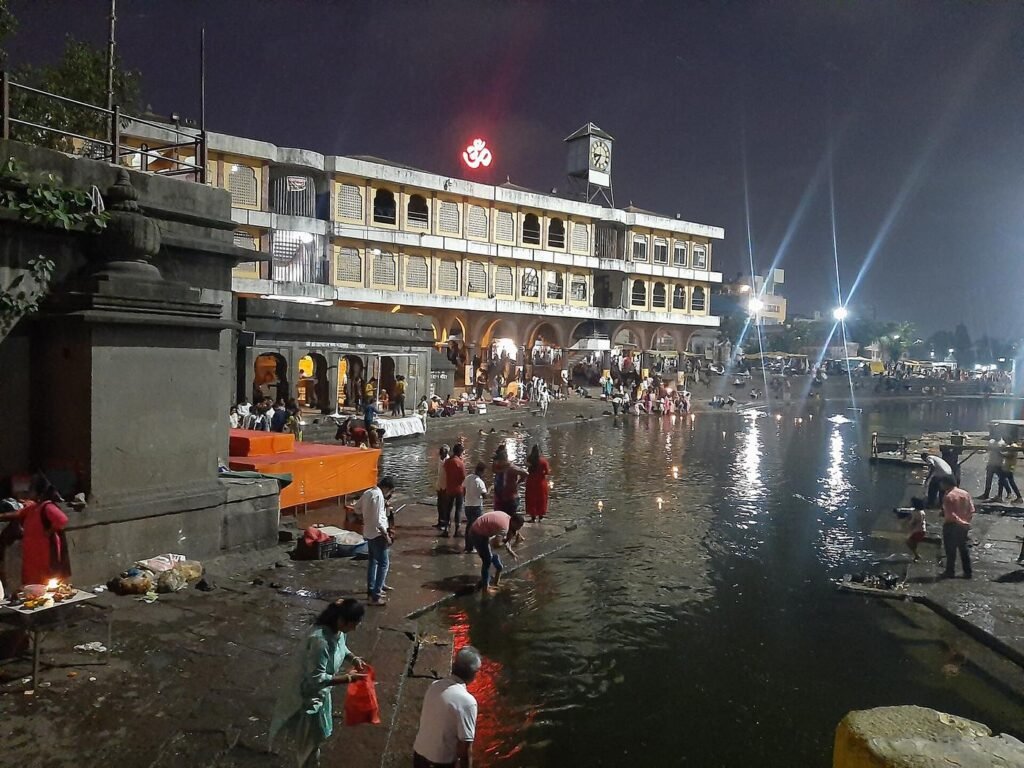 Photo: Dhondudagde, CC BY-SA 4.0, via Wikimedia Commons
Ramkund is a large sacred tank and group of ghats on the Godavari in Nashik city. Local tradition, as told by the Nashik district, links the place with Rama. Rites still take place here, including the immersion of ashes of the dead. So be quiet and respectful, and take photos only with great care.
Ramkund is not another name for every Godavari ghat in Nashik. On a big bathing day, entry points, the way you walk, bathing spots and crowd movement can all be controlled. Do not rely on a normal-day map. Being near the river does not mean you can reach a certain ghat.
Godavari ghats and Panchavati
Panchavati is a wider sacred part of the city. It has temples, lanes, river banks and many ghats. Its links with the Ramayana come from faith and cultural memory. They are not proof from archaeology.
NTKMA’s list of approved works includes work on Nashik ghats and the river works around them. Its plan also proposes new Dhwaja Stambhas (flag pillars) at Ramkund. A plan or an approval only means the work is meant to happen. It does not mean the work is finished, open to the public, or part of the final 2027 visitor plan.
Trimbakeshwar
Trimbakeshwar is a separate temple town. It is linked with one of the Jyotirlinga traditions and with the source of the Godavari. Rules for temple entry, darshan, footwear, queues and ritual services are separate from general Kumbh information. They can change.
Do not plan to go between a Nashik ghat and Trimbakeshwar on the same day using normal travel times. Road diversions and security checks can make the trip much longer.
Kushavart
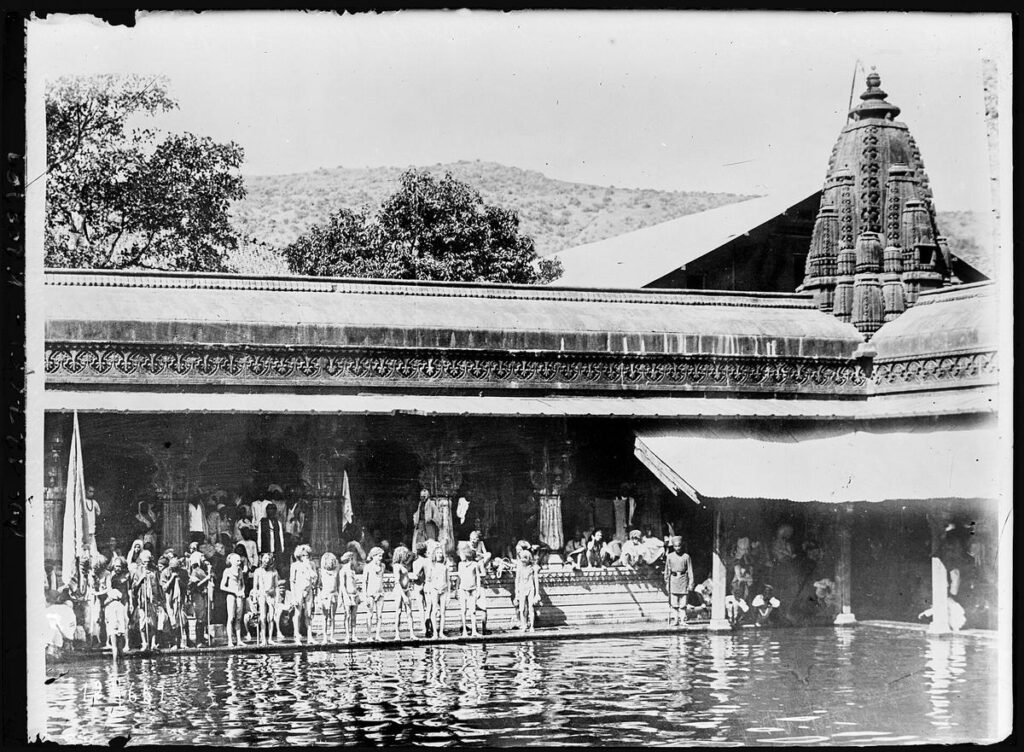 Kushavarta Kund at Trimbak, photograph by the Central News agency, 1928, Bibliothèque nationale de France. Public domain, via Wikimedia Commons
Kushavart is a sacred kund in Trimbakeshwar, near the temple. Local tradition, as told by the district, says the Godavari appears here again after Brahmagiri. The kund, the temple and the mountain are linked, but they are three different places. NTKMA’s plan names Kushavart as the Trimbakeshwar bathing site for 2027.
Like Ramkund, Kushavart is a living place of worship. Do not take photos that intrude on people. Keep paths clear. Follow what the temple and event staff tell you on the day.
Who bathed where in the past?
The Nashik district’s cultural account describes an old local pattern. Vaishnava Akharas (orders of sadhus) bathed in Nashik. Shaiva, Sannyasi and Udaseen groups bathed in Trimbakeshwar. This helps explain why one Kumbh has two centres.
This old pattern does not set the 2027 bathing plan. Do not pick a ghat for a procession, an Akhara or a date until NTKMA publishes its plan for 2027.
How do I choose where to go?
Pick the place that matches why you are going:
- Nashik and Ramkund: if your visit, or an NTKMA announcement, is about the Godavari ghats in the city or Panchavati.
- Trimbakeshwar and Kushavart: if your ritual, temple visit or an NTKMA announcement is about Trimbakeshwar.
- Not sure yet: wait for the final date and the bathing plan. Then compare travel and places to stay.
Check Nashik Kumbh dates before you fix a day. Use How to reach for travel to the region, and the first-time guide to get ready.
Ramkund or Kushavart?
| What | Ramkund | Kushavart |
|---|---|---|
| Where | Nashik city, among the Godavari ghats of Panchavati | Trimbakeshwar, a separate temple town, near the temple |
| What it is | A large sacred tank and group of ghats on the Godavari | A sacred kund where, by local tradition, the Godavari appears again after Brahmagiri |
| Local tradition | Links the place with Rama | Links the kund, the temple and Brahmagiri, three different places |
| In the 2027 plan | A bathing centre named by NTKMA | The Trimbakeshwar bathing site named by NTKMA |
| On a big bathing day | Entry points, walking routes and bathing spots can all be controlled | Temple entry, darshan, queues and ritual services follow their own rules |
Walking with children and older people
No source yet gives a final step-free route, wheelchair service, shuttle stop, walking distance or medical post for 2027. NTKMA’s plan proposes “Purple” corridors, which are easier routes for people with disabilities. It also proposes set ghats and dates for them. These are still plans, not a promise. So plan with care:
- Expect steps, wet or uneven ground and long walks.
- Carry an ID, but keep personal details out of sight.
- Do not block a ghat edge, a procession route or a place where rites are taking place.
- Wait for NTKMA’s mobility and access details before you decide a route suits someone.
- Use only the emergency contacts published for this Kumbh.
How to behave at the snan (holy bath)
The holy bath is an act of worship, not a show. Use only the entry points that are allowed, and give people space. Do not take photos of people bathing or at funeral rites without their consent. Never enter water or ghat areas that are closed off. Read the Kumbh snan guide before you go.
Faith in the holy river does not replace public health, water safety or crowd instructions.
What is still being planned?
NTKMA’s public lists of approvals and meetings show active work on ghats, water, roads, transport, health, safety and crowd control. Its plan names the two bathing centres. But these lists are not yet a final visitor map.
Some works are proposed, some are out to tender, and some are approved. None of these means the work is finished. We will call a work complete only when a later source says it is finished and open to the public.
Help with planning (optional)
Once you know your date and place, you can look at personal planning help on Tirth.com. This link takes you away from KumbhMela.info. Tirth.com is separate from NTKMA. It cannot guarantee ghat access, transport, rooms or any spiritual result.
Frequently asked questions
Is Ramkund in Trimbakeshwar?
No. Ramkund is in Nashik city. Kushavart is in Trimbakeshwar.
Are Ramkund and Kushavart connected?
Yes, through the Godavari and the shared Kumbh tradition. But they are two separate places.
Which ghat should I use in 2027?
Both places are bathing sites for 2027. But NTKMA has not yet said which groups bathe where on which day. Entry points and routes are not out yet either. Wait for NTKMA’s instructions.
Is the map on this page a route map?
No. Any drawing of these places on this page is not to scale and is not a route map. It only shows how the places relate. For directions, closures and emergencies, follow the event maps that NTKMA publishes.
Spotted a mistake?
If a place or access detail on this page is wrong, tell us through Contact and Corrections. Please say who published the correct information, and when.
Sources
7 sources · checked 19 Sep 2026
- Kumbh Mela Plan (First Edition): Nashik–Trimbakeshwar Simhastha Kumbh Mela 2027 · Nashik–Trimbakeshwar Kumbh Mela Authority, Office of the Divisional Commissioner, Nashik, Government of Maharashtra ·
- Culture and Heritage: Simhastha Kumbhamela · Nashik District, Government of Maharashtra ·
- Ramkund Nashik · Nashik District, Government of Maharashtra ·
- Kushavart Tirtha: Trimbakeshwar · Nashik District, Government of Maharashtra ·
- About Nashik–Trimbakeshwar Kumbh Mela Authority · Divisional Commissioner Office, Nashik, Government of Maharashtra ·
- Administrative Approvals: Nashik–Trimbakeshwar Simhastha Kumbh Mela · Divisional Commissioner Office, Nashik, Government of Maharashtra ·
- Meeting Proceedings: Nashik–Trimbakeshwar Kumbh Mela Authority · Divisional Commissioner Office, Nashik, Government of Maharashtra ·