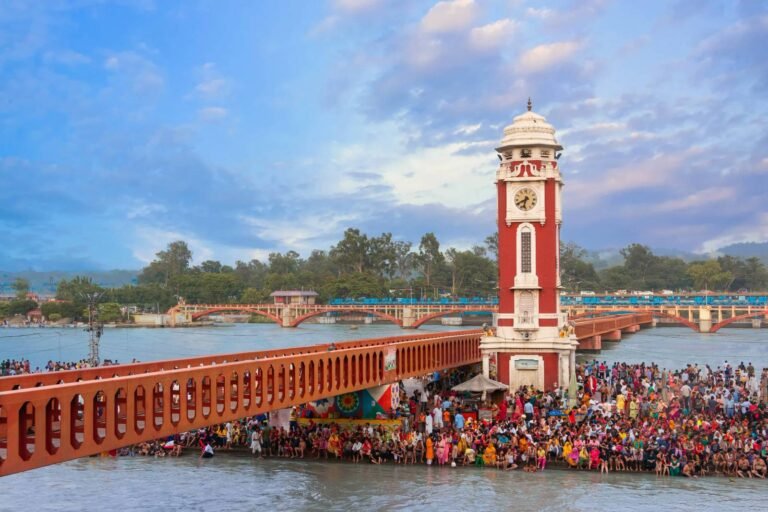
By tradition, the Kumbh is held at Haridwar when Jupiter (Brihaspati) is in Kumbha, the sign Aquarius, about once every twelve years, and its main bath falls when the Sun enters Mesha, the sign Aries. In 2027 that day is Mesh Sankranti, Wednesday 14 April, which the official Haridwar Kumbh website lists as the main (Pramukh) Amrit Snan.
The rule, as official sources give it
Haridwar’s district history page links the Kumbh with Brahmakund at Har Ki Pauri, where, it says, drops of amrit fell. It adds that when Jupiter comes into Aquarius, once in about twelve years, the Kumbh is celebrated at Haridwar.
The fullest version comes from the Nashik district’s account of all four Kumbh places. It quotes a Sanskrit verse for Haridwar, “Padmini Nayeke Meshe Kumbh Rashi Gate Guroh, Ganga Dvare bhaved Yogah Kumbh Nama Tathottamah”. Ganga Dvara is an old name for Haridwar. The page explains the verse this way: when Jupiter is in Aquarius, and the Sun and the Moon are in Aries and Sagittarius, the Kumbh is held at Haridwar.
Not every official summary words it the same way. The Garhwal division’s Kumbh page links Haridwar with the Sun in Aquarius, not with Jupiter. The new official Haridwar Kumbh 2027 website gives no formula at all. It says only that the timing of the Kumbh is traditionally connected with the movements of the Sun, the Moon and Jupiter.
| Source | What it says about Haridwar |
|---|---|
| Haridwar district, history page | Jupiter comes into Aquarius, about once in twelve years |
| Nashik district, culture page | Jupiter in Aquarius, the Sun in Aries and the Moon in Sagittarius, with a Sanskrit verse |
| Garhwal division, Kumbh page | The Sun in Aquarius |
| Official Haridwar Kumbh 2027 website | Timing tied to the Sun, the Moon and Jupiter; Mesha Sankranti, when the Sun enters Aries, is the principal Amrit Snan |
These are accounts of a religious tradition, so we give each one with its source rather than pick one as correct.
Why about twelve years, and not always twelve
The Jupiter part of the rule explains the length of the cycle. NASA says Jupiter takes about 12 Earth years, or 4,333 days, to go once round the Sun. Seen from the Earth, it moves through the twelve signs of the zodiac in that time, so it comes back to Aquarius about once in twelve years. The Nashik page makes the same point: because Jupiter takes almost twelve years to cross the zodiac, the Kumbh returns to each place after about twelve years.
But 4,333 days is a little less than twelve years. A date tied to Jupiter therefore cannot follow an exact twelve-year count. The official website’s list of Haridwar Kumbh years shows this: 1986, 1998, 2010 and 2021. The last gap is eleven years, not twelve.
Where the Sun comes in: Mesh Sankranti
Jupiter sets the year. The Sun’s part of the rule points to a day. Mesh Sankranti is the day the Sun moves into Mesha, the sign Aries, and the official Haridwar Kumbh website describes it as a principal Amrit Snan, observed when the Sun enters Aries. On its list for 2027, Mesha Sankranti on 14 April is the only day marked Pramukh, or main, Amrit Snan.
The same pattern held in 2021. The 14 April 2021 bath, on Mesh Sankranti and Baisakhi, was one of that Kumbh’s shahi snans, and Har Ki Pauri was kept for the akharas that day. The other end of the season is set by the Sun too: the official site describes Makar Sankranti, the first bathing day on 14 January 2027, as the day the Sun enters Capricorn.
What this means for 2027
The Jupiter rule describes the full Kumbh, such as 2010 and 2021. The 2027 mela comes six years after 2021, in the slot the Ardh Kumbh usually fills, and the official sources we read give no separate Jupiter rule for it. What 2027 does share with the tradition is the Sun’s part: its main bath is on Mesh Sankranti. Read whether Haridwar 2027 is an Ardh Kumbh or a Kumbh for the naming question.
Myth or fact?
Haridwar’s Kumbh comes exactly every twelve years.Tap to check
Haridwar 2027 is timed by Jupiter in Aquarius.Tap to check
The main Amrit Snan of 2027 is on Mesh Sankranti, 14 April.Tap to check
The sky sets the season, not the timetable. The official website, read on 16 October 2026, lists eleven bathing days from 14 January to 20 April 2027, with four Amrit Snans on 6 March, 8 March, 15 March and 14 April. The April 2026 announcement reported by PTI had named three Amrit Snans, so the list has changed once already. All the days are provisional.
Plan with the Haridwar dates page and the 14 April Amrit Snan guide, not with a date worked out from the stars. Our page on the Kumbh cycle compares the rule at all four places.
Plan your trip
Sources
10 sources · checked 16 Oct 2026
- History: Haridwar · District Haridwar, Government of Uttarakhand ·
- Culture and Heritage: Simhastha Kumbhamela, astrological aspect (Nashik district) · District Administration, Nashik, Government of Maharashtra ·
- Kumbh Mela · Office of the Commissioner, Garhwal Division, Government of Uttarakhand ·
- Significance of the Kumbh (Haridwar Kumbh 2027 official website) · Haridwar Kumbh Mela administration, Government of Uttarakhand ·
- Snan and Events: day descriptions in the 'View Details' panels (Haridwar Kumbh 2027 official website) · Haridwar Kumbh Mela administration, Government of Uttarakhand ·
- Snan and Events: Haridwar Kumbh 2027 (official website) · Haridwar Kumbh Mela administration, Government of Uttarakhand ·
- Jupiter: Facts · NASA Science ·
- About Kumbh (Haridwar Kumbh 2027 official website) · Haridwar Kumbh Mela administration, Government of Uttarakhand ·
- Dates announced for bathing festivals during Ardh Kumbh Mela in Haridwar · Press Trust of India (via The Week) ·
- Shahi snan in Haridwar: Lakhs ignore Covid-19 concerns to take holy dip · Press Trust of India (via Deccan Herald) ·
 Photo: DeeKayGangwar, CC BY-SA 4.0
 Photo: Subhankar Banerjee, CC BY-SA 4.0