
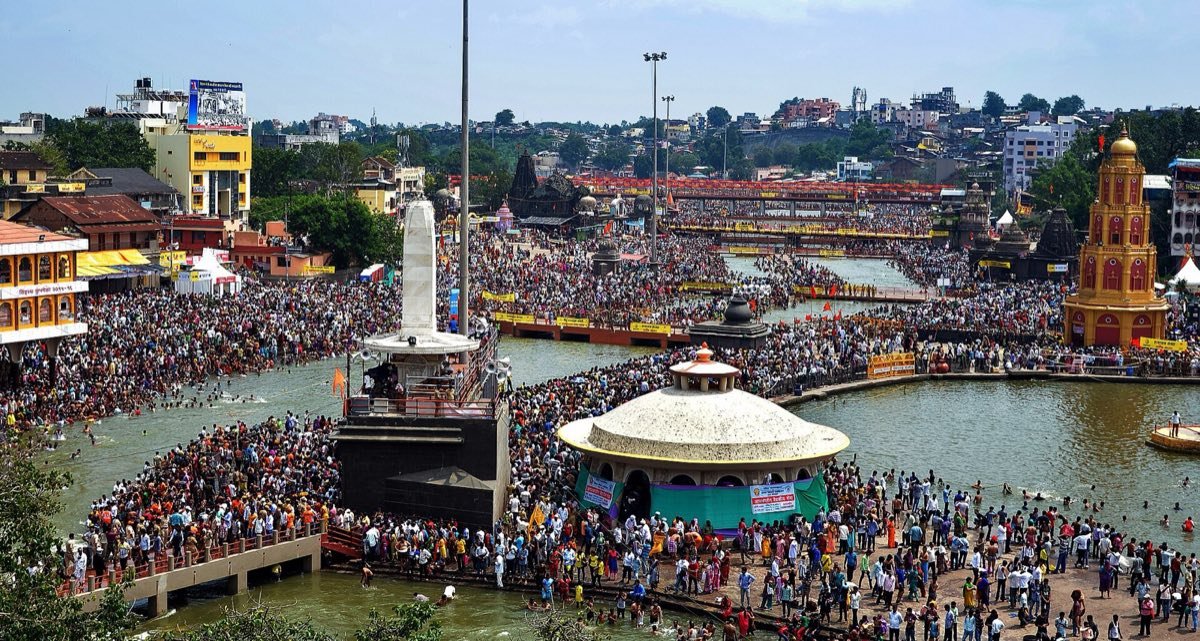
 A Kumbh bathing day at Ramkund, Nashik. Photo: Prashant Kharote, CC BY-SA 4.0, via Wikimedia Commons
Amrit Snan · Nashik 2027
First Amrit Snan पहला अमृत स्नान
Tithi: Ashadha Amavasya
Nashik–Trimbakeshwar Simhastha · Amrit Snan
Nashik Kumbh First Amrit Snan: Monday 2 August 2027
The first amrit snan of the Nashik–Trimbakeshwar Simhastha is on Monday 2 August 2027, at Ramkund in Nashik and Kushavarta in Trimbakeshwar.
The dates are in the Nashik–Trimbakeshwar Kumbh Mela Authority's plan of 15 June 2026, which the authority marks as interim and subject to change. Tithi: Ashadha Amavasya (amanta), from the Tirth panchang.
The day is the new moon that ends the month of Ashadha in Nashik's amanta calendar. It is the first of the three Amrit Snans of the Nashik–Trimbakeshwar Simhastha. It falls in the monsoon, so rain and river levels shape the day.
The day, hour by hour
- The evening before
Amavasya tithi begins.
- Before sunrise
29 Aug 2015: at Kushavarta, the Juna Akhara took the first royal bath at 4:15 am.1
In 2015 - Sunrise
Sunrise. The tithi at sunrise is Amavasya.
- Morning
2015: the Nirvani Akhara bathed first at Ramkund at 7:15 am, after a procession from Tapovan.1
In 2015 2015: the Digambar Akhara bathed from 8 am; the Nirmohi reached the ghats at 9:30 am.1
In 20152027 bathing times, the akhara order and public hours at Ramkund and Kushavarta are not yet published.2
Not announced yet- Midday
2015: other pilgrims bathed at Ramkund and Kushavarta after the saints, including the Naga sadhus.3
In 2015 - Afternoon
Amavasya tithi ends.
- Sunset
Sunset.
Times in grey type are from the Tirth panchang for the bathing place. Bathing times are set by the mela administration, not by the panchang.
Sources for these rows (5)
- Press Trust of India (via India TV): Kumbh Mela: Thousands take holy dip during first 'shahi snan' (2015)
- Nashik-Trimbakeshwar Kumbh Mela Authority, Office of the Divisional Commissioner, Nashik, Government of Maharashtra: Kumbh Mela Plan, Nashik-Trimbakeshwar Simhastha Kumbh Mela 2027 (first edition, interim): bathing-day timelines not yet set (2026)
- Deccan Herald (DHNS): Festivities mark Kumbh's first shahi snan (2015)
- Department of Tourism, Government of Maharashtra (official Threads account): Goda Aarti (official post) (2024)
- Lokmat (Lokmat News Network): गंगा आरतीच्या धर्तीवर गोदावरी आरती (A Godavari aarti on the lines of the Ganga aarti) (2019)
What Ashadha Amavasya means
The first Amrit Snan falls on the new moon that ends the month of Ashadha in the amanta calendar used in Maharashtra. In Maharashtra this new moon is kept as Deep Amavasya, also called divyanchi avas, the new moon of lamps: by tradition the household lamps are cleaned, worshipped and lit again, and the holy month of Shravan begins the next day. In 2027 the new moon falls on a Monday, so the state’s schedule calls it Ashadh Somvati Amavasya, and a Monday new moon is counted among the most powerful of the year.
The Simhastha itself is tied to Jupiter. A verse quoted by the Nashik district says the Kumbh comes to the Godavari when Jupiter is in Simha (Leo), which is why it is called the Simhastha.
What happens on the day
- Before the day: park, then walkThe Kumbh Mela Authority’s plan sets out outer and inner parking with shuttle buses to the inner areas, and walking is the only way from inner parking to the ghats, akharas and temples. The police traffic and parking notice for 2 August had not been published when we checked.
- Ramkund: the Vaishnava akharasThe Vaishnava akharas bathe here. At the first shahi snan of 2015, on 29 August 2015, the three Vaishnava akharas went in procession from the Laxminarayan temple in Tapovan to Ramkund and bathed one after another: Nirvani first, then Digambar, then Nirmohi.
- Kushavarta: the Shaiva and Udasin akharasThe Shaiva and Udasin akharas bathe here, about 30 km away, an arrangement the Nashik district traces to the Peshwas. In 2015 the Juna Akhara bathed first at Kushavarta, followed by the other Shaiva akharas.
- Then the pilgrimsPilgrims bathe at the ghats and kunds the police direct them to. The 2027 order and timings have not been announced. Amrit Snan days usually draw the most pilgrims; follow police and mela instructions on the day.
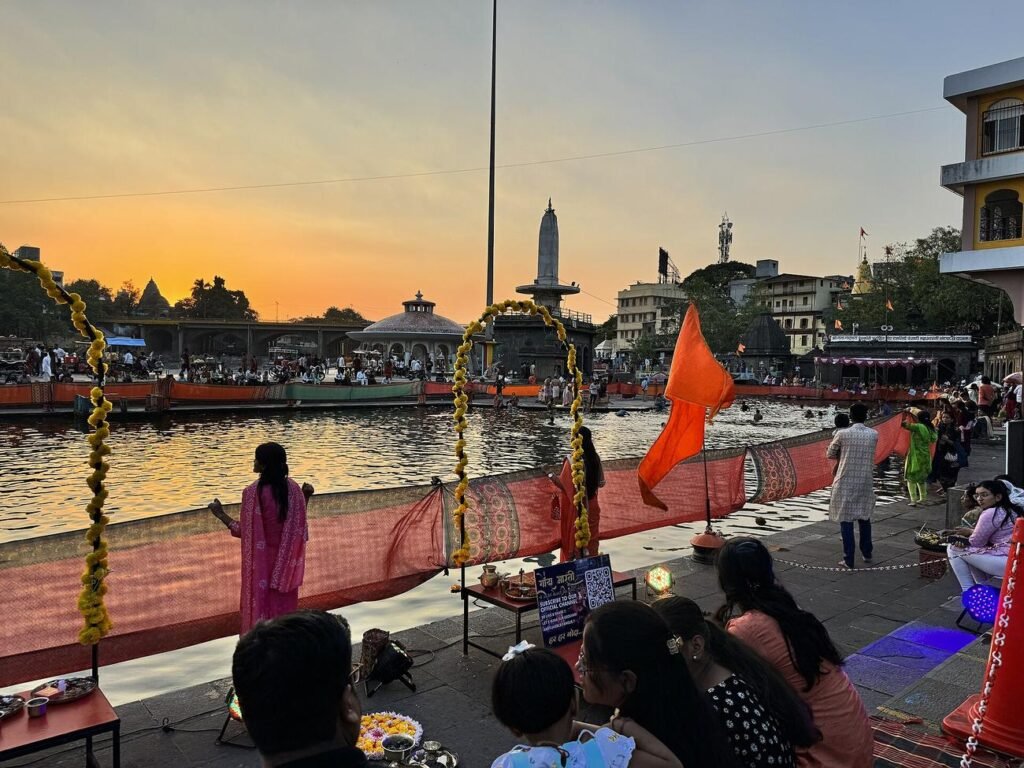 Photo: Rohit R Nashik, CC BY-SA 4.0, via Wikimedia Commons
The tithi and its end time are in the panchang below. Read more: Nashik Kumbh in the monsoon: what rain means for the Amrit Snans
Where the bathing happens
The Simhastha has two bathing centres, about 30 km apart: Ramkund in Nashik, where the Vaishnava akharas bathe, and Kushavarta in Trimbakeshwar, where the Shaiva and Udasin akharas bathe.
- 1RamkundGhat · Bathing place
- 2Kalaram TempleTemple
- 3Sita GufaTemple
- 4Kapaleshwar Mahadev TempleTemple
- 5Sundar Narayan TempleTemple
A guide to where places are, not a route plan. During the mela, roads and ghats open and close by the official plan; follow police and mela directions.
Map data © OpenStreetMap contributors (ODbL). Some temple locations from Wikidata (CC0). openstreetmap.org/copyright
- 1Trimbakeshwar TempleTemple
- 2Kushavarta KundGhat · Bathing place
- 3GangadwarTemple
- 4BrahmagiriHill
- 5AnjaneriTemple
- 6Trimbakeshwar bus depotBus
A guide to where places are, not a route plan. During the mela, roads and ghats open and close by the official plan; follow police and mela directions.
Map data © OpenStreetMap contributors (ODbL). Some temple locations from Wikidata (CC0). openstreetmap.org/copyright
The panchang, and a card to share
- Sunrise6:10 am
- Tithi at sunriseAmavasya until 3:34 pm
- From 3:34 pmPratipada until 11:51 am the next day
- Paksha and monthKrishna paksha, Ashadha (amanta) or Shravana (purnimanta)
- Observed asShravana Amavasya, Darsha Amavasya
- Sunset7:12 pm
Calculated by the Tirth panchang (PyJHora 4.8.7) · open the panchang · checked on Sun 18 Oct 2026
The panchang gives the day's timings by tradition; it does not set bathing times. The mela administration decides when each ghat opens and the order of the akhara processions. Follow its plan, the police and mela instructions on the day.
Send this date to family. The card shows the status, so nobody mistakes an expected date for an official one.
Questions people ask
Nashik Kumbh ka pehla Amrit Snan kab hai?
On Monday 2 August 2027, at Ramkund in Nashik and Kushavarta in Trimbakeshwar. The date is in the Kumbh Mela Authority’s plan of 15 June 2026.
How many Amrit Snans does the Nashik Kumbh have?
Three: 2 August, 31 August and 11 September 2027 in Nashik, with the third at Trimbakeshwar on 12 September.
Sources
8 sources · checked 18 Oct 2026
- Kumbh Mela Plan (First Edition): Nashik–Trimbakeshwar Simhastha Kumbh Mela 2027 · Nashik–Trimbakeshwar Kumbh Mela Authority, Office of the Divisional Commissioner, Nashik, Government of Maharashtra ·
- Ramkund Nashik · Nashik District, Government of Maharashtra ·
- Kushavart Tirtha: Trimbakeshwar · Nashik District, Government of Maharashtra ·
- Kumbh Mela Plan (First Edition), Nashik Trimbakeshwar Simhastha Kumbh Mela 2027: schedule, framework, chapters and financial outlays · Nashik-Trimbakeshwar Kumbh Mela Authority, Office of the Divisional Commissioner, Nashik, Government of Maharashtra ·
- Panchang for Nashik on the 2027 Amrit Snan days (Tirth panchang) · Tirth.com ·
- Kumbh Mela: Thousands take holy dip during first 'shahi snan' · Press Trust of India (via India TV) ·
- Culture and Heritage: Simhastha Kumbhamela, the Nashik-Trimbakeshwar Kumbh and its astrological aspect (Nashik district) · District Administration, Nashik, Government of Maharashtra ·
- Divisional Commissioner Office Nashik website: Nashik-Trimbakeshwar Kumbh Mela 2027 Authority menu and linked accounts · Divisional Commissioner Office, Nashik, Government of Maharashtra (hosted by National Informatics Centre) ·