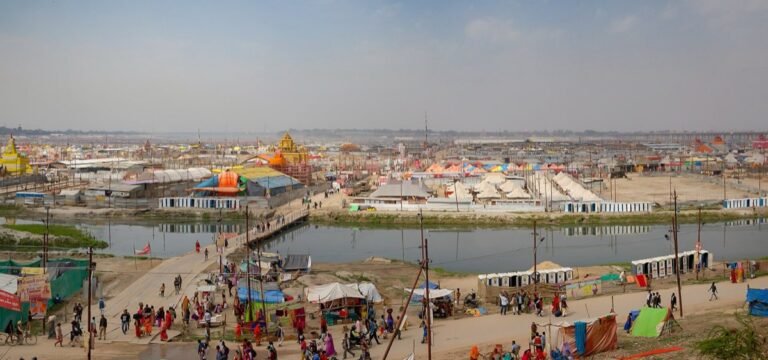
At the Kumbh, a kalpvasi is a householder who lives by the river for about a month under vows, a sadhu is anyone who has given up home and family for a religious life, and a Naga is an initiated ascetic of an akhara, mostly of the Shaiva akharas. In a crowd they can look alike, but their lives are very different.
Pilgrims, kalpvasis and their priests
Most people at a Kumbh are pilgrims who come to bathe and then go home. The Prayagraj Mela Authority describes the gathering as ascetics, saints, sadhus, sadhvis, kalpvasis and pilgrims from all walks of life, which is a good list to start from.
A kalpvasi stays longer and keeps vows. At Prayagraj, kalpvasis live for about a month in simple tents near the Sangam, usually from Paush Purnima to Magh Purnima. The mela authority’s list of their rules includes rising before sunrise, prayer at the three junctions of the day, satsang, one meal a day and sleeping on the ground, and it says a kalpvasi wears clean white or yellow clothes. Kalpvasis are householders: when the month ends they go back to family life. The official Haridwar Kumbh site also describes kalpvasis who spend the Kumbh period on the banks of the Ganga in a disciplined routine. Our guide to kalpvas explains the month in detail.
Many pilgrims also have a family priest at the tirth. At Prayagraj these are the Prayagwals, or tirth purohits, families who have lived in the city for generations. They settle pilgrims at their camps, perform the rituals for them and keep registers of each family’s visits. Each flies a banner on a tall bamboo pole so that pilgrims can find him on the mela ground.
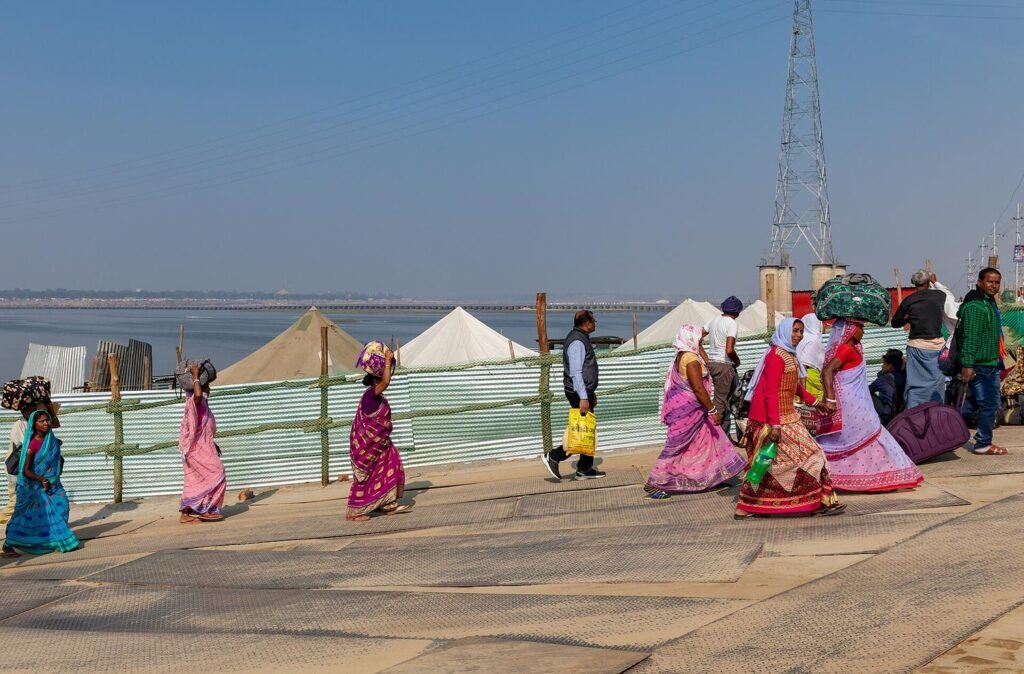 Photo: Ninara, CC BY 2.0, via Wikimedia Commons
Sadhu, sannyasi and vairagi
Sadhu is the widest word. Britannica describes a sadhu as a religious ascetic or holy person, a class that includes renunciants of many types. Sadhus generally take vows of poverty and celibacy and live on the charity of householders. Some live in monasteries (mathas) that belong to an order, some wander alone or in small groups, and some live in seclusion.
Each tradition has its own word. In Shaivism the usual term is sannyasi, and in Vaishnavism vairagi, often said bairagi. The name sannyasi is linked especially with the Dashanami order, which tradition traces to Shankara. The Udasin ascetics form a third group: the Prayagraj Mela Authority says the Udaseen akharas regard Chandra Dev, son of the first Sikh guru, as their founder. A woman ascetic is usually called a sadhvi, or a sannyasini if she has taken sannyas.
Not every sadhu belongs to an akhara. Research on Haridwar describes sanyasi, bairagi and Udasi orders alongside independent renouncers. The mela authority also describes the Dandi sannyasis, who carry a wooden staff called the Brahma Danda and whose organisation at the mela is called the Dandi Bada.
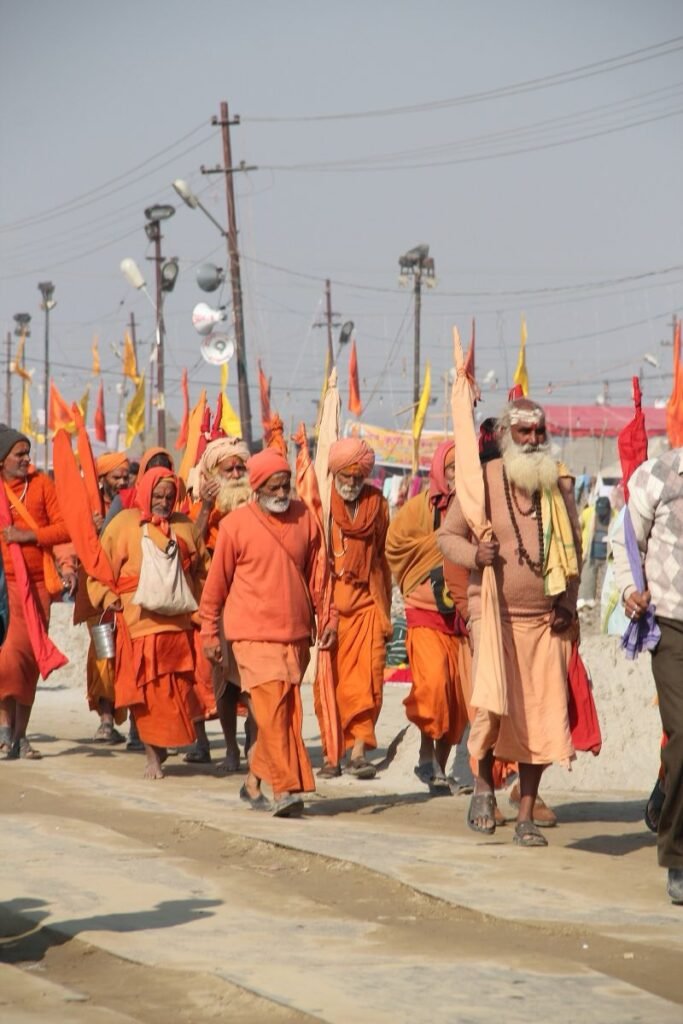 Photo: Seba Della y Sole Bossio from Cordoba, Argentina, CC BY 2.0, via Wikimedia Commons
Naga sannyasis
A Naga is a particular kind of sannyasi. The Prayagraj Mela Authority says every Naga is attached to an akhara, and Government of India material links them especially with the Shaiva akharas, where they carry traditional weapons such as spears and swords in processions. On Amrit Snan days Naga sannyasis are often at the front of their akhara. In 2025 some rode horses and others walked, with flowers in their matted hair and tridents held high, and some played the damru as they went to the river.
Like other sannyasis, a Naga is initiated by a guru within an akhara; the mela authority says only an akhara’s Mahamandaleshwars may give the guru-mantra to new saints. So you cannot tell a Naga from dress alone. Our page on Naga sadhus covers their history and customs.
Myth or fact?
Every sadhu at the Kumbh belongs to an akhara.Tap to check
A kalpvasi is a kind of sadhu.Tap to check
Every Naga is attached to an akhara.Tap to check
Mahant, Mahamandaleshwar and the akhara
An akhara is an organised order of ascetics, not a wrestling ground. The established list in government Kumbh material has 13, in Shaiva, Vaishnava, Udasin and Nirmal groups. The mela authority says Mahamandaleshwars lead the akharas, and that in the processions they ride on decorated chariots with the Shri Mahant, followed by the akhara’s secretaries, Naga sannyasis on horses and the other saints on foot. Titles and duties are not the same in every akhara. The Vaishnava akharas also share a camp at Prayagraj called Khak Chowk, which houses more than a hundred of their mahants and mandaleshwars.
| Who | Way of life | Where you usually see them |
|---|---|---|
| Pilgrim | Householder on a visit | At the ghats, often for a day or two |
| Kalpvasi | Householder keeping a month of vows | In tents near the river, at prayer and satsang |
| Prayagwal (tirth purohit) | Family priest at Prayagraj | At his camp, under his banner, with the family registers |
| Sadhu or sadhvi | Renunciant; the broad term | In camps and ashrams, and at the ghats |
| Sannyasi or vairagi | Renunciant of a Shaiva or a Vaishnava order | In the camp of the order |
| Naga sannyasi | Initiated ascetic of an akhara, mostly Shaiva | In akhara processions on Amrit Snan days |
| Mahant, Mahamandaleshwar | Office-holders of an akhara | At the head of the akhara and its processions |
Meeting them with respect
Everyone here is at a religious event, so treat a tent or camp as someone’s home and place of worship. Ask before you photograph a person, and take silence or a shake of the head as a no. Do not assume that everyone in saffron belongs to an akhara, and do not ask which akhara ranks highest. For the orders themselves, read Akharas of Kumbh Mela, and before you take pictures see our note on photographing ascetic traditions with respect.
Plan your trip
Sources
17 sources · checked 16 Oct 2026
- Introduction (Maha Kumbh 2025 official website) · Prayagraj Mela Authority ·
- The Beginning of Maha Kumbh 2025: A Grand Spiritual Spectacle · Press Information Bureau / Ministry of Culture, Government of India ·
- Rituals of Kumbh (Maha Kumbh 2025 official website) · Prayagraj Mela Authority, Government of Uttar Pradesh ·
- Rituals of Kumbh: Veeni Daan, Aarti and Dev Pujan (Maha Kumbh 2025 official website) · Prayagraj Mela Authority, Government of Uttar Pradesh ·
- Kalpavas (Maha Kumbh 2025 official website) · Prayagraj Mela Authority, Government of Uttar Pradesh ·
- Rituals of Kumbh (Haridwar Kumbh 2027 official website) · Haridwar Kumbh Mela administration, Government of Uttarakhand ·
- Spiritual Gurus: Prayagwal and Khak Chowk sections (Maha Kumbh 2025 official website) · Prayagraj Mela Authority, Government of Uttar Pradesh ·
- Sadhu and swami (Hindu ascetic) · Encyclopaedia Britannica ·
- Sannyasi (Hinduism) · Encyclopaedia Britannica ·
- Spiritual Gurus: Akharas section (Maha Kumbh 2025 official website) · Prayagraj Mela Authority, Government of Uttar Pradesh ·
- Women in Ochre Robes: Gendering Hindu Renunciation (publisher's description) · State University of New York Press (SUNY series in Hindu Studies); author Meena Khandelwal ·
- God's Gateway: Identity and Meaning in a Hindu Pilgrimage Place: Chapter 6, Ascetic Life · Oxford University Press ·
- Spiritual Gurus: Dandiwada and Acharya Bada sections (Maha Kumbh 2025 official website) · Prayagraj Mela Authority, Government of Uttar Pradesh ·
- Spiritual Powerhouses: Akharas at the Forefront of Maha Kumbh 2025 (PDF feature) · Press Information Bureau, Ministry of Culture, Government of India ·
- Around 3.5crore take holy dip, as Akharas perform their first 'Amrit Snan' at Maha Kumbh · United News of India (UNI) ·
- Maha Kumbh: Akhara Walk Tour · Uttar Pradesh State Tourism Development Corporation, Government of Uttar Pradesh ·
- Spiritual Gurus: Akharas · Prayagraj Mela Authority, Government of Uttar Pradesh ·
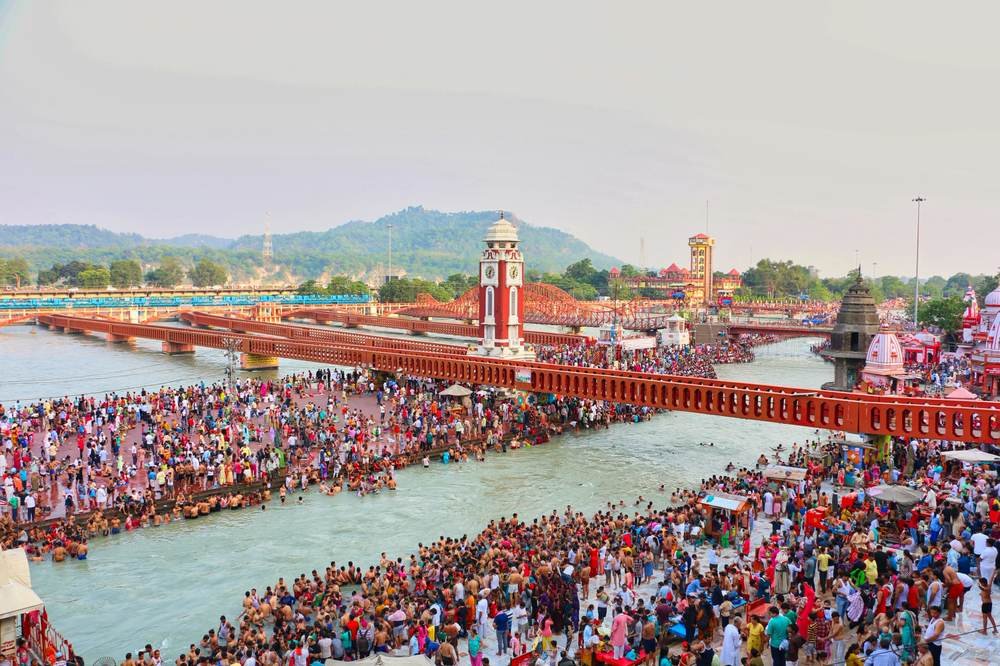 Photo: Tirth
 Photo: Rangan Datta Wiki, CC BY-SA 4.0