Kumbh Mela guide
Mythology and Origin of Kumbh Mela
According to a widely told Hindu tradition, Kumbh Mela is linked with the Samudra Manthan, the churning of the cosmic ocean. It is also linked with the struggle over a kalasha, a pot holding amrita, the nectar of immortality.
Later Kumbh retellings link the nectar with Prayagraj, Haridwar, Nashik–Trimbakeshwar and Ujjain. The broad story is widely known, but its details vary by text, by place and by oral tradition. It is sacred mythology. It is not a single archaeological account of how the festival began.
The story in brief
| Part of the story | Its role in a well-known telling |
|---|---|
| Devas and asuras | Rival powers who work together to churn the cosmic ocean in search of amrita. |
| Mount Mandara | The mountain used as the churning rod. |
| Vasuki | The serpent used as the churning rope. |
| Kurma | Vishnu’s tortoise form, which holds up the mountain. |
| Amrita | The nectar of immortality that appears after the churning. |
| Kalasha or kumbha | The pot that holds the nectar. In Kumbh tradition it is linked with the four sacred places. |
Old paintings in museum collections, including one at the Metropolitan Museum of Art, show how artists in different regions and periods pictured this story. They help us see the story’s place in culture. They are not photographs of a real event in history.
The story in six pictures
The churning of the ocean as the Puranas tell it, in old Indian paintings that are now in the public domain.
- 1

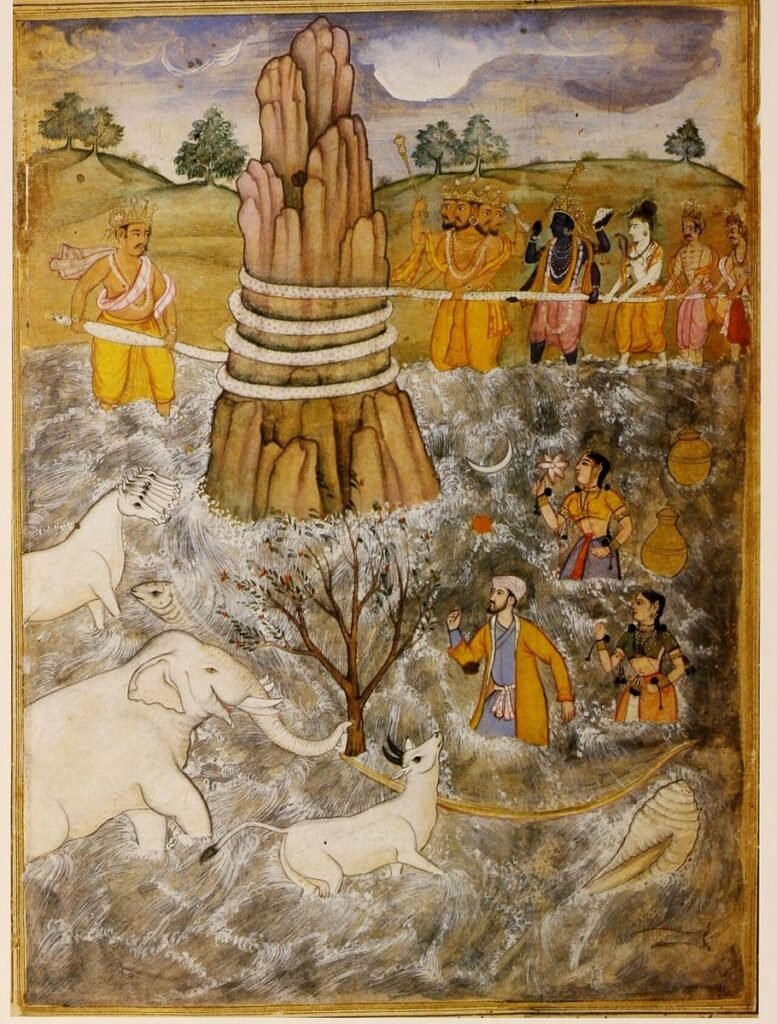
The churning of the ocean, Razmnama painting attributed to Fattu, about 1598, Free Library of Philadelphia. Public domain, via Wikimedia Commons Churning the ocean of milkAccording to the Vishnu Purana, the gods and the asuras agree to churn the ocean of milk for amrita, the nectar of immortality. Mount Mandara becomes the churning staff and the serpent Vasuki the rope. Vishnu, in the form of a tortoise, holds up the mountain as it turns.1,2
- 2
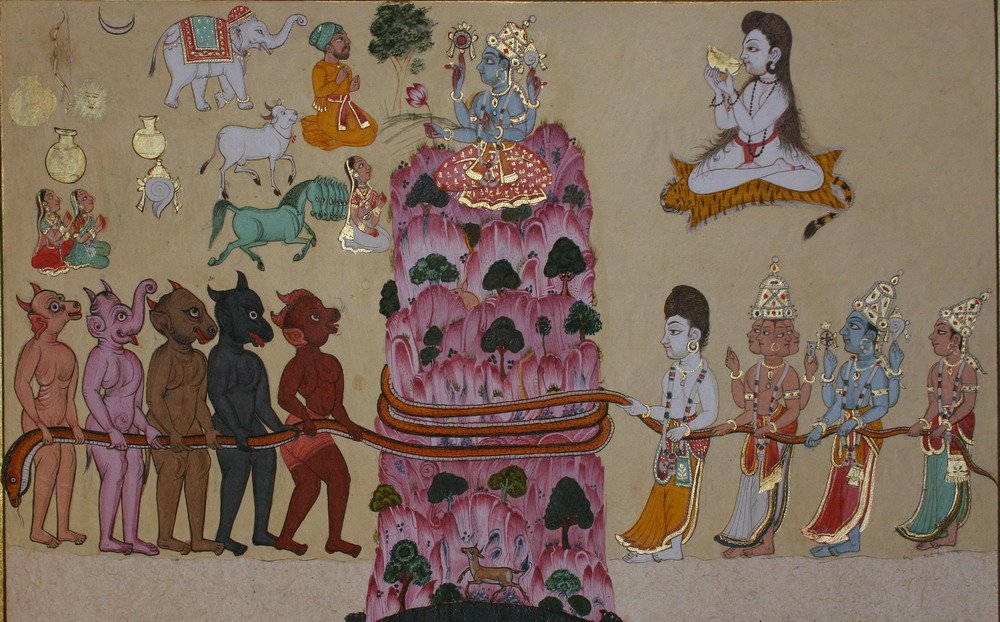
The churning of the ocean, folio from a Purana manuscript with Marathi text, Maharashtra, about 1800. Painting: unknown artist, public domain, via Wikimedia Commons Shiva drinks the poisonIn the story, the churning also brings up a deadly poison. The Bhagavata Purana calls it halahala and says it came first; the Mahabharata calls it Kalakuta. Shiva swallows it to protect creation and holds it in his throat, which is why, the Mahabharata says, he is called Nilakantha, the blue-throated.3,2,4
- 3
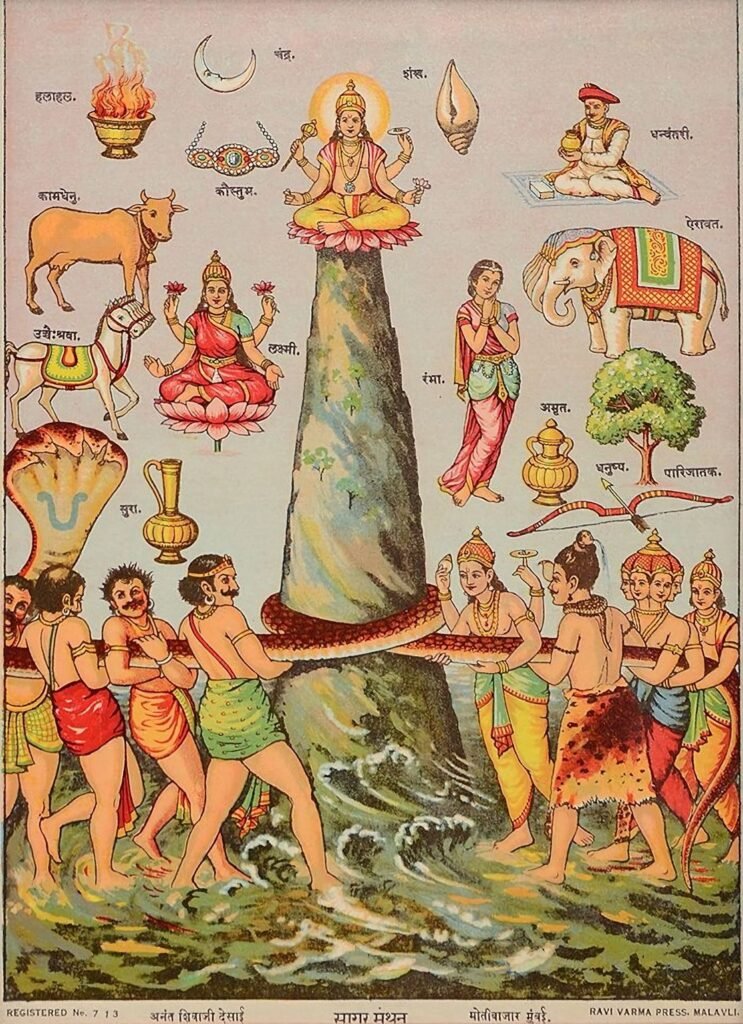
Sagar Manthan, undated chromolithograph published by Anant Shivaji Desai, Bombay, and printed at the Ravi Varma Press, Malavli. Print: unknown artist, Ravi Varma Press, public domain (PD-India), via Wikimedia Commons - 4
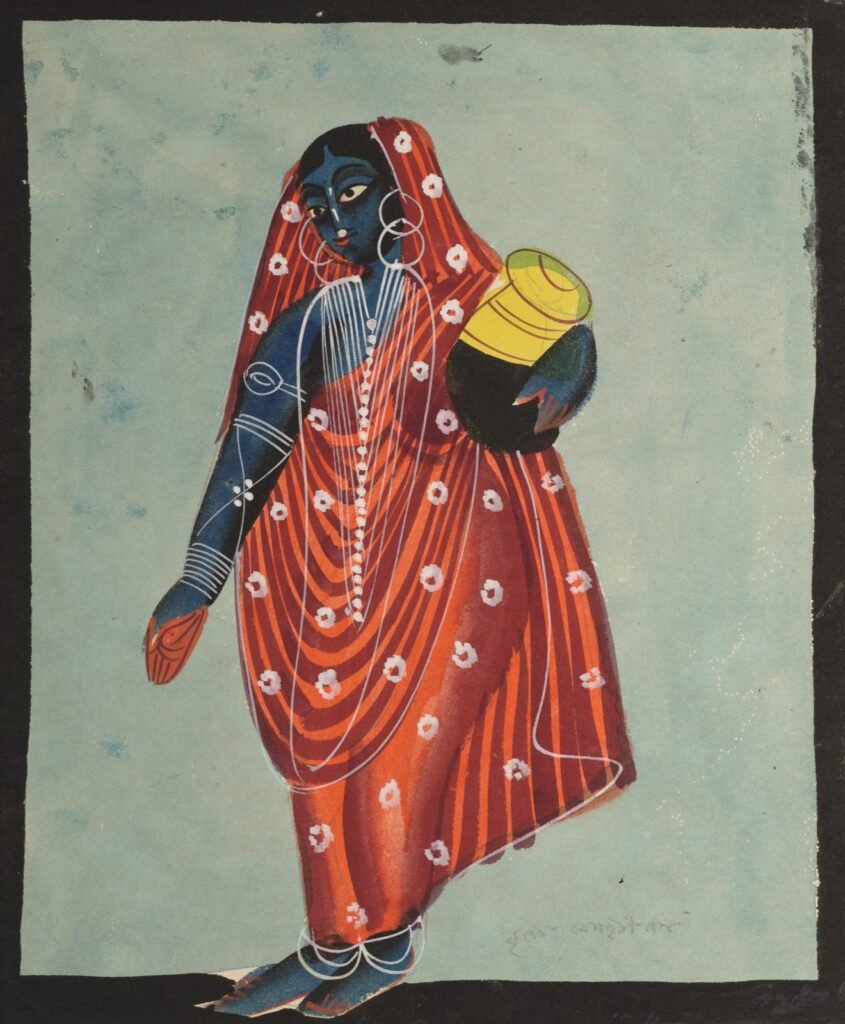
Vishnu in female form as Mohini carrying amrita for the gods, Kalighat painting, Kolkata, about 1890, Cleveland Museum of Art. Painting: unknown Kalighat artist, CC0, via Wikimedia Commons Mohini wins back the potThe struggle begins at once. According to the Vishnu Purana, the asuras seize the cup from Dhanvantari, but Vishnu takes a woman's form, enchants them and wins back the amrita for the gods. The Mahabharata tells the same turn, and later tellings call this enchantress Mohini.1,2,5,8,9
- 5
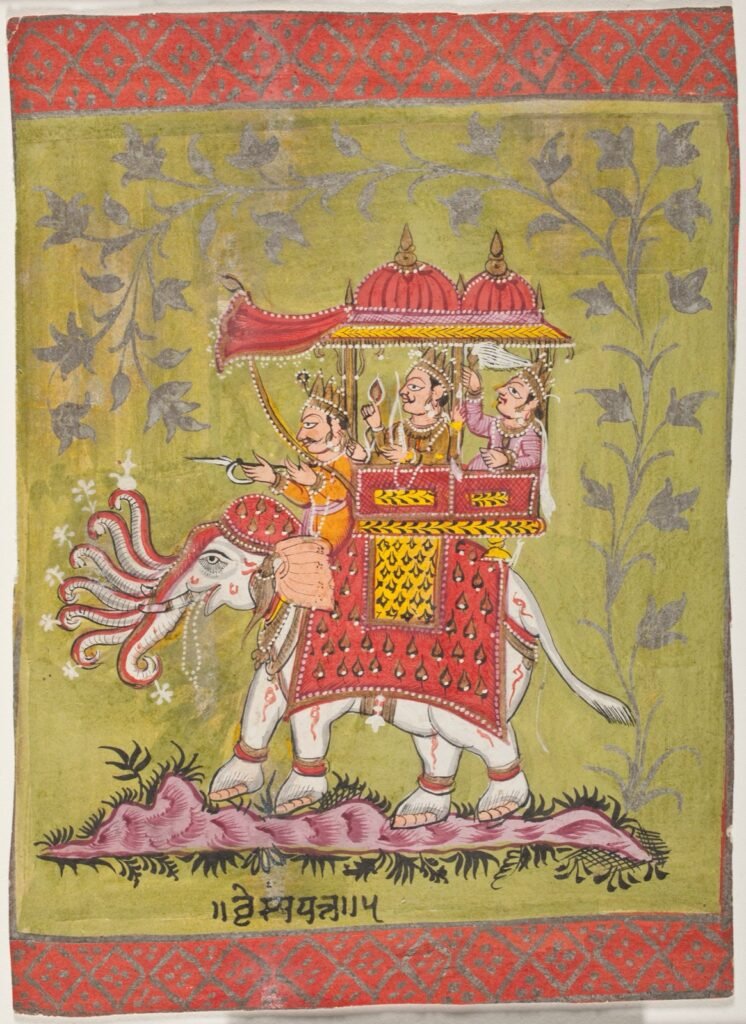
The planetary deity Brihaspati (Jupiter), western Rajasthan, about 1800, Los Angeles County Museum of Art. Painting: unknown artist, public domain, via Wikimedia Commons The pot's journey and the dropsKumbh tradition adds a journey. According to the Haridwar district's account, Brihaspati, Surya, Chandra and Shani ran with the pot to keep it from the asuras and set it down at four places during a twelve-day chase. Other Puranic tellings, it says, have the pot knocked in a fight, spilling nectar.10,11
- 6Four places on four rivers
In the telling on the Maha Kumbh 2025 website, drops of amrita fell at four places, and the twelve divine days of the chase equal twelve human years. The Kumbh is held at Haridwar on the Ganga, Nashik-Trimbakeshwar on the Godavari, Prayagraj at the Sangam and Ujjain on the Shipra.8,12,13
The story as the Puranas tell it. The paintings are old Indian works in the public domain; none is a photograph, and none was made with AI.
Sources for the story (13)
- John Murray, London (Internet Archive scan, Digital Library of India): The Vishnu Purana, translated by H. H. Wilson (1840), Book I, chapter 9: the churning of the ocean (pp. 75 to 77) (1840)
- Project Gutenberg text held on the Internet Archive: The Mahabharata, translated by Kisari Mohan Ganguli: Adi Parva, Astika Parva, Sections XVIII and XIX
- Bhaktivedanta Book Trust (Vedabase): Srimad-Bhagavatam, Canto 8, Chapter 7: Lord Siva Saves the Universe by Drinking Poison (verses 18 and 43)
- Wikimedia Commons: Samudramanthana, the Churning of the Ocean of Milk, Maharashtra, circa 1800 (Wikimedia Commons file page)
- Bhaktivedanta Book Trust (Vedabase): Srimad-Bhagavatam, Canto 8, Chapter 8: The Churning of the Milk Ocean (chapter summary)
- Wikimedia Commons: Sagar Manthan, Ravi Varma Press print (Wikimedia Commons file page)
- Wellcome Collection: A royal sage tells the father of the fishergirl of their marriage. Chromolithograph by R. Varma, 1907 (Wellcome Collection) (1907)
- Prayagraj Mela Authority, Government of Uttar Pradesh: Pauranic Significance (Maha Kumbh 2025 website)
- Cleveland Museum of Art (Open Access API): Vishnu in Female Form of Mohini Carrying Amrita for the Gods (object 2003.122)
- District Administration, Haridwar: About Kumbh (District Haridwar, Government of Uttarakhand)
- Wikimedia Commons (image and data from the Los Angeles County Museum of Art): The Planetary Deity Brihaspati (Jupiter), LACMA M.79.191.8 (Wikimedia Commons file page)
- UNESCO Intangible Cultural Heritage: Kumbh Mela: element on the Representative List of the Intangible Cultural Heritage of Humanity
- Press Information Bureau (Ministry of Information and Broadcasting), Government of India: Mahakumbh 2025: A Spectacle of Faith, Unity, and Tradition (2025)
Going to the Kumbh? Tirth.com can plan it for you. We are taking bookings for the Kumbh, with packages, our own people on the ground and help from your first call to the bath. Leave your number and our yatra team will call you back.
- Stay and travel planned around your bathing day
- Our own people on the ground at the mela
- No payment to enquire
Calls between 10:30 am and 7:30 pm IST, usually the same working day.
From Tirth.com, which runs this guide · How this works
Samudra Manthan: the churning of the ocean
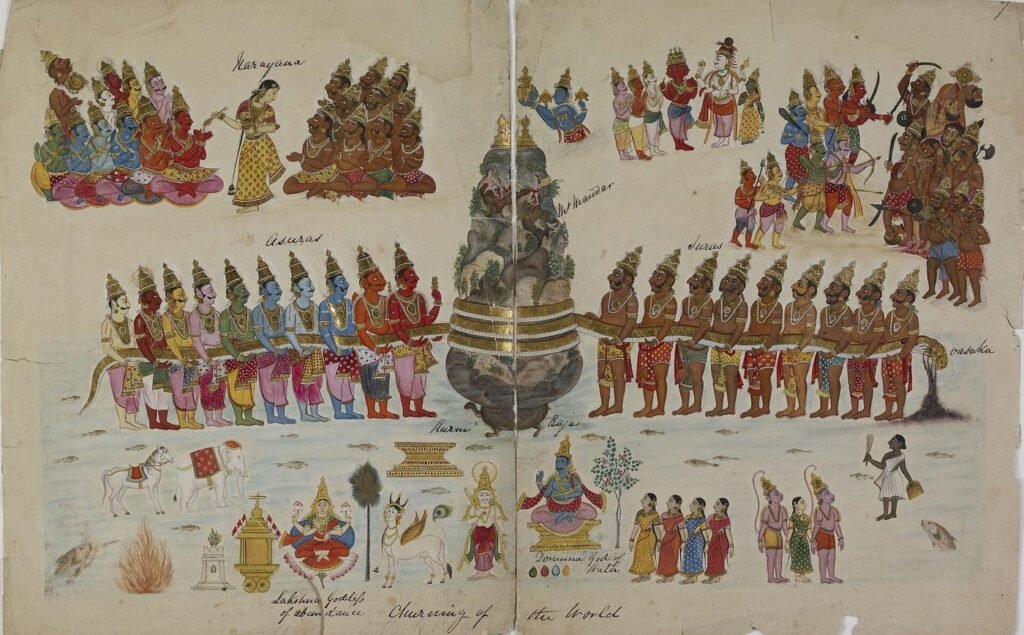
Samudra Manthan, the churning of the ocean, South Indian painting, about 1820, British Museum. Public domain, via Wikimedia CommonsThe story begins with the devas and asuras looking for amrita. Neither side can get it alone, so they agree to churn the great ocean together. Mount Mandara becomes the churning rod. Vasuki is wound around it as a rope, and the two sides pull in turn. When the mountain needs support, Vishnu takes the form of Kurma, the tortoise, and holds it up from below.
In different tellings, the churning brings up many beings and treasures. It also brings danger: a deadly poison rises before the nectar. The wider story includes divine help, endurance and rivalry. It also shows how hard it is to separate what harms from what sustains life.
At last, amrita appears in a pot. A struggle follows, because in the story the nectar means freedom from death. Retellings differ on who holds, guards or carries the kalasha. They also differ on how control of the amrita passes from hand to hand.
How is the amrita pot linked to the four Kumbh places?
In the Kumbh tradition known today, the pot that both sides fought over becomes linked with four sacred places:
- Prayagraj, at the Sangam of the Ganga and Yamuna, and in tradition the unseen Saraswati.
- Haridwar, on the Ganga.
- Nashik–Trimbakeshwar, on the Godavari.
- Ujjain, on the Shipra, also written Kshipra.
A common retelling says drops of amrita fell at these places while the pot was being carried or guarded. Government culture pages for Nashik, Haridwar and Prayagraj all give forms of this four-place tradition. The details are not the same. That is why careful writers say “according to tradition”, and do not call one version the only true one.
See the places and rivers together in why Kumbh is held at four locations, or open the all-locations hub.
The four Kumbh places and their rivers. Nashik and Trimbakeshwar are the two centres of one Simhastha, about 30 km apart.
Rivers and coast, simplified. Not a political map: no borders are shown. Natural Earth (public domain) and OpenStreetMap contributors. openstreetmap.org/copyright
Why are there different versions of the story?
The churning of the ocean of milk, painting from Mandi, Punjab Hills, about 1780 to 1790, Metropolitan Museum of Art. CC0, via Wikimedia CommonsMyths live on through recitation, worship, commentary, art, local memory and family teaching. A different version does not mean that one community got the story wrong. It can show what a place, or a line of teachers, chooses to stress.
Versions differ on:
- who carries or guards the kalasha;
- whether drops spill during a chase, the pot is set down, or a place becomes linked in some other way;
- how long the struggle lasts, and how “divine days” relate to human time;
- which gods or treasures get the most attention;
- the exact local ghat or sacred spot linked with the nectar;
- whether the telling focuses on cosmic balance, moral judgement, pilgrimage or ritual bathing.
The broad Kumbh link is shared, but a local account belongs to its own place. For example, a Haridwar belief about Brahma Kund should be told as Haridwar tradition. It should not be applied to all four cities.
What can the story mean?
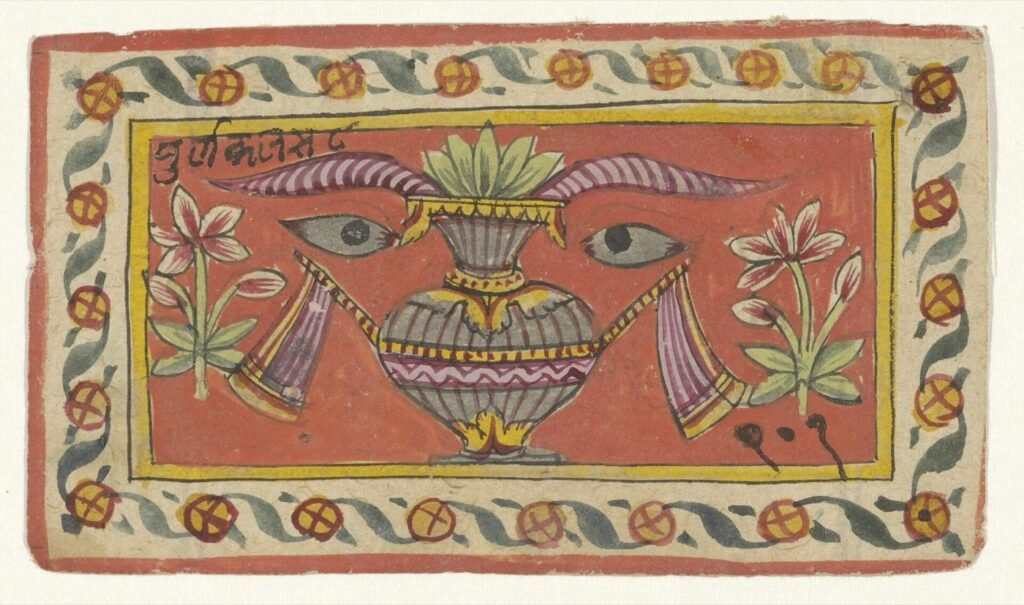
A kalasha symbol, Indian miniature drawing, about 1890 to 1910, Rijksmuseum. CC0, via Wikimedia CommonsThe Samudra Manthan is first of all a sacred story. It has also inspired many symbolic readings. These are interpretations. They are not one teaching that everyone must accept.
Working together despite conflict
The devas and asuras must work together even though their aims clash. This can stand for the hard work it takes to gain something precious. It can also stand for the tension that stays when power is shared.
Discipline before reward
The churning is long and hard. It can be read as a picture of steady discipline. Real insight or change can need patience, not one quick act.
Poison and nectar
Danger comes up along with treasure. Some readers see this as a reminder to judge wisely when a hard process brings both good and harm.
The pot as a sacred vessel
The kalasha is an important ritual object across Hindu practice. In the Kumbh story, it can stand for the power to hold life, plenty, knowledge or divine blessing. The word kumbha, meaning pot, helps explain the festival’s name. But word origins alone cannot give an exact date in history for when the festival began.
Pilgrimage as an inner and outer journey
For a pilgrim, travelling to a sacred river can be both a journey of the body and a disciplined inner practice. This is a spiritual reading. It is not a result that any website or event can promise.
Sacred bathing and the nectar tradition
Photo: The open draft, CC BY-SA 4.0, via Wikimedia CommonsMany devotees believe that the rivers at Kumbh carry special spiritual meaning at the holy time. Ritual bathing can be understood as cleansing, renewal, remembrance or a step on one’s religious path. UNESCO’s heritage record names bathing in a sacred river as a central practice. It also notes the knowledge carried by akharas, ashrams, teachers and communities.
Faith in sacred water must not be turned into a claim about health or water quality. You can honour a river’s holiness and still follow current public health advice, drink safe water and obey event safety rules. The Kumbh snan guide covers ritual respect and practical safety together.
Mythology and history are different questions
Mythology carries sacred meaning, memory and identity. History asks when names, institutions, records and practices can be shown from evidence. You do not have to insult mythology to write careful history. And you do not have to treat a sacred story as archaeology to respect it.
The four-place amrita tradition is central to how many people understand Kumbh. Historical research, especially on Prayagraj, also shows that the modern organised mela has changed. Government, bargaining over public space, print, transport and politics all shaped it. The history of Kumbh Mela explains that evidence separately.
Keeping the two apart avoids two common mistakes:
- claiming that the myth proves every feature of today’s event has existed unchanged since ancient times;
- assuming that change over history makes the religious tradition unimportant.
Kumbh can be both an old sacred tradition and a living institution whose public form keeps changing.
The sacred rivers of the four places
A drawing of the four rivers, not a map: not to scale and not in their real positions.
The story gains local meaning through four different river landscapes.
| Place | Sacred water | Traditional link |
|---|---|---|
| Prayagraj | Ganga–Yamuna Sangam; Saraswati in tradition | Local tradition honours the confluence as Tirtharaj, king of sacred places. |
| Haridwar | Ganga | Har Ki Pauri and Brahma Kund stand out in the local amrita account. |
| Nashik–Trimbakeshwar | Godavari | The Kumbh’s sacred sites span Nashik and Trimbakeshwar. |
| Ujjain | Shipra/Kshipra | Simhastha joins the river, the city and astrological tradition. |
This table explains religious links. It does not tell you how to get into the event today. For the places themselves, use the guide for each place. For any schedule or arrangement, use a dated announcement from the authority.
Frequently asked questions
Is the Samudra Manthan story the historical origin of Kumbh Mela?
It is the central mythological origin story linked with Kumbh. It explains sacred meaning and the link between the four places. A historical claim about the founding needs other kinds of evidence, and the modern institution developed over time.
Did amrita really fall at four places?
Many Hindu traditions say that the four Kumbh places are linked with drops of amrita. This is a matter of sacred tradition and belief. KumbhMela.info does not present it as proven by archaeology.
Are all versions of the story the same?
No. The main parts are widely known. But who carries the pot, its route, how the drops fall, which gods take part and the local links all vary.
What does “Kumbh” mean?
Kumbh, or kumbha, means a pot, pitcher or vessel. In the festival tradition, it recalls the kalasha that held amrita.
Does bathing at Kumbh guarantee moksha?
Many devotees believe that sacred bathing brings purity and spiritual freedom. This is a belief of faith. It is not a promised spiritual or medical result.
Can you see the Saraswati at Prayagraj?
You can see the Ganga and Yamuna meet at the Sangam. Local religious tradition understands the Saraswati as an unseen or underground river. So describe it as tradition, not as a stream you can see.
Found a mistake?
We last reviewed this page on 14 July 2026. It gives lasting background. Statements about myth and devotion are marked as tradition or belief.
If a regional tradition is shown wrongly, send the source and the place through Contact and Corrections.
Where next
Photo: TirthProvisionalहरिद्वार कुंभ 2027Haridwar Kumbh 2027Thu 14 Jan to Tue 20 Apr 2027Open the guide
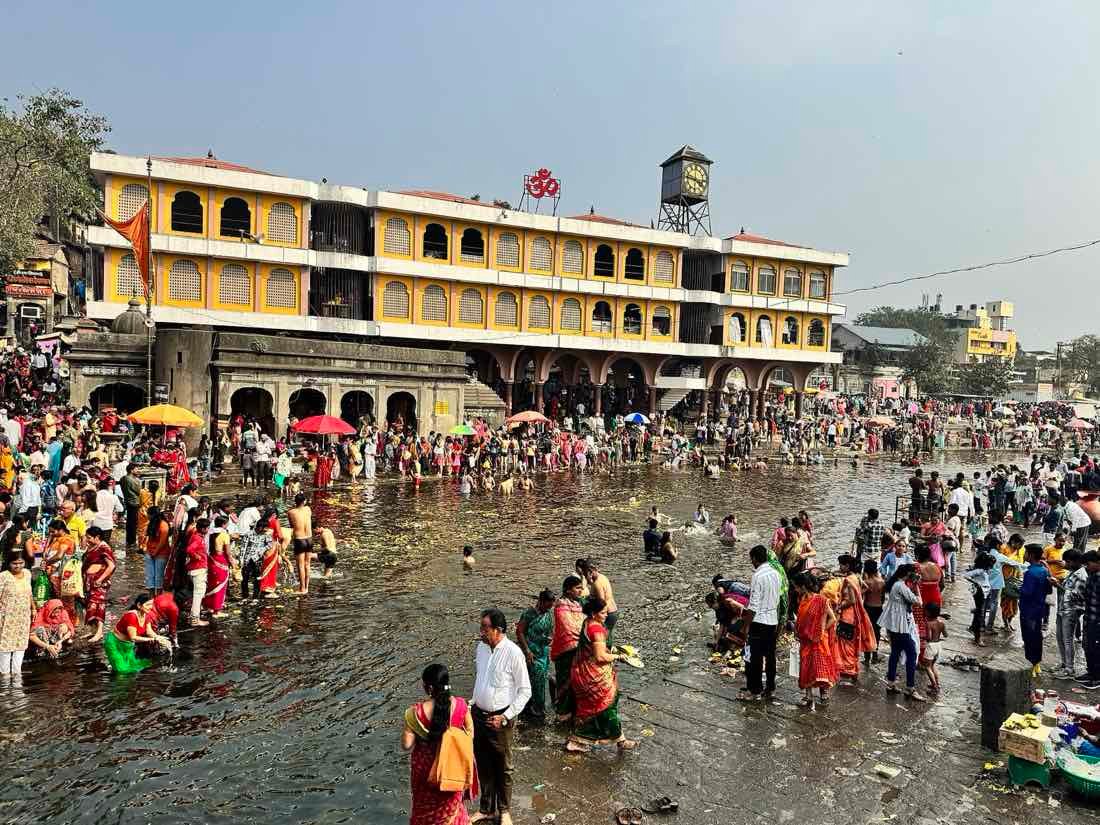
Photo: Rohit R Nashik, CC BY-SA 4.0Officialनासिक कुंभ 2027Nashik–Trimbakeshwar SimhasthaMain bathing Aug to Sep 2027Open the guide
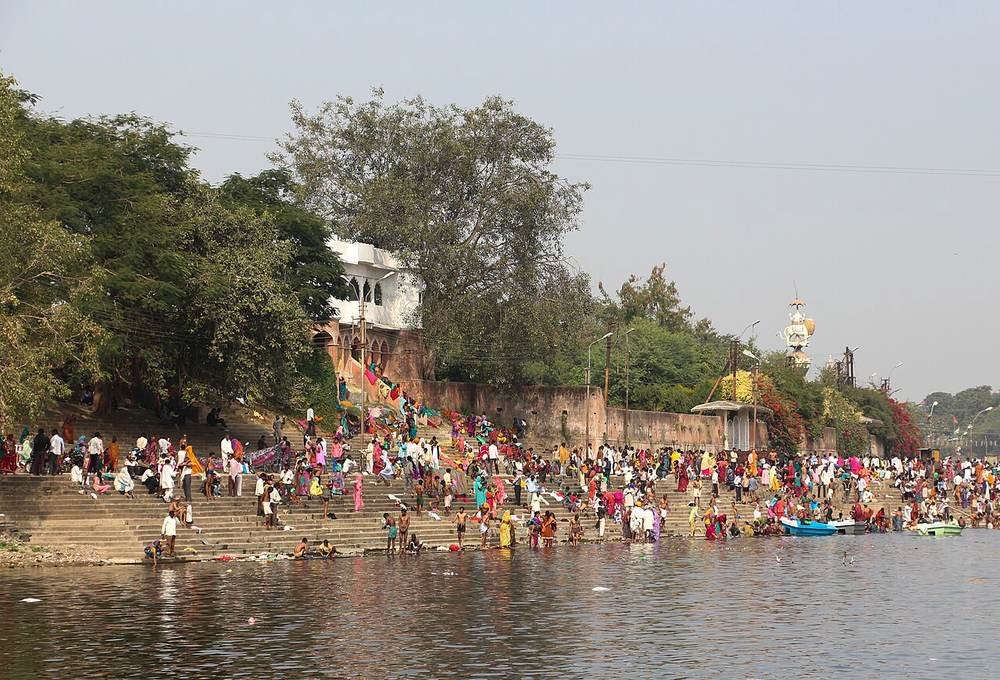
Photo: Bernard Gagnon, CC BY-SA 3.0Expectedउज्जैन सिंहस्थ 2028Ujjain Simhastha 202827 Mar to 27 May 2028Open the guide
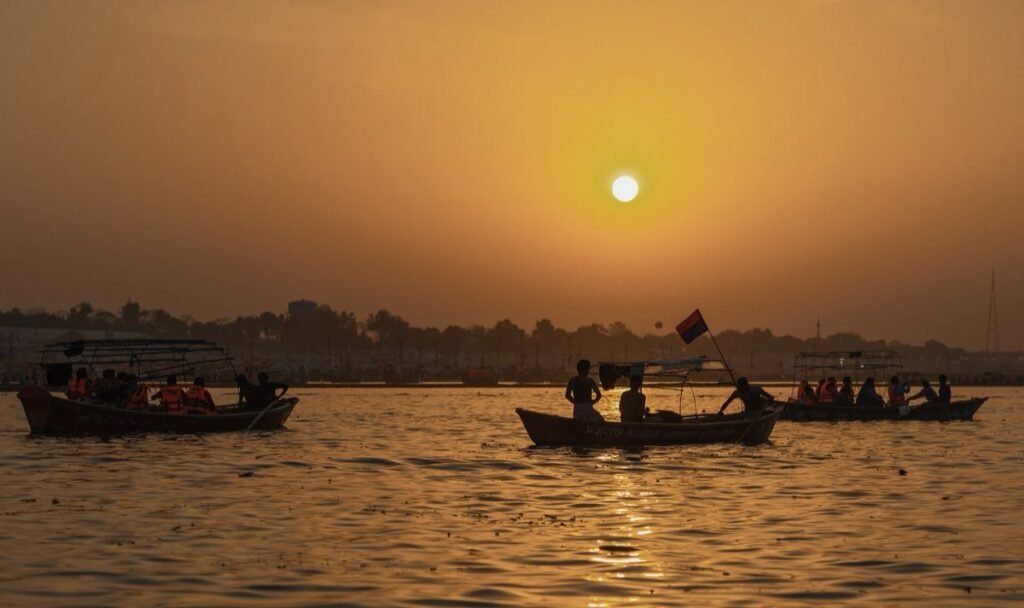
Photo: Ninara, CC BY 2.0Expectedप्रयागराज माघ मेला 2027Prayagraj Magh Mela 2027Magh Mela, 15 Jan to 6 Mar 2027Open the guideSources
7 sources · checked 14 Jul 2026
- The Churning of the Ocean of Milk: India (Punjab Hill, Mandi), ca. 1780–90 · The Metropolitan Museum of Art ·
- Culture and Heritage: Simhastha Kumbhamela · Nashik District, Government of Maharashtra ·
- About Kumbh · Haridwar District, Government of Uttarakhand ·
- Kumbh Mela and Sangam · District Prayagraj, Government of Uttar Pradesh ·
- Kumbh Mela: Representative List of the Intangible Cultural Heritage of Humanity · UNESCO Intangible Cultural Heritage ·
- Making the Colonial State Work for You: The Modern Beginnings of the Ancient Kumbh Mela in Allahabad · The Journal of Asian Studies / Cambridge University Press ·
- Pilgrimage and Power: The Kumbh Mela in Allahabad, 1765–1954 · Oxford University Press ·