
The oldest records we could find that name a twelve-yearly Kumbh are Persian works of the Mughal period: the Khulasat-ut-Tawarikh, written in the late 1690s in Aurangzeb’s reign, describes a great gathering at Hardwar whenever Jupiter enters Aquarius. British officers and district gazetteers later described the fairs at Hardwar, Nasik and Allahabad in detail. Historians accept these records but read them differently, above all on how old the Kumbh at Prayagraj is.
Mughal-era writers: Hardwar’s twelfth-year fair
The Khulasat-ut-Tawarikh was written by Sujan Rai of Batala, in the Punjab, some time between 1695 and 1699, according to the historian Jadunath Sarkar, who translated its account of the provinces in 1901. Of Hardwar it says that people gather every year on Baisakhi, when the Sun enters Aries, and above all in the year when Jupiter enters Aquarius, “otherwise named Kumbh”, once every twelve years, when vast numbers come from remote distances. They bathe, give alms and shave the hair and beard there as acts of merit.
The same work records a gathering on the Godavari, which rises near Trimbak: when Jupiter enters Leo, people come from far away and form a large gathering, famous in all parts of the kingdom. Jupiter in Leo is still the rule of the Simhastha at Nashik and Trimbakeshwar. Of Allahabad it says that Hindu books call the place Prayag and Tribeni, that Akbar built a stone fort between the rivers and named the city Illahabas, and that Shah Jahan gave it the name Allahabad. In Sarkar’s translation the Allahabad passage mentions no twelve-year fair.
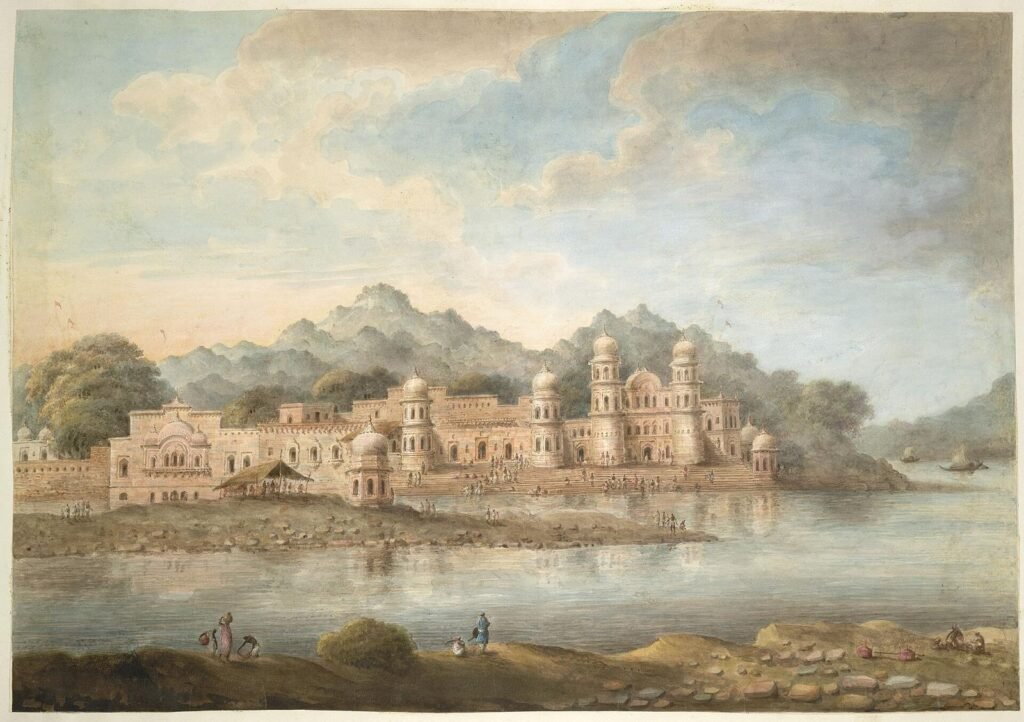 The ghats at Haridwar, watercolour by Seeta Ram, 1814. Public domain, via Wikimedia Commons
A later Persian work, the Chahar Gulshan of 1759, lists the “Mela at Hardwar in Baisakh” and says its largest gathering, in the year Jupiter enters Aquarius, is called the Kumbh mela, drawing lakhs of lay pilgrims, faqirs and sannyasis.
Go deeperSarkar’s inference about Akbar’s time1 min read
Sarkar noted that Akbar’s great survey, the Ain-i-Akbari, says nothing about Hardwar, though he assumed its Kumbh must have been as famous in Akbar’s time. That is his inference, not a record.
Early British accounts
In April 1796 Captain Thomas Hardwicke, an East India Company officer, reached Hurdwar on a journey into Garhwal and published his account in the journal Asiatic Researches. He described the mela as a yearly gathering of Hindus to bathe when the Sun enters Aries, and wrote that every twelfth year, when Jupiter is in Aquarius at that time, the number of people grows greatly. The year 1796 was one of them. He also noted the trade, with people from Kabul, Kashmir, Lahore, Bhutan and the hills.
At Allahabad, Akbar’s fort of 1583 stands beside the Sangam. The city passed to the British in 1801 and the army used the fort, according to the Prayagraj district, and Maclean’s study describes the East India Company establishing itself in north Indian pilgrimage cities while profiting from pilgrim taxes.
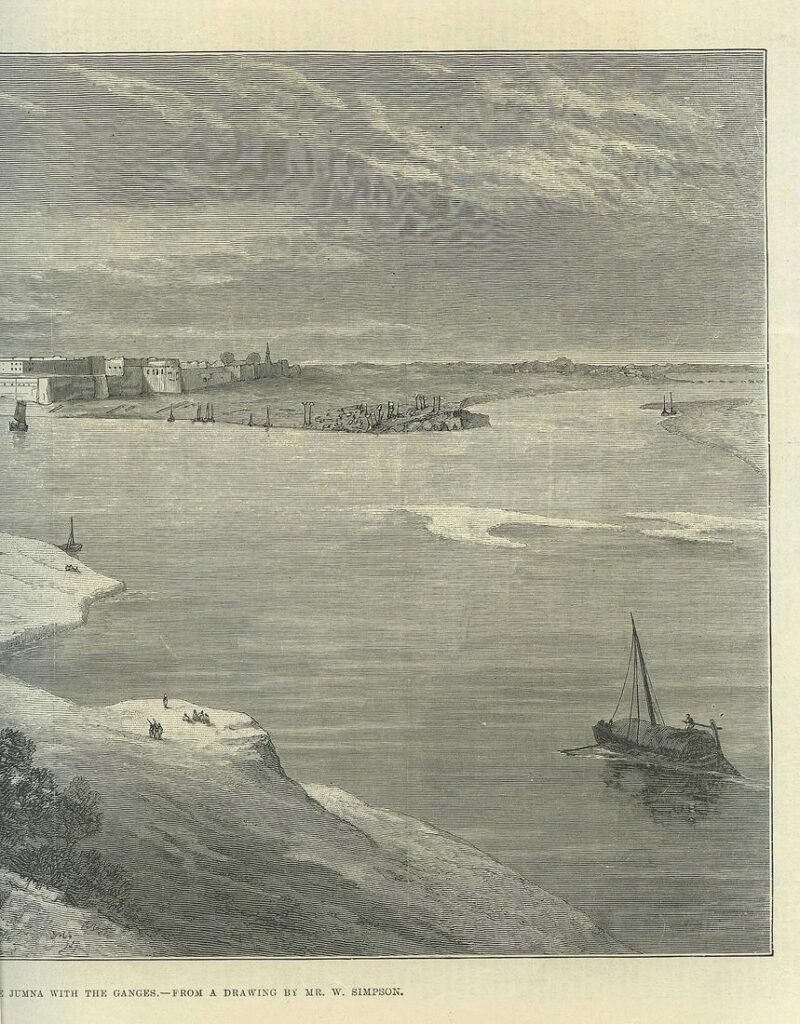 The Allahabad fort seen from across the river, engraving, The Illustrated London News, 1887. Public domain, via Wikimedia Commons
Going to the Kumbh? Tirth.com can plan it for you. We are taking bookings for the Kumbh, with packages, our own people on the ground and help from your first call to the bath. Leave your number and our yatra team will call you back.
- Stay and travel planned around your bathing day
- Our own people on the ground at the mela
- No payment to enquire
Calls between 10:30 am and 7:30 pm IST, usually the same working day.
From Tirth.com, which runs this guide · How this works
What the district gazetteers recorded
Later the British compiled district gazetteers, official handbooks for each district. Two of them describe Kumbh places in detail:
| Record | What it says |
|---|---|
| Nasik gazetteer, 1883 | The Godavari at Ramkund and at Trimbak is always sacred, but in the Sinhasth year, once in every twelve, when Jupiter enters Leo, local tradition holds that even the Ganga, Narmada, Yamuna and Saraswati come to wash in the Godavari. It counts about 20,000 pilgrims in an ordinary year and 100,000 to 200,000 in a Sinhasth year, and cites railway returns of 284,761 passengers for 1873, the last Sinhasth year, against about 118,000 in 1868. |
| Allahabad gazetteer, 1911 | Describes the yearly Magh Mela, its kalpvasis and its bathing days from Makar Sankranti to the full moon. Every twelfth year a Kumbh brings a far larger gathering; the last was in 1906, with an Adh (Ardh) Kumbh midway, as in 1900. On those occasions the ascetic orders march to the river in procession on Sankranti, Amavasya and Basant Panchami. The mela was paid for from shop and ground rents and from fees paid by barbers, boatmen and others. |
One detail stands out. The 1911 gazetteer gives Allahabad’s Kumbh the same sky rule, Jupiter in Aquarius with the Sun in Aries, that the older accounts give for Hardwar. The Prayagraj Mela Authority’s rule today is different, with the Sun in Capricorn, as our Kumbh cycle guide explains.
Where historians disagree
The records are not in dispute; what they mean is. A Government of India feature released on the last day of Maha Kumbh 2025 says the mela received royal patronage from several dynasties, including the Mughals, and was documented by colonial administrators. Kama Maclean, in her study published by Oxford University Press, reads the Allahabad evidence differently. She argues that the yearly Magh Mela there is old and well recorded, but that the Kumbh form was adapted from Haridwar by Allahabad’s pilgrimage priests, the Prayagwals, in the years after the uprising of 1857.
In the records we read, the Hardwar Kumbh is named from the 1690s, the Godavari gathering appears in the same work, and the Allahabad Kumbh appears only in the 1911 gazetteer. Records written by officials also need care for another reason: they tell us about revenue, order and numbers, and very little about devotion. Our history of the Kumbh Mela explains how to weigh each kind of source, and the Haridwar and Nashik and Trimbakeshwar guides cover each place.
Sources
12 sources · checked 16 Oct 2026
- The India of Aurangzib (topography, statistics, and roads) compared with the India of Akbar, with extracts from the Khulasatu-t-tawarikh and the Chahar Gulshan · Jadunath Sarkar (translator and editor), Sanyal and Co., Calcutta, 1901; scan on the Internet Archive ·
- Narrative of a Journey to Sirinagur, by Captain Thomas Hardwicke, Asiatic Researches vol. 6 · Asiatick Society (Bengal); London edition 1801; scan on the Internet Archive ·
- Gazetteer of the Bombay Presidency, Volume XVI: Nasik (1883): Simhastha, holy places and the names of Nasik · Government of Bombay, Government Central Press; scan by Cornell University Library on the Internet Archive ·
- Allahabad: A Gazetteer, being Volume XXIII of the District Gazetteers of the United Provinces of Agra and Oudh (H. R. Nevill, 1911): the Magh Mela and the Kumbh · Government Press, United Provinces, Allahabad; scan on the Internet Archive (Digital Library of India) ·
- History of Prayagraj (Huan Tsang, Prakrista Yag, Tirth Raj, Illahabas and 1801) · District Administration, Prayagraj, Government of Uttar Pradesh ·
- Allahabad Fort · Uttar Pradesh Tourism, Government of Uttar Pradesh ·
- Sovereign Spaces: Allahabad Fort and the Sangam, 1765-1860 (chapter 2 abstract, Pilgrimage and Power) · Oxford University Press (Kama Maclean) ·
- Mela as Resistance: The Modern Beginnings of the Ancient Kumbh in Allahabad, 1857-1870 (chapter 3 abstract, Pilgrimage and Power) · Oxford University Press (Kama Maclean) ·
- Pilgrimage and Power: The Kumbh Mela in Allahabad, 1765–1954 · Oxford University Press ·
- Making the Colonial State Work for You: The Modern Beginnings of the Ancient Kumbh Mela in Allahabad · The Journal of Asian Studies / Cambridge University Press ·
- Mahakumbh 2025: A Spectacle of Faith, Unity, and Tradition (history paragraph) · Press Information Bureau, Ministry of Information and Broadcasting, Government of India ·
- Astrological Significance (Maha Kumbh 2025 official website) · Prayagraj Mela Authority, Government of Uttar Pradesh ·
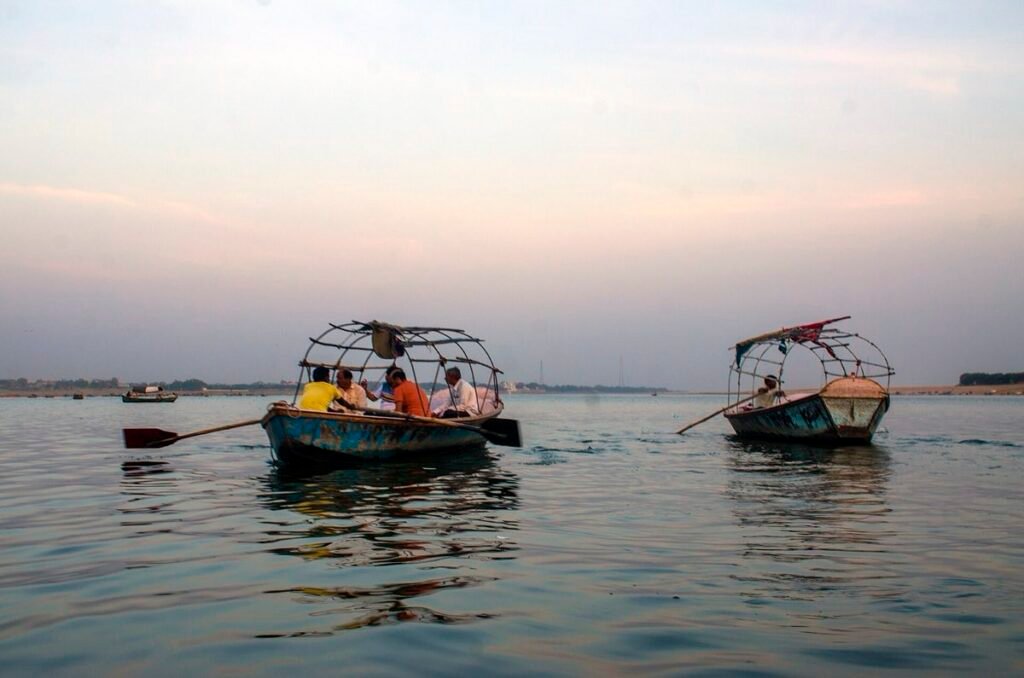 Photo: Rangan Datta Wiki, CC BY-SA 4.0
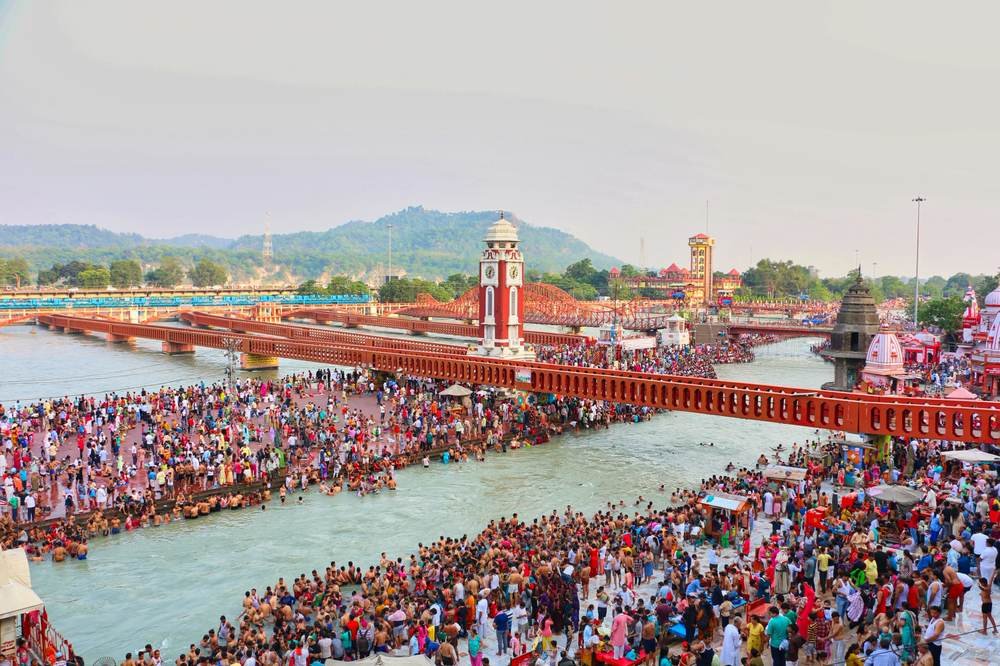 Photo: Tirth
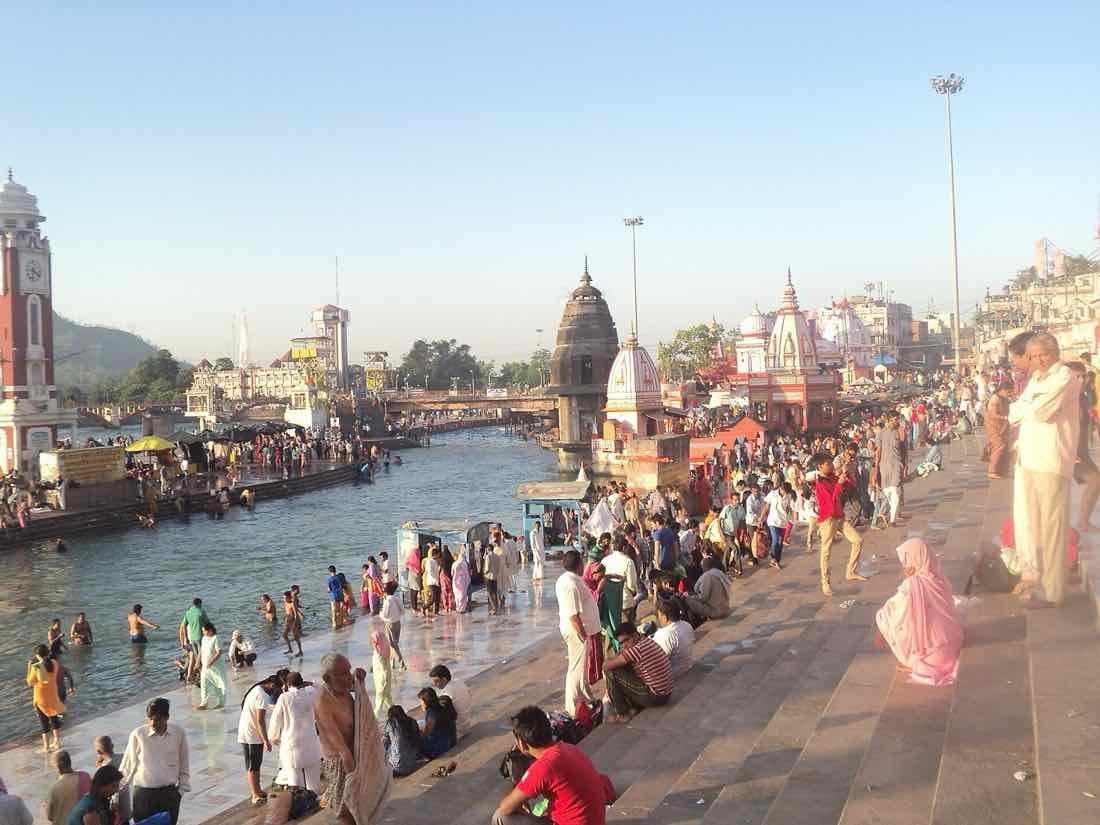 Photo: Subhankar Banerjee, CC BY-SA 4.0