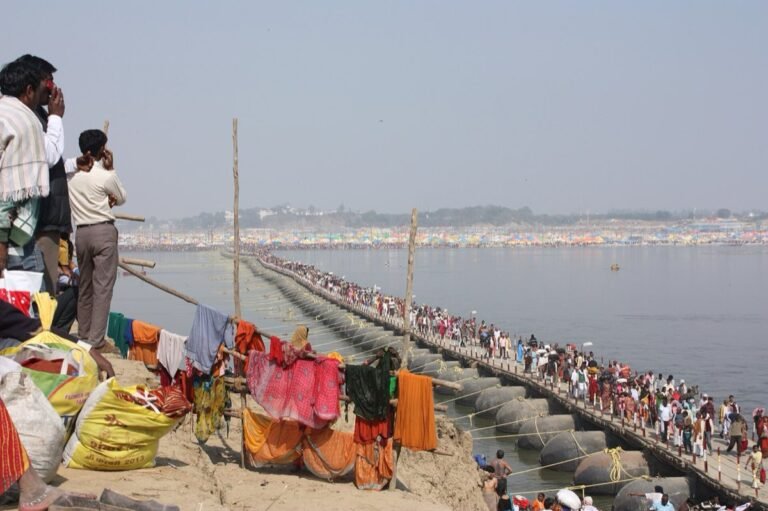
Xuanzang, also written Hiuen Tsang, was a Chinese Buddhist monk who travelled in India from 629 to 645. He described Prayag as a holy place where kings gave away their wealth beside the meeting of the Ganga and Yamuna, but what he recorded was a five-yearly royal almsgiving, not a Kumbh, so calling it the first record of the Kumbh Mela is an interpretation on which sources disagree.
Who Xuanzang was, and the two texts
Xuanzang left China in 629 and returned in 645. Two texts describe his time at Prayag. The first is his travel record, which describes each country he passed through. The second is a biography by his disciple Hwui Li, which tells the story of one visit near the end of his journey. The Prayagraj district administration dates his visit to 643.
Go deeperAbout the translations we use1 min read
Both texts are read here in Samuel Beal’s English translations. The dates of the journey come from the introduction to his translation of the travel record, published in 1884 as Si-yu-ki: Buddhist Records of the Western World. Beal also translated Hwui Li’s biography.
What he wrote about Prayag
In the travel record, the capital of Prayag stands between two branches of the river. Xuanzang counted two Buddhist monasteries with few monks and several Hindu temples, and wrote that followers of other faiths, whom Beal’s translation calls heretics, were very many. A 2024 Government of India backgrounder says he described Prayagraj as a “great city of idolaters”, a sign of its strong Brahminical traditions.
To the east of the city, between the two rivers, he described a stretch of fine sand of about ten li, the li being a Chinese measure of distance. From old times, he wrote, kings and noble families came here to give away their goods, so the place was called the great charity enclosure. In his day King Shiladitya, the ruler known in Indian history as Harsha, gave away there the wealth he had gathered over five years. Xuanzang also recorded the local belief that bathing in the water at the confluence washes away sin, and that people came from distant regions for it.
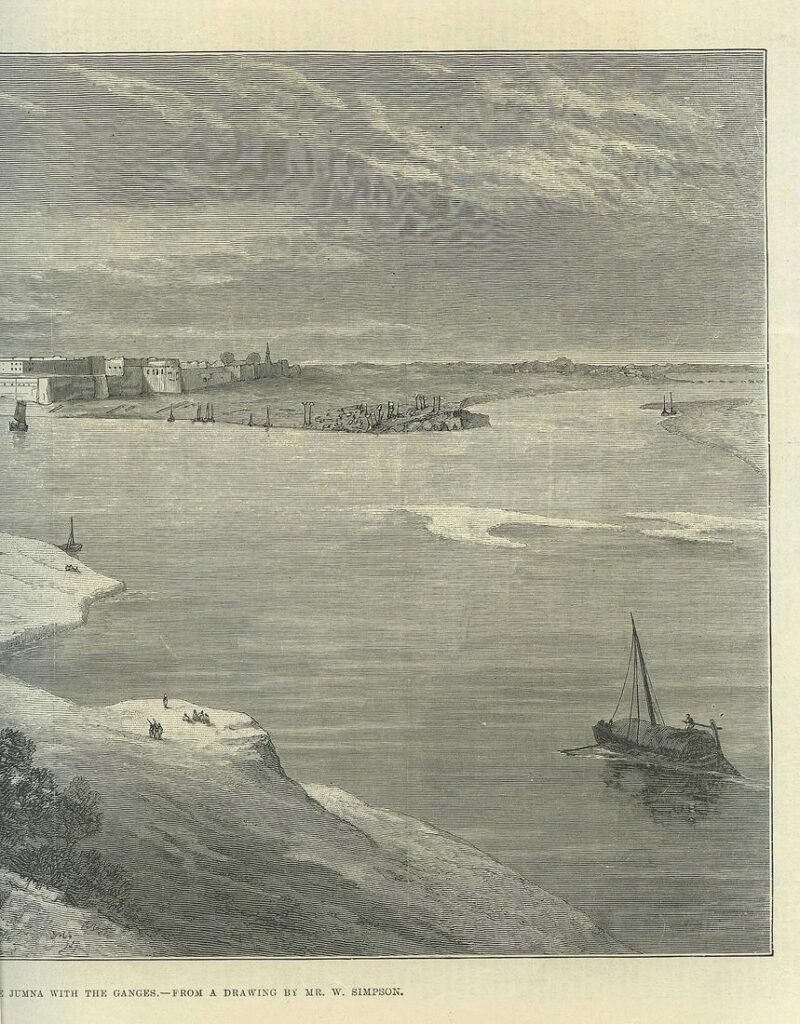 The Allahabad fort seen from across the river, engraving, The Illustrated London News, 1887. Public domain, via Wikimedia Commons
The sixth great assembly, in his biography
Hwui Li’s biography gives the fullest picture. In it, the king tells Xuanzang that every five years he holds a great religious assembly between the two rivers, to which he invites the Buddhist monks and Brahmans of all India and the poor, the orphaned and the destitute. The giving lasts seventy-five days. He has held five and is about to hold the sixth, and he asks Xuanzang to stay and see it.
Xuanzang went. The biography calls the ground the Arena of Charitable Offerings, a flat plain by the meeting of the rivers, and says about 500,000 people had gathered, with the kings of eighteen kingdoms in the royal party. Treasure was stored in thatched buildings inside a bamboo enclosure, and the gifts followed a fixed order:
| Turn | What the biography records |
|---|---|
| First day | An image of the Buddha is installed and the finest gifts are given |
| Second day | An image of Aditya, the Sun god, is installed, with gifts |
| Third day | An image of Ishvara (Shiva) is installed, with gifts |
| Fourth day | Gifts to 10,000 Buddhist monks |
| Next twenty days | Gifts to Brahmans |
| Next ten days | Gifts to followers of other sects |
| Next ten days | Gifts to those who came from far away to ask for alms |
| One month | Gifts to the poor, orphans and destitute |
At the end, the biography says, the king gave away his own jewels and clothes and asked his sister for a used garment to wear.
Why it is linked to the Kumbh, and where sources disagree
The official website of Maha Kumbh 2025, run by the Prayagraj Mela Authority, says historic evidence points to Harsha’s reign as the time when the Kumbh Mela gained wide recognition, and that Xuanzang described the grandeur of the Kumbh in his travelogue.
The texts themselves give reasons for caution. In Beal’s translations they:
- do not use the word Kumbh;
- describe an assembly held every five years, not every twelve;
- do not mention Jupiter or the other positions in the sky that set a Kumbh today;
- centre on a king’s almsgiving, opening with an image of the Buddha.
The Prayagraj district’s own history page says only that Xuanzang found Prayag inhabited by many Hindus who regarded the place as very holy. The historian Kama Maclean, whose study of the Allahabad mela was published by Oxford University Press, argues that the yearly Magh Mela at Prayag is old and appears in several historical accounts, but that those accounts record no Kumbh there, and that the Kumbh form was adapted from Haridwar after 1857. Our history of the Kumbh Mela takes the same careful line: the account is good evidence that Prayag was a sacred place of bathing and giving in the seventh century, but not proof that today’s Kumbh existed then.
Echoes at the Sangam today
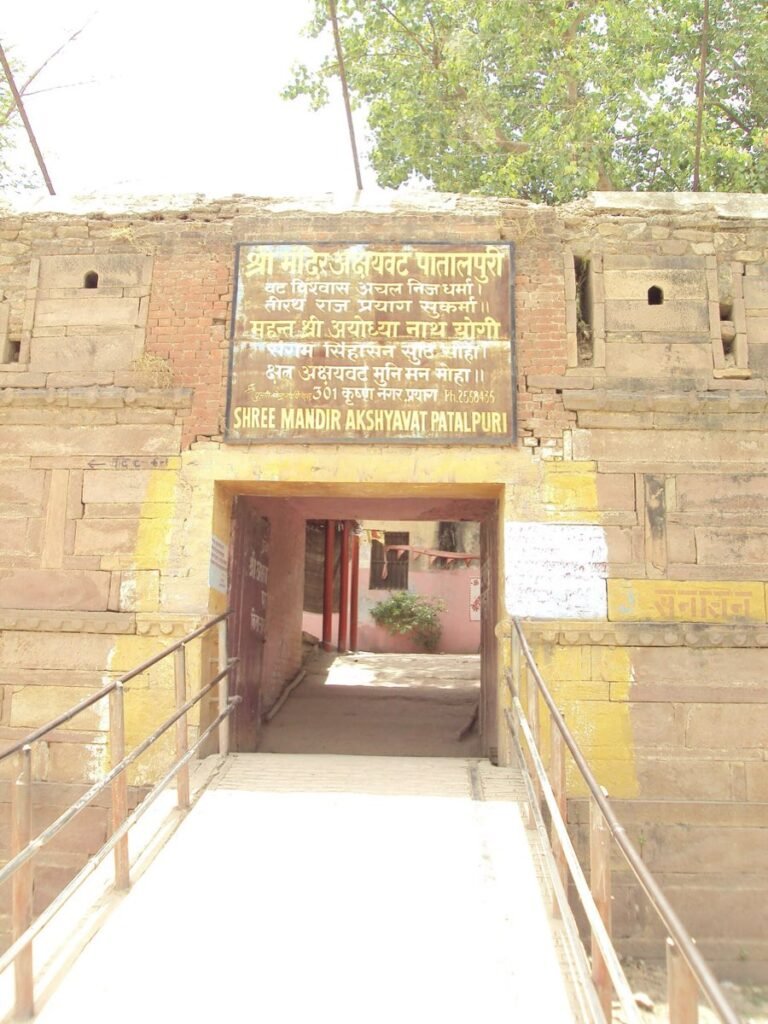 Photo: Nikhil2789, CC BY-SA 3.0, via Wikimedia Commons
Two things Xuanzang described are still part of a visit to Prayagraj. One is giving: daan remains central to the Magh Mela and the Kumbh, as our article on daan at the Kumbh explains. The other is the sacred tree. Beal’s notes identify a great tree that Xuanzang saw in front of a temple at Prayag with the Akshaya Vat, the undying banyan, following the archaeologist Alexander Cunningham, and the Prayagraj district says the Patalpuri temple that holds the tree was seen by Hiuen Tsang. See Akshayavat and Patalpuri Temple and our Prayagraj Kumbh guide.
Plan your trip
Sources
12 sources · checked 16 Oct 2026
- Si-yu-ki: Buddhist Records of the Western World, translated from the Chinese of Hiuen Tsiang, vol. 1 (1884), Book V: Po-lo-ye-kia (Prayaga) · Trubner and Co., London (translated by Samuel Beal); scan on the Internet Archive ·
- The Life of Hiuen-Tsiang by the Shaman Hwui Li, translated by Samuel Beal, new edition (1911), Book V: the assembly at Prayaga · Kegan Paul, Trench, Trubner and Co., London; scan on the Internet Archive ·
- History of Prayagraj (Huan Tsang, Prakrista Yag, Tirth Raj, Illahabas and 1801) · District Administration, Prayagraj, Government of Uttar Pradesh ·
- History of Prayagraj · District Prayagraj, Government of Uttar Pradesh ·
- Prayagraj: Blending Tradition with Modernity, 2025 Maha Kumbh Mela to Set New Global Standards (history paragraph) · Press Information Bureau, Ministry of Culture, Government of India ·
- Pauranic Significance (Maha Kumbh 2025 official website) · Prayagraj Mela Authority, Government of Uttar Pradesh ·
- Mela as Resistance: The Modern Beginnings of the Ancient Kumbh in Allahabad, 1857-1870 (chapter 3 abstract, Pilgrimage and Power) · Oxford University Press (Kama Maclean) ·
- Pilgrimage and Power: The Kumbh Mela in Allahabad, 1765–1954 · Oxford University Press ·
- Making the Colonial State Work for You: The Modern Beginnings of the Ancient Kumbh Mela in Allahabad · The Journal of Asian Studies / Cambridge University Press ·
- Places of Interest (Sangam, Allahabad Fort, Patalpuri and Akshaya Vat) · District Prayagraj, Government of Uttar Pradesh ·
- Places to see (Maha Kumbh 2025 official website) · Prayagraj Mela Authority, Government of Uttar Pradesh ·
- Rituals of Kumbh (Maha Kumbh 2025 official website) · Prayagraj Mela Authority, Government of Uttar Pradesh ·
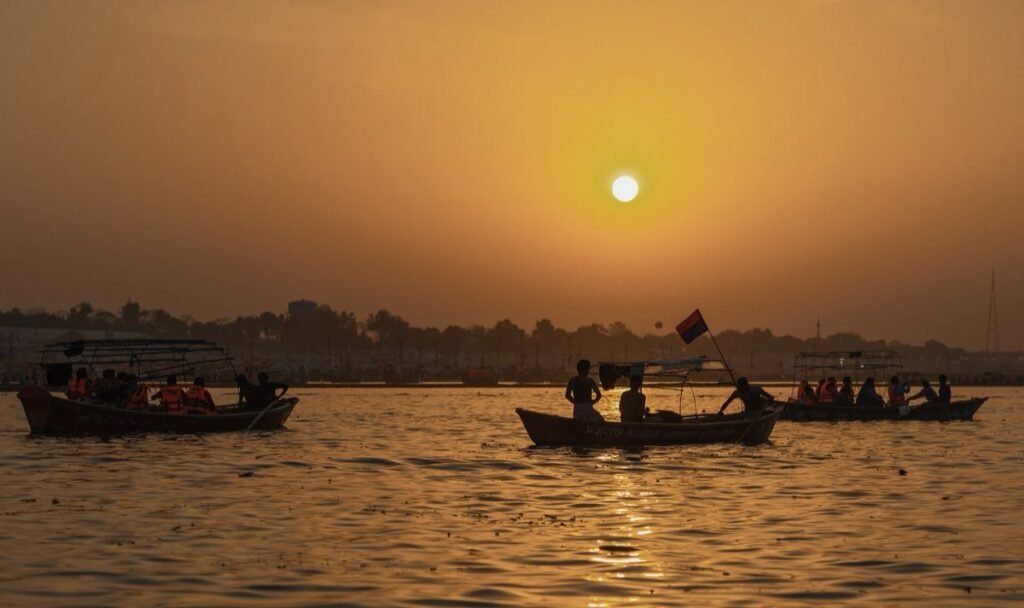 Photo: Ninara, CC BY 2.0