
Haridwar’s pandas, the hereditary pilgrim priests of the city, keep handwritten registers called bahis for the families they serve, recording names, places of origin, births and marriages, and the passing of family members. When a family visits, often after losing a relative, its panda finds the family’s pages and the new entries are added in front of them.
What a bahi records
The Hindu reported in 2023 that the records include place of origin, names, births, the passing of relatives, place of residence, grants made to temples, caste and clan. A BBC correspondent described births, marriages and family losses written on long paper scrolls, and called Haridwar the most complete and best preserved of the places where such records are kept.
An entry is made with the family present. A purohit told the Times of India in 2018 that the signature of the family head or a family member on the bahi is mandatory, and that people travel long distances to see their forefathers’ signatures and details. The records follow the male line: a Tribune writer noted that married daughters rarely appear, though visitors now often make sure their names are added. When a branch of a family runs out of space, a new sheet is bound in.
How families find their panda
Each panda family looks after particular places. The Hindu describes the priests as organised into firms by states, districts and villages; in one family it met, two brothers had divided districts between them. A family is matched to its panda by the village its ancestors came from, not by where it lives now.
If you do not know your panda, ask at the ghats.
Finding your family’s pages
- Gather the family detailsThe family name, and the caste and clan the family uses; the ancestral village or town, and its district; the names of grandparents or great-grandparents, and roughly when a relative last visited.
- Ask at the ghatsThe Hindu says members are stationed at the ghats to help locate the right panda by village, and the Tribune’s writer found his by asking at Har Ki Pauri, where the priests gather.
- Sign the new entryThe entry is made with the family present, and the signature of the family head or a family member is mandatory, a purohit told the Times of India.
The BBC’s reporter, whose family came from near Rawalpindi, tried three priests and needed her father’s memory of a courtyard tree before she found the right panda. Her family’s scrolls went back to the early 1800s, ten generations, and she added her own entry.
Go deeperHow old are the records, and how many pandas are there?1 min read
Claims vary, so treat any single figure with care. The Hindu reported that the panda community holds records of families going back 15 to 20 generations, and Haridwar purohits told the Times of India they had kept such records for over 400 years. The historian Irfan Habib, quoted by The Hindu, said the records span only about four centuries. The Tribune notes that the Genealogical Society of Utah has microfilmed some of them.
The number of pandas is also uncertain. The Hindu in 2023 and the Times of India in 2018 put it at about 2,500, while a 2012 BBC report spoke of some 300 hereditary pandas still at work.
Going to the Haridwar Kumbh 2027? Tirth.com can plan it for you. We are taking bookings for the Kumbh, with packages, our own people on the ground and help from your first call to the bath. Leave your number and our yatra team will call you back.
- Stay and travel planned around your bathing day
- Our own people on the ground at the mela
- No payment to enquire
Calls between 10:30 am and 7:30 pm IST, usually the same working day.
From Tirth.com, which runs this guide · How this works
Old books and new uses
Most purohits have resisted putting the registers on computers. In 2018 one told the Times of India that the bahis are the private records of families, kept by the priests for generations; the few who use computers keep them only for reference, with the real details still in the bahi.
Historians and courts take an interest in them. In 2023 the Indian Council of Historical Research said it wanted to help researchers use such records to study famines, epidemics and migration, The Hindu reported. The Indian Express reported in 2024 that genealogy ledgers have been used as evidence in property disputes, and a Haridwar genealogist told the paper that many people living abroad now come to trace ancestral land.
Nothing special has been announced for the registers during the 2027 Kumbh. The panda offices are in the lanes near the ghats, and the official Kumbh guidance advises against accepting services from people you do not know, so ask at the ghat for your family’s panda by name and village. See the Haridwar Kumbh 2027 guide and our note on Kumbh scams.
Plan your trip
Sources
6 sources · checked 16 Oct 2026
- Rooting out a Hindu family history the traditional way · BBC News (Anu Anand, From Our Own Correspondent) ·
- Ancestry records of pilgrim centres to shed light on India's past · The Hindu (Sreeparna Chakrabarty) ·
- Haridwar purohits shun digitization, prefer old-fashioned way to store centuries-old records · The Times of India (Kautilya Singh) ·
- Tracing one's roots in Haridwar · The Tribune (Lalit Mohan) ·
- How caste-based genealogists have been preserving India's history · The Indian Express (Parul Kulshrestha) ·
- Pilgrim Dos & Don'ts: Haridwar Kumbh 2027 (official website) · Haridwar Kumbh Mela administration, Government of Uttarakhand ·
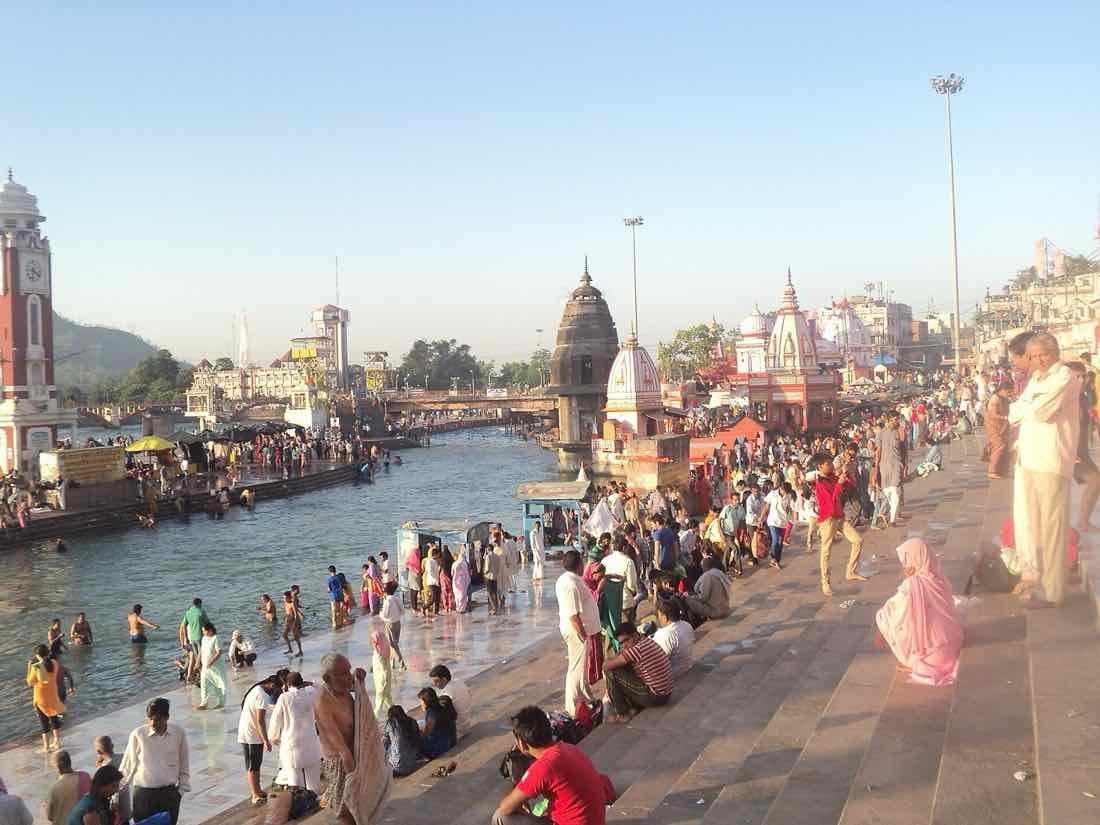 Photo: Subhankar Banerjee, CC BY-SA 4.0