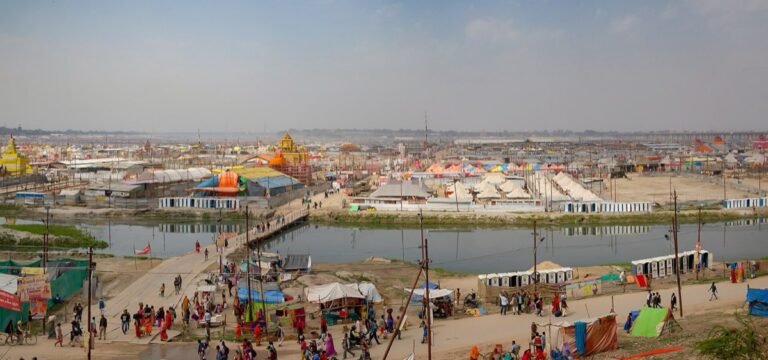
An akhara procession is an order of sadhus moving through the mela in public: first when it enters its camp at the start of the Kumbh (the peshwai, now also called Chhavni Pravesh), and then on each Amrit Snan day, when it goes to the river to bathe before everyone else. The order and timing are fixed for each Kumbh by the Akhil Bharatiya Akhara Parishad with the mela administration, and the public watches from the places the police open for it.
The peshwai: an akhara’s entry into the mela
The Prayagraj Mela Authority describes the peshwai as a grand procession that marks the beginning of the Kumbh, and says the word is a local form of “praveshai”, meaning entry. Saints arrive with their followers in decorated carriages, with bands playing, while people along the route shower petals on them.
A Press Trust of India report describes the peshwai as the procession from an akhara’s ashram to the mela area, a tradition followed for centuries. Before Maha Kumbh 2025 the akharas made these entries on a set schedule, with Naga sadhus, acharyas, mandaleshwars and mahamandaleshwars on elephants, horses, chariots and camels. The entries come before the first big bathing days.
In the Kumbh, an akhara is an organised order of ascetics, not a wrestling ground. The 2025 mela authority notes that akhara leadership has religious, ceremonial and administrative sides, which is why an entry is both a procession and the start of the akhara’s work at the mela.
Peshwai or Chhavni Pravesh?
In October 2024 the Akhil Bharatiya Akhara Parishad, the council of the thirteen main akharas, said a proposal passed at a meeting in Prayagraj would replace the words Shahi Snan and Peshwai, and named Chhavni Pravesh, entry into the camp, as the new word for the procession. In January 2025 its president said the change had been made, and that the aim was a Sanskrit or Sanatani name in religious matters, not to set one community against another. Older pages and many people still say peshwai, so you will hear both words for the same procession.
The Amrit Snan procession
On the main bathing days the akharas go to the river in procession and bathe first. The Prayagraj Mela Authority calls this bath the Shahi Snan or Rajyogi Snan, and describes the tradition that the public bathes after the saints, in the belief that this brings them the merit of the saints’ deeds and wisdom. The Parishad renamed the Shahi Snan the Amrit Snan at the same time as the peshwai; see Amrit Snan or Shahi Snan.
Who decides the order and the timing
The Prayagraj Mela Authority sets out the arrangement. The Akhara Parishad decides the date, time and order of the akharas for both the bathing procession and the peshwai, in consultation with the mela committee of the Divisional Commissioner, the District Magistrate and the Mela Adhikari. Our guide to who runs a Kumbh explains those offices.
Each akhara is told its slot in advance. For the first Amrit Snan of Maha Kumbh 2025, on 14 January, All India Radio and UNI reported that each of the 13 akharas had been notified of its time and sequence. UNI said the day began with the Mahanirvani Akhara, with the Atal Akhara, “as per tradition”, and All India Radio said the Nirmal Akhara was the last to bathe.
The order is set for each mela, so it does not carry over. At Haridwar on 14 April 2021, PTI reported, the Niranjani Akhara bathed first with the Anand Akhara, followed by the Juna and then the Mahanirvani, each in its allotted time slot, and Har Ki Pauri was reserved for the akharas that day.
What you will see
- Leaders on chariots. According to the Prayagraj Mela Authority, mahamandaleshwars lead the procession on decorated chariots with the Shri Mahant, followed by secretaries on elephants, Naga sadhus on horses and other saints on foot.
- Flags, banners and deities. The akharas carry their flags and banners. At Haridwar in 2021 the seers took their deities to the river in decorated palanquins.
- Naga sadhus. UNI described Naga sadhus at the 2025 bath playing the damru and carrying tridents and traditional weapons, to chants of Har Har Mahadev.
- Pilgrims along the route. The Mela Authority says pilgrims gather on both sides of the procession to receive the saints’ blessings.
Government material for 2025 lists thirteen established akharas in Shaiva, Vaishnava, Udasin and Nirmal groups. We describe them without ranking. To learn about the orders themselves, read Akharas of Kumbh Mela and Naga sadhus: history, tradition and role.
Where and how to watch
Routes, ghats and viewing places are set by the mela administration and the police for each day. Watch only from the places the police open for the public. Some ghats can be kept for the akharas, as Har Ki Pauri was in 2021. The official Haridwar Kumbh 2027 map already shows a proposed reserved area for the akharas’ chariots in sector 8 (Rodi) and proposed camping areas for several akharas in sector 7 (Gauri Shankar). Amrit Snan days usually draw the most pilgrims; follow police and mela instructions on the day.
- Treat the procession as a religious rite, not a show. The official Haridwar site asks pilgrims to keep respectful behaviour and follow local customs.
- Do not touch flags, ritual objects, deities or animals. Keep clear of elephants and horses, never step into the route, and never cross between groups in the procession.
- Ask before a close-up photo, and never block the way for one. Read photographing ascetic traditions with respect.
- Do not make remarks about dress or ascetic practice.
- Follow what the police, volunteers and public announcements tell you, and cooperate with the organisers.
What is known for 2027 and 2028
- Haridwar 2027: the official site lists four Amrit Snans, on Sat 6 March, Mon 8 March, Mon 15 March and Wed 14 April 2027. PTI reported in November 2025 that, for the first time in an Ardh Kumbh, the akharas would take the Amrit Snan on the named days. Peshwai (Chhavni Pravesh) dates and the akharas’ order and times had not been published in October 2026.
- Nashik and Trimbakeshwar 2027: three Amrit Snans, on Mon 2 August and Tue 31 August, and the third on Sat 11 September at Nashik and Sun 12 September 2027 at Trimbakeshwar. According to the Nashik district, the Vaishnava akharas bathe at Nashik and the Shaiva and Udasin akharas at Trimbakeshwar. The Simhastha opens with the flag hoisting on Saturday 31 October 2026, a separate ceremony from the peshwai. No Chhavni Pravesh dates or bathing order had been published in October 2026.
- Ujjain 2028: the Simhastha is proposed for 27 March to 27 May 2028. No bathing day has been announced.
Check the Haridwar dates and Nashik dates pages for the status of each day, and read What is Kumbh Mela? for the wider picture. Take routes and viewing places only from the authorities’ latest notice, not from videos of past melas.
Sources
- Kumbh 2019 Attractions: Peshwai (Praveshai) · Prayagraj Mela Authority, Government of Uttar Pradesh ·
- Akhara body to ban food stalls by 'non-Sanatanis' at Kumbh, rename 'Urdu' terms for rituals · Press Trust of India (via Deccan Herald) ·
- Ancient temples converted into mosques be vacated, demands Akhara chief · Press Trust of India (via Deccan Herald) ·
- Maha Kumbh Mela 2025: Naga Sadhus' grand entry sets the tone for mega-festival · Deccan Herald ·
- Spiritual Gurus: Akharas section (Maha Kumbh 2025 official website) · Prayagraj Mela Authority, Government of Uttar Pradesh ·
- Bathing Dates: Maha Kumbh 2025 · Prayagraj Mela Authority, Government of Uttar Pradesh ·
- Makar Sankranti Amrit Snan underway at Mahakumbh in Prayagraj · All India Radio News (newsonair.gov.in), Prasar Bharati ·
- Around 3.5crore take holy dip, as Akharas perform their first 'Amrit Snan' at Maha Kumbh · United News of India (UNI) ·
- Shahi snan in Haridwar: lakhs take holy dip (PTI, Deccan Herald AMP copy) · Press Trust of India, via Deccan Herald ·
- Shahi snan in Haridwar: Lakhs ignore Covid-19 concerns to take holy dip · Press Trust of India (via Deccan Herald) ·
- Maha Kumbh: Akhara Walk Tour · Uttar Pradesh State Tourism Development Corporation, Government of Uttar Pradesh ·
- Spiritual Powerhouses: Akharas at the Forefront of Maha Kumbh 2025 · Press Information Bureau, Government of India ·
- Spiritual Gurus: Akharas · Prayagraj Mela Authority, Government of Uttar Pradesh ·
- Map and Traffic Updates: Kumbh sectors and proposed akhara camping areas (Haridwar Kumbh 2027 official website) · Haridwar Kumbh Mela administration, Government of Uttarakhand ·
- Snan and Events: Haridwar Kumbh 2027 (official website) · Haridwar Kumbh Mela administration, Government of Uttarakhand ·
- Snan and Events: 'Three Ways to Experience the Snan' (Haridwar Kumbh 2027 official website) · Haridwar Kumbh Mela administration, Government of Uttarakhand ·
- Haridwar Ardh Kumbh 2027 will be celebrated as grandly as Purna Kumbh: CM Dhami · PTI (via The Week) ·
- Kumbh Mela Plan (First Edition): Nashik–Trimbakeshwar Simhastha Kumbh Mela 2027 · Nashik–Trimbakeshwar Kumbh Mela Authority, Office of the Divisional Commissioner, Nashik, Government of Maharashtra ·
- Culture and Heritage: Simhastha Kumbhamela, Godavari and the akhara arrangement (Nashik district) · Nashik District, Government of Maharashtra ·
- MP Simhastha Kumbh 2028: ₹25k Cr Infrastructure Push For 40Cr Devotees, Says CM Yadav · Deccan Chronicle ·
- Pilgrim Dos & Don'ts: respect and conduct (Haridwar Kumbh 2027 official website) · Haridwar Kumbh Mela administration, Government of Uttarakhand ·
- Do's and Don'ts: Maha Kumbh 2025 · Prayagraj Mela Authority, Government of Uttar Pradesh ·
- Simhastha Kumbh Mela to begin in Nashik-Trimbakeshwar on Oct 31 next year · Press Trust of India (via The Week) ·
 Photo: Rangan Datta Wiki, CC BY-SA 4.0