
Nashik–Trimbakeshwar Simhastha · Places
Kalaram Temple, Panchavati, Nashik
The Kalaram temple is a temple of Rama in Panchavati, Nashik, a few minutes from Ramkund. It is named after its black stone idol of Rama: kala means black. It is a place of darshan, not a Simhastha bathing centre.
Place facts are from Maharashtra Tourism, the Nashik district and the 1883 Bombay Gazetteer. The Amrit Snan dates are official, from the Kumbh Mela Authority's plan of 15 June 2026. The Ramkal Path project is a proposal reported by PTI. Temple hours and entry arrangements for 2027 are not announced.
Maharashtra Tourism says Sardar Rangarao Odhekar built the temple of black basalt between 1788 and 1792. In 1930, Dr B. R. Ambedkar led a satyagraha here for the right of Dalits to enter and worship.
Kalaram temple at a glance
| Question | Answer |
|---|---|
| Where | Panchavati, Nashik city, a few minutes from Ramkund (Maharashtra Tourism) |
| Deity | Rama, with Sita and Lakshmana, all in black stone; a Hanuman idol at the entrance faces Rama |
| Built | By Sardar Rangarao Odhekar, 1788 to 1792 (Maharashtra Tourism). The 1883 Bombay Gazetteer gives 1782. |
| Nearest railway station | Nashik Road, about 10 km (Maharashtra Tourism) |
| Airport | Nashik (Ozar), about 24 km (Maharashtra Tourism) |
| Role in the Simhastha | Not a bathing centre. The bathing centre in Nashik is Ramkund. |
| 2027 arrangements | Not announced |
History and tradition
According to the temple’s story, Sardar Rangarao Odhekar, a Maratha noble, saw in a dream a black idol of Rama lying in the Godavari, and found it at that spot. Maharashtra Tourism says he began the temple in 1788 and finished it in 1792.
The 1883 Bombay Gazetteer records the belief that the temple stands on the spot where Rama lived during his exile in Panchavati. This is a matter of faith, not a finding of archaeology.
In 1930, Dr B. R. Ambedkar led a satyagraha at the temple, demanding equal rights for Dalits to enter and worship. Maharashtra Tourism calls it a milestone in the fight against caste discrimination.
Go deeperWhy two building dates are given1 min read
The 1883 Bombay Gazetteer gives a different date. It says Odhekar built the temple in 1782, on the site of an older wooden temple, and that the work is said to have taken twelve years. The two sources do not agree, so we give both.
The temple building
Maharashtra Tourism describes the temple as built entirely of black basalt, in the Hemadpanthi style. The main spire rises about 70 feet and ends in a gold-plated peak. A 17-foot wall surrounds the complex, with four gates facing north, south, east and west.
In the sanctum stand black stone idols of Rama, Sita and Lakshmana. At the entrance, an idol of Hanuman faces Rama.
The 1883 Gazetteer describes a line of arched cloisters inside the wall and an open assembly hall to the east of the temple, then used for kathas and Purana readings. It says the stone was brought from Dhair or Bhorgad fort near Ramsej, about six miles (about 10 km) north of Nashik.
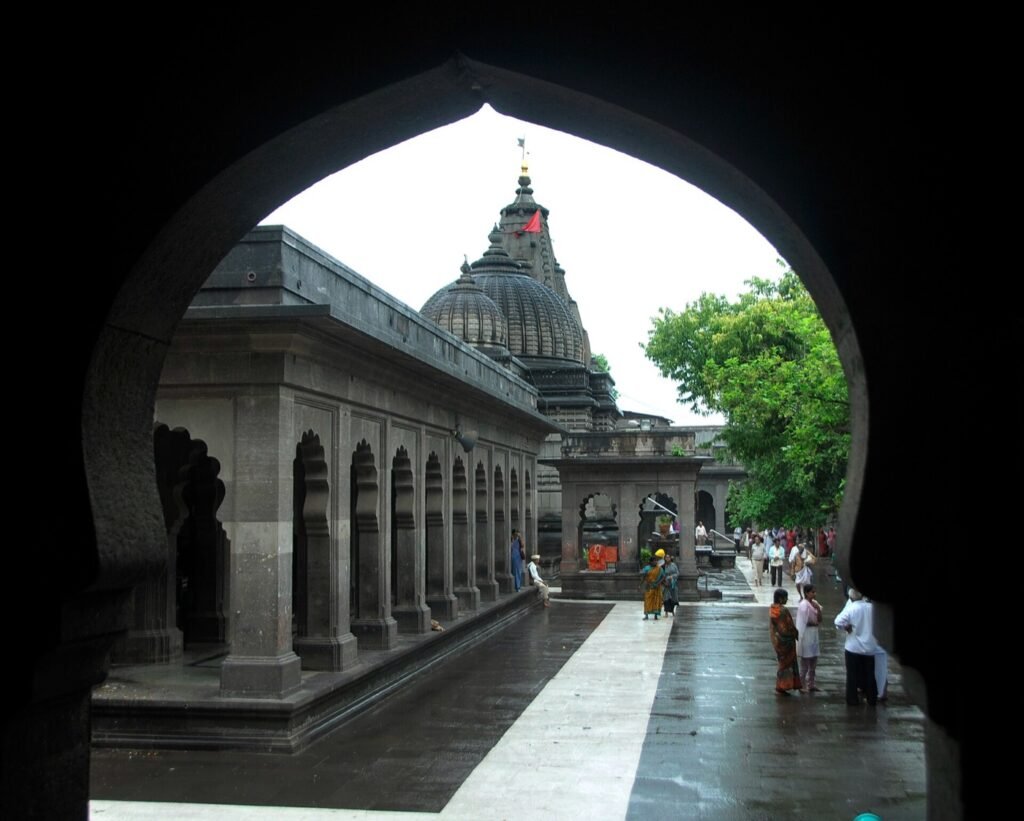 Photo: PKharote, CC BY-SA 4.0, via Wikimedia Commons
Festivals at the temple
Ram Navami and Dussehra are the temple’s big festivals, with prayers and processions, Maharashtra Tourism notes.
Festival dates and timings change from year to year. Check with the temple before you plan a visit for a festival.
The Kalaram temple and the Simhastha
There is no Kumbh bath at the temple. The Simhastha bathing in Nashik is at Ramkund, a few minutes away, on Monday 2 August, Tuesday 31 August and Saturday 11 September 2027, according to the Kumbh Mela Authority’s plan of 15 June 2026. Amrit Snan days usually draw the most pilgrims; follow police and mela instructions on the day.
In November 2025, PTI reported a proposed Ramkal Path project of about ₹99.14 crore for the Simhastha. It includes renovation and conservation of structures and better amenities for visitors, and is meant to present Ramkund, Sita Gufa, the Kalaram temple and other temples of the area together. A proposal is not a finished work.
On 6 May 2026, a Dharmadhwaj (religious flag) was raised at the temple on a 21-foot, five-metal flagstaff, in the presence of former President Ram Nath Kovind and Chief Minister Devendra Fadnavis, UNI reported, ahead of the Simhastha. This is separate from the Simhastha’s official flag hoisting on 31 October 2026 at Ramkund and Kushavarta.
- Not announced: temple hours and entry on Amrit Snan days
- Not announced: whether the Ramkal Path work will be finished before the Simhastha
- Not announced: road closures and walking routes in Panchavati
Nearby places in Panchavati
Sita Gufa, the cave shrine linked by tradition with Sita, is a short walk away. The Nashik district notes that the old banyan trees near the temple are believed to have sprung from the five banyans that gave Panchavati its name.
Ramkund and the Naroshankar temple are on the river nearby. See also the Godavari ghats beyond Ramkund.
Where it is
- 1RamkundGhat
- 2Kalaram TempleTemple · This page
- 3Sita GufaTemple
- 4Kapaleshwar Mahadev TempleTemple
- 5Sundar Narayan TempleTemple
A guide to where places are, not a route plan. During the mela, roads and ghats open and close by the official plan; follow police and mela directions.
Map data © OpenStreetMap contributors (ODbL). Some temple locations from Wikidata (CC0). openstreetmap.org/copyright
Also in this area
Sources
7 sources · checked 16 Oct 2026
- Kalaram · Department of Tourism, Government of Maharashtra ·
- Kalaram (temple architecture, festivals and access) · Department of Tourism, Government of Maharashtra ·
- Panchvati · Nashik District, Government of Maharashtra ·
- Gazetteer of the Bombay Presidency, Volume XVI: Nasik (1883) · Government of Bombay, Government Central Press (compiled under James M. Campbell); scan by Cornell University Library on the Internet Archive ·
- Kumbh Mela Plan (First Edition): Nashik–Trimbakeshwar Simhastha Kumbh Mela 2027 · Nashik–Trimbakeshwar Kumbh Mela Authority, Office of the Divisional Commissioner, Nashik, Government of Maharashtra ·
- Nashik-Trimbakeshwar Simhastha Kumbh: Fadnavis lays foundation stone of projects costing Rs 6k cr · Press Trust of India (via The Week) ·
- Maha: 'Dharmadhwaj' hoisting ceremony concluded at Nashik Temple · United News of India (UNI) ·