Independent Kumbh knowledge guide
Nashik–Trimbakeshwar Kumbh
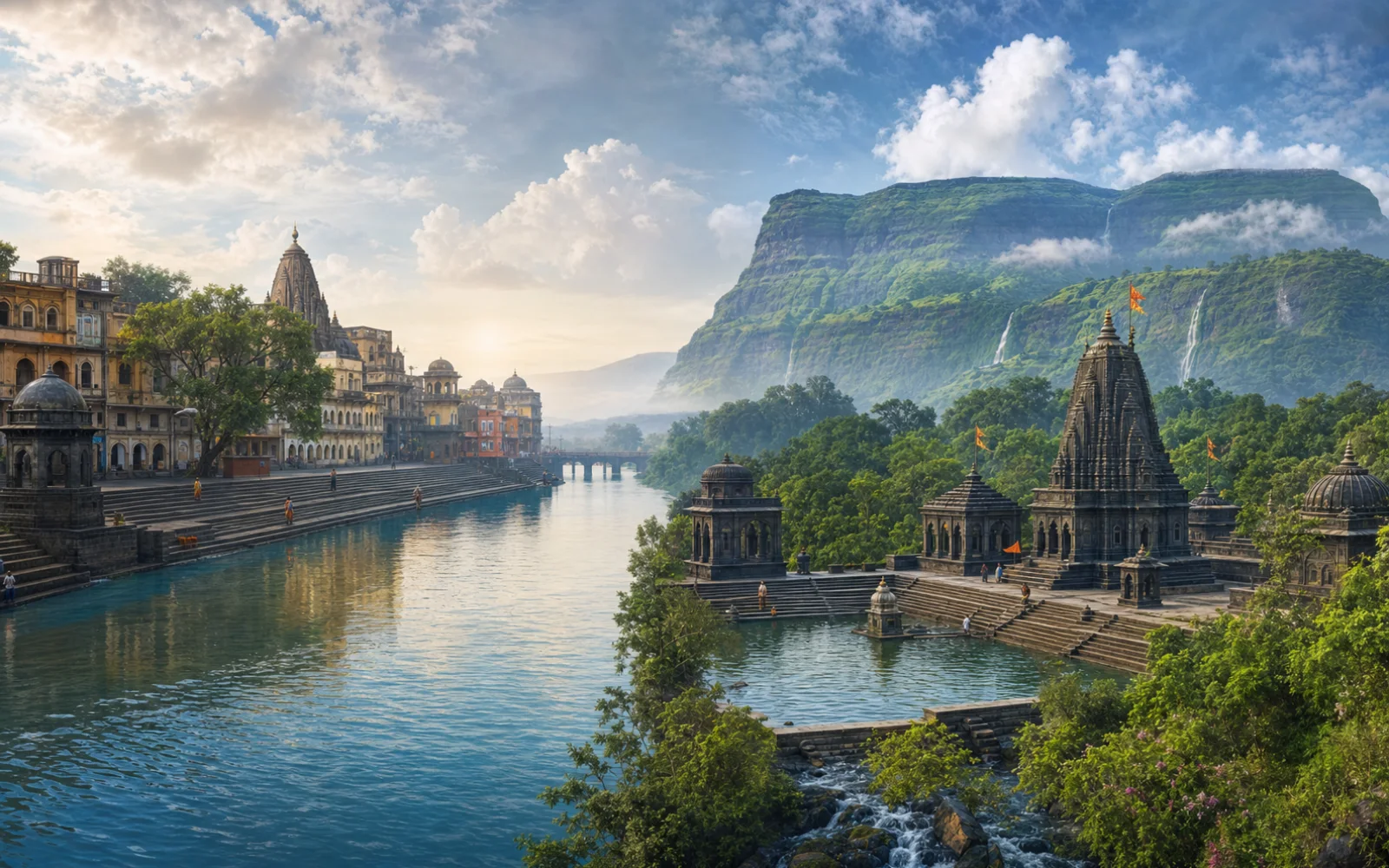
Nashik–Trimbakeshwar Kumbh is one connected Kumbh event with two distinct sacred centres on the Godavari. Nashik’s urban centre includes Ramkund and Panchavati; Trimbakeshwar’s centre includes Kushavart, Brahmagiri and the Trimbakeshwar temple landscape. The paired name matters: these are separate towns, not one ghat or interchangeable destination.
Key facts
| Topic | Verified orientation |
|---|---|
| State | Maharashtra |
| Sacred water | Godavari |
| Nashik centre | Ramkund, Panchavati and the urban Godavari ghats |
| Trimbakeshwar centre | Kushavart, Brahmagiri and Trimbakeshwar temple area |
| Event language | Nashik–Trimbakeshwar Kumbh or Simhastha, according to source context |
| Current status | Government planning confirmed for Simhastha Kumbh Mela 2027; detailed operations are not asserted here |
One event, two centres
Nashik and Trimbakeshwar are connected by the Godavari and the Kumbh institution, but their physical settings differ. Nashik is a city with river ghats, neighbourhoods and transport networks. Trimbakeshwar is a separate town closer to the Brahmagiri source landscape.
Official Maharashtra material describes historically separate bathing geographies for some traditions: Vaishnava Akharas in Nashik and Shaiva/Sannyasi/Udaseen groups in Trimbakeshwar. That is important local context, not a guarantee that every future route or allocation will match the archived arrangement.
Godavari, Ramkund, Trimbakeshwar and Kushavart
Ramkund and Panchavati
Ramkund is a major sacred tank and ghat complex on the Godavari within Nashik city. District tradition associates it with Rama, while continuing ritual practice includes the immersion of ashes nearby. The visible kund is also connected with early-modern patronage in the official account.
Panchavati extends the sacred landscape along the urban Godavari through temples, ghats and Ramayana-linked traditions. Those stories should be labelled as belief and cultural memory.
Kushavart and Trimbakeshwar
Kushavart is a sacred kund within Trimbakeshwar town near the temple. District tradition describes it as the place where the Godavari re-emerges after Brahmagiri. The source-hill, kund and temple are related but not the same physical place.
Temple entry, ritual booking and opening rules require current official temple guidance. A permanent location page cannot promise access during Kumbh.
Why Kumbh is held here
According to the shared Kumbh tradition, Nashik–Trimbakeshwar is one of the four places linked with the amrita kalasha. The event’s Simhastha name is connected in official local explanation with Jupiter in Simha, or Leo, and location-specific celestial conditions.
The rule explains traditional timing; it is not an independent date announcement. See the Kumbh cycle guide and four-location explanation.
History and cultural significance
Nashik’s Ramkund/Panchavati and Trimbakeshwar’s Kushavart/temple landscape bring together Godavari pilgrimage, Ramayana tradition and Shaiva sacred geography. Current Ramkund and Kushavart structures have early-modern construction histories in district records, while their religious associations are presented as older tradition.
The district account also preserves the history of sectarian bathing separation. It should be explained without sensationalising past conflict or predicting present tension. The 2015–16 Simhastha is the previous edition identified in current district material; its practical plan is archived.
Permanent location page or current event guide?
| This permanent page | Current Nashik Kumbh cluster |
|---|---|
| Godavari, Ramkund, Kushavart, Brahmagiri, temples and stable history | Confirmed dates, routes, ghats, stay, transport, safety and changes for 2027 |
| Quarterly context review | More frequent review as notices appear |
| No duplicated operational table | Owns event-specific instructions |
For current preparation, use the Nashik Kumbh Event Guide and Ghats and Sacred Geography.
Previous and future event context
Status reviewed 15 July 2026: NTKMA confirms official planning for Simhastha Kumbh Mela 2027 across Nashik and Trimbakeshwar. This page does not assert a bathing-date table, route, parking plan or entry rule.
The authority’s mandate covers infrastructure, sanitation, safety, transport, digital systems and pilgrim facilitation. Each operational claim still needs its own dated notice.
Travel orientation
Plan Nashik and Trimbakeshwar as separate destinations connected by road. Nashik Road railway station serves the region, while airport and local transport details can change. During Kumbh, road controls and transfer times may be very different from ordinary days.
Choose your centre based on the ritual, ghat, temple, camp or official arrangement you intend to visit. Do not assume accommodation in one centre gives quick access to the other.
Frequently asked questions
Are Nashik and Trimbakeshwar the same place?
No. They are separate centres within one Kumbh event.
Which river is associated with the event?
The Godavari.
What are the main bathing landscapes?
Ramkund and the urban Godavari ghats are central in Nashik; Kushavart is central in Trimbakeshwar. Current authorised arrangements require the event authority.
Why is it called Simhastha?
Official local tradition connects the timing with Simha, or Leo, particularly Jupiter’s position.
Is the 2027 schedule confirmed?
The event and government planning are confirmed. This permanent page does not claim detailed bathing dates or operations without later official notices.
Sources and review status
Reviewed 15 July 2026. Stable geography is Evergreen; 2027 status requires quarterly review. Sources include UNESCO, Nashik district cultural, Ramkund and Kushavart pages, the Government of India four-location summary and NTKMA. Source IDs: SRC-UNESCO-001, SRC-MOC-001, SRC-NSK-001, SRC-NSK-RAMKUND-001, SRC-NSK-KUSHAVART-001, SRC-NTKMA-001 and SRC-PIB-MK25-001.